



The ACE Workout Builder for Stronger Bones
Certified™: October 2026

For many people, the first time they think about bone health is when an older parent experiences a fall or a physician orders a screening that reveals the presence of osteopenia or osteoporosis. Like most elements of health, bone health can be addressed long before it becomes an issue later in life.
Osteoporosis is a disease that causes bones to become weak and brittle, which increases the risk of fractures. You can think of osteopenia as being similar to prediabetes, as it’s a less-severe version of osteoporosis, much like prediabetes is a precursor to type 2 diabetes.
The good news is that the elements of fitness that improve bone health are already commonly performed by most avid exercisers. However, you have an opportunity to educate clients on the importance of bone health and how the movements they’re performing will reap rewards as they get older—giving them one more reason to stick with their program—and to incorporate additional exercises into their existing routine that will help them prevent the loss of bone mineral and decrease the risk of falls and fractures.
Let’s begin by looking at the three primary components of an exercise program with a goal of maintaining or improving bone health, all of which are easily integrated into a well-rounded exercise program:
- Weight-bearing cardiorespiratory exercise is best performed most days of the week, with a weekly goal of 150 minutes or more of moderate-intensity aerobic activity. Examples include brisk walking, hiking, stair climbing and jogging—essentially any activity that requires the body to support its own weight while working against gravity.
- Resistance training places healthy stress on bones and muscles and can be performed at least two days per week. The goal is to target the major muscle groups, either with a twice-weekly full-body workout or a split routine that targets those groups over the course of multiple workouts. Body-weight exercises such as squats, lunges, push-ups and step-ups are great choices, but other forms of resistance, including free weights, resistance bands and weight machines are also appropriate for most clients.
- Balance and stability training performed a few times per week will help reduce fall risk, even if they don’t directly build bone density. As mentioned above, a fall that results in a bone fracture is often the first sign an older adult has osteoporosis. Building balance and stability earlier in life will reduce the likelihood of a catastrophic fall later on. Examples include tai chi and yoga, along with exercises like lunges and single-leg stands that can be incorporated into the warm-up or cool-down of a client’s current workout.
If you have a client who does not have osteopenia or osteoporosis but is concerned about maintaining or improving their bone health, a progressive resistance-training program may offer the highest return on their time investment. This type of workout not only makes your muscles work harder than normal to get stronger, but the force of the muscles pulling on bones, as they do during a resistance-training workout to create movement, stimulates bone maintenance and growth. Resistance training also helps preserve muscle mass, which naturally declines with age.
Bones also respond well to impact and ground-reaction forces. While brisk walking is a good starting point for cardiorespiratory training, adding higher-force activities like hiking or stair climbing over time can provide additional benefits, but only if the client’s joints tolerate them well.
Finally, encourage your clients to keep moving throughout the week. Consistency is vital, as bones tend to respond best to regular loading rather than one or two tough workouts each week.
Working With Clients Who Have Osteopenia or Osteoporosis
The most important consideration for these clients is to adhere to the guidelines provided by their physician. The principles presented above still hold true for these clients, but some important adjustments must be made in order to shift the focus from maximizing bone loading to balancing bone strengthening with fracture prevention.
According to the latest American College of Sports Medicine guidelines, the following exercise considerations are helpful for individuals who have, or are at risk for, osteoporosis:
- Exercise program design should include moderate-intensity weight-bearing activities that do not cause or exacerbate pain. Explosive and high-impact loading should be avoided.
- Avoid movements and positions that require excessive twisting, bending or compression of the spine.
- Exercise program design can include activities that improve balance and strengthen the hamstrings, quadriceps, gluteal muscles and trunk muscles, as they are needed for postural control and balance.
- Weight-bearing cardiorespiratory and high-velocity muscular training are recommended as tolerated.
- Emphasize proper form, which is more important than intensity.
- Avoid movements or environments that could lead to a fall. Quick, jarring movements or exercise on slick surfaces or around tripping hazards should be avoided to minimize the risk of a fall or fracture.
Nutrition Considerations
While exercise provides the stimulus for bones to stay strong, nutrition provides the raw materials needed for that maintenance.
When people think about nutrition for bone health, one word typically comes to mind—calcium. And, while getting enough calcium is vital, there are several other nutrients to consider. Remember, as a health coach or exercise professional, you can educate your clients about these nutrients and provide a list of healthy sources of each, but it is outside your scope of practice to build a meal plan or provide any supplement recommendations.
- Calcium is the primary mineral in bone. If dietary calcium is consistently too low, the body may draw calcium from bone to maintain normal blood calcium levels. Good sources include dairy products like milk, cheese and yogurt, as well as calcium-fortified plant-based milks, sardines with bones, collard greens and kale.
- Protein consumption is essential for bone and muscle health and strength, as about half of bone volume is made of this macronutrient. This is important because muscle and bone function and mass are interconnected at a biological and mechanical level. Good sources include fish, poultry and lean meats, as well as eggs, Greek yogurt, milk, soy-based foods, beans and lentils.
- Vitamin D is needed for the efficient absorption of calcium and plays an important role in muscle function. In addition to sunlight exposure, healthy nutrition sources include fatty fish and fortified milks and cereals.
- Fruits and vegetables provide a number of nutrients that support bone health and metabolism, including potassium, magnesium, vitamin C and vitamin K.
What the Evidence Tells Us
Exercise is well established as an important tool for preserving bone mineral density (BMD), but researchers are still working to determine which types of exercise provide the greatest benefit. A recent systematic review and network meta-analysis examining postmenopausal women offers some useful guidance. Researchers found that combining aerobic exercise with resistance training had the greatest effect on BMD, supporting other research showing that programs that incorporate multiple types of exercise may be more beneficial for bone health than those that rely on a single approach. Resistance training on its own also stood out, slowing bone loss more effectively than modalities such as tai chi and whole-body vibration training.
The amount of time people spend being sedentary may also matter. A recent narrative review from the International Osteoporosis Foundation found that greater sedentary behavior is associated with lower BMD in children and adolescents, particularly at weight-bearing sites. Among adults and older adults, weight-bearing and impact-loading activities, including resistance training and moderate-to-vigorous aerobic activity, are consistently associated with greater BMD and a lower risk of fractures.
The same review found that greater amounts of sedentary time are associated with lower BMD and a higher risk of fractures in adults and older adults, particularly among those who are frail or pre-frail. Encouragingly, replacing some sedentary time with even low-intensity physical activity may provide measurable benefits for bone health. Taken together, these findings reinforce the value of both structured exercise and simply helping clients move more throughout the day.
A Sample Workout
There is no consensus for the optimal exercise program design for individuals with osteoporosis, so general recommendations should align with exercise recommendations for older adults. Proper exercise form and alignment should be prioritized over exercise intensity, especially for those with a history of fractures.
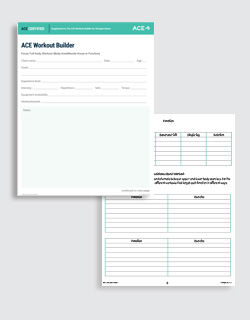
While resistance-training workouts can be organized by body area/muscle group, lower-body/upper-body splits or as a form of circuit training, the workout below was created using the Function section of the ACE Workout Builder (see the link at the top of this article for a downloadable PDF). After working with the client to fill in page 1 of that document, the next step is to create an exercise list that aligns with the client’s abilities and goals. Use the ACE Exercise Library to find exercises based on equipment availability and difficulty level. The following is a sample list of exercises.
|
Pushing |
Pulling |
Bend-and-Lift |
Single-Leg |
Rotation* |
The sample workout below features compound exercises and targets all major muscle groups and movement patterns:
- For those new to resistance training, begin with muscle strengthening exercise on one to two nonconsecutive days per week and progress to two to three days per week as tolerated.
- Begin with one set of eight to 12 repetitions, adjusting the resistance so that the last two repetitions are challenging to perform.
- Increase to performing two sets after two weeks of consistent training and complete no more than eight to 10 exercises per session.
- Complete each workout by moving from left to right across the table
|
Push/ Bend-and-Lift |
Pull |
Single-Leg/Rotation |
Pull |
Push/ Bend-and-Lift |
Rotation |
Single-Leg |
Final Thoughts
Bone health is a lifelong consideration, and the good news is that many of the strategies that support stronger bones also support overall fitness, function and independence. By incorporating progressive resistance training, weight-bearing activity, balance work and regular movement into your clients’ programs—and adapting those strategies appropriately for clients with osteopenia or osteoporosis—you can help make bone health part of the bigger picture of healthy aging. The goal is to give clients the strength, confidence and physical capacity they need to stay active throughout their lives.



More Articles
- Certified™: October 2026
The Health Coach Elevator Pitch Makeover: How to Describe What You Do (and Why it Matters)
Health and Fitness Expert
- Certified™: October 2026
Is Sparkling Water Bad for Your Teeth? What New Research Suggests
Contributor