




Asset 19 angle-down-bold angle-left-bold angle-right-bold angle-up-bold Asset 10 certifications Asset 14 close-bold close Asset 8 Asset 12 menu Asset 18 Asset 17 Asset 6 Asset 16 Asset 9 Asset 15 Asset 11 Asset 13

Get answers to all your questions!

Things like:

How long is the program?
Is the program and exam online?
What makes ACE's program different?

Call (888) 825-3636 or Chat chat icon now!

ACE RRAMP Approach

ACE
RRAMP Approach

Empower participants to improve health, fitness and motivation by creating a climate that fosters success.

Create inclusive, motivating classes

Develop group fitness environments where every participant feels valued, respected, and motivated — regardless of ability, background, or experience level.

Increase engagement and retention

Turn group classes into meaningful, memorable, and individualized experiences that encourage participants to return week after week and bring friends.

Coach with purpose and impact

Use a research-informed, easy-to-apply system that helps you apply behavior-change principles — even without one-on-one interaction.

What is the ACE RRAMP Approach?

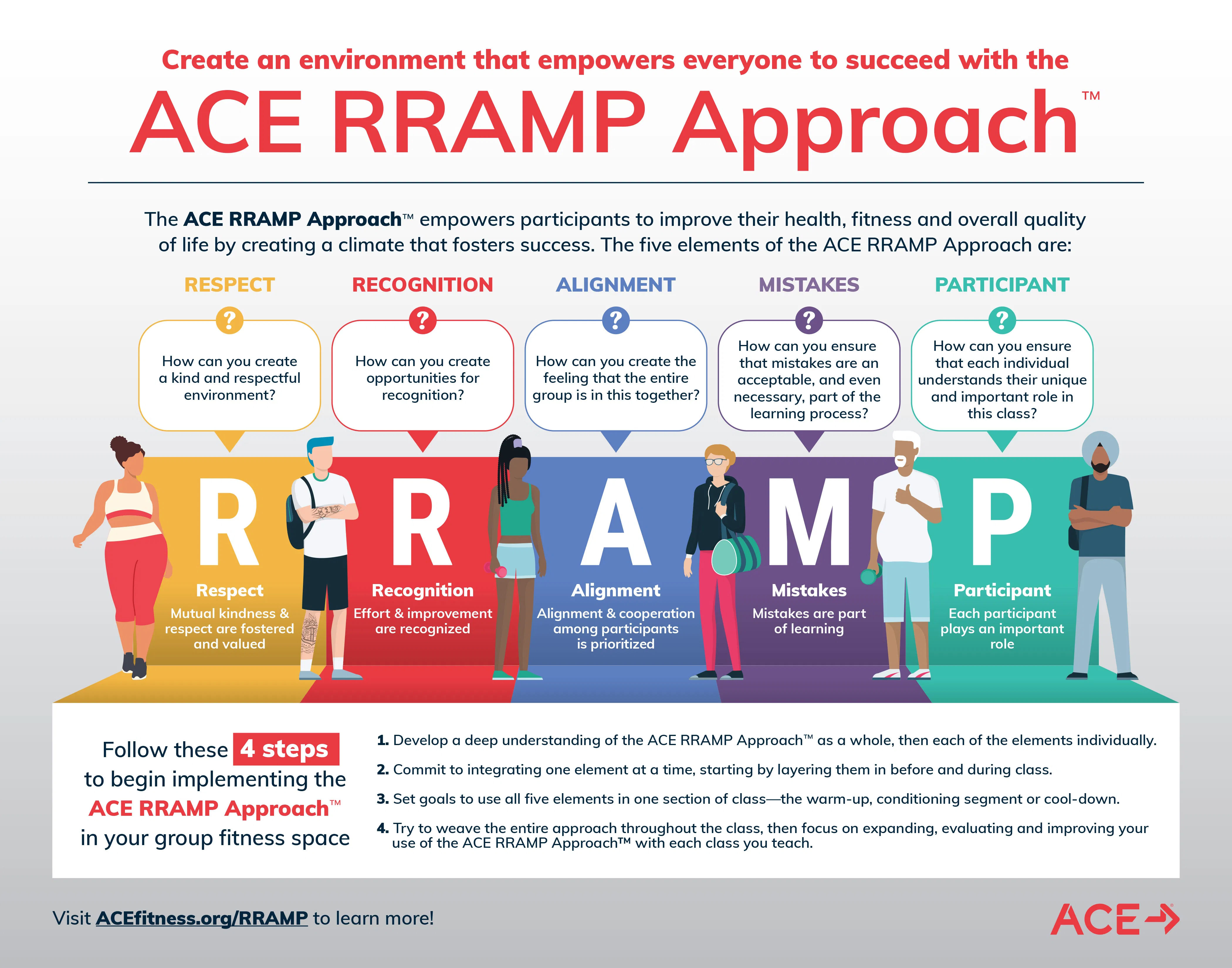
The ACE RRAMP Approach—an acronym for Respect, Recognition, Alignment, Mistakes and Participant—is a practical approach that can be used by group fitness instructors and fitness facility operators to create a caring and task-involving environment that builds intrinsic motivation and inspires participants to return again and again. When done well, the ACE RRAMP Approach can help you establish an inclusive environment where every participant feels like a contributing and valuable part of the group, no matter their skill or fitness level, what they look like or their background.

The five essentials for creating a class where everyone feels included.

Every time you interact with a class participant before, during and after class is an opportunity to utilize coaching skills to help build rapport while positioning the participant as an active partner in their behavior-change journey. The ACE RRAMP Approach helps to build an environment that recognizes and serves everyone who shows up to participate in class, and its tenets can be weaved into pre-class interactions, introductions, programming, cues, class closings and post-class interactions.

The first R in the ACE RRAMP Approach—Respect—is a reminder that each class participant should feel valued. Each participant in every class deserves, and should receive, the same amount of care. More importantly, the participants should, at all times, believe this is the case. Their experience should be as rich as that of the person in front of, behind or next to them in class.

Keep this question in mind when creating, scripting and delivering classes:

How can I create a kind and respectful environment?

Here are some ideas to help you accomplish this:

  1. Arrive with enough time to get situated before participants begin to show up and be ready to greet as many people as possible when participants start to arrive. Greetings should be made with open body language, a warm smile and a genuine appreciation of their presence.
  2. During the introduction to class, consider building in a request for each class member to acknowledge another. For example, it may be as simple as including, "Please turn to a person beside or behind you and introduce yourself," right before the warm-up begins.
  3. Once class begins, intentionally focus on cueing toward all rows and all corners of the room. No matter where someone is in the room or on their journey, they should receive the instruction and encouragement needed to believe you created the class with them in mind.
  4. When closing out the class, include sincere appreciation for all participants and, when possible, encourage class members to do so, as well. If possible, keep the music playing once the class is complete and hold off on clean-up. Instead, position yourself near the door or wherever participants will go to put away their equipment and seek out two or three participants to whom you will express your gratitude individually.

The second R in the ACE RRAMP Approach—Recognition—signifies that effort and improvement should be prioritized and honored. Specific acknowledgments, instead of general statements such as "good job" or "well done," are essential. Aim to recognize individuals' achievements for all behaviors that contribute to positive outcomes of the class, such as showing up, trying something new, smiling or helping another participant. In other words, you must look beyond achievements that focus solely on physical outcomes. Keep this question in mind when creating, scripting and delivering classes:

How can I create opportunities for recognition?

Consider the following ideas:

  1. Whenever possible, make a note of class participants' milestones, such as birthdays, anniversaries, streaks (i.e., the number of classes or weeks in a row they have participated), weight selection in a strength class, mastery of a move or other goals of which you might be aware. Then, as participants are arriving, seek out at least one person and acknowledge one of these milestones.
  2. When creating the opening statement, include genuine congratulations for attendance. Acknowledge that participants have choices, and the act of showing up is a reason to celebrate.
  3. Throughout the class, point out any improvements you see, being careful to include recognition for all individuals rather than focusing on a select few "star" performers. Whether the progress is from set to set or from one week to the next, publicly commenting on participants' progress toward expressed goals, or task-oriented improvements such as completing all the repetitions in a challenging set of exercises, promotes a positive motivational climate.
  4. Encourage participants to congratulate themselves and others. For example, you might say, "Give yourself a literal pat on your own back—you just completed the most challenging part of class!" Or, ask each participant to turn to someone beside them and give a thumbs up for finishing a set.
  5. Finally, during the closing, provide specific guidance that helps participants focus on what went well in class, which will help increase confidence and get them excited about returning. Then, find at least one or two individuals to congratulate for specific achievements made during class as everyone is departing.

The A in the ACE RRAMP Approach stands for Alignment. This does not refer to physical alignment or including cues focused on proper exercise execution, though this is certainly an integral part of a GFI's job. Creating a caring and task-involving climate requires looking at alignment from a different perspective. Alignment, in this instance, serves to remind you that participants should feel like they are part of an alliance with their classmates. Your job is to ensure that cooperation is fostered and valued in their classes.

Keep this question in mind when creating, scripting and delivering classes:

How can I create the feeling that the entire group is in this together?

Here are some ideas worth considering:

  1. Creating the feeling of camaraderie can begin before class. Attempt to introduce any new participants to one of the regulars and ask the veterans to help new class members become acclimated by helping them set up and giving them an "insider's perspective" on the experience. The new participant will immediately see that they have an ally in class.
  2. Provide a moment toward the end of the warm-up when you encourage all participants to keep in mind that your role is that of the group facilitator. You will be leading the way, but the entire group is in this together.
  3. Throughout the class, be sure to use inclusive cueing when appropriate. Try to cue using the pronoun "we" (versus "I") to reinforce the sense of teamwork. If it feels authentic, calling the class a team or squad can help, too.
  4. While it may not work in every class, changing the group's orientation from time to time can enhance their alliance. Try to identify a point in class that works to turn the group toward one another and perform a drill, exercise or set. Encourage eye contact and suggest they send positive energy to someone across the room. If this will not work with the entire group, consider doing so with smaller groups or in pairs.
  5. Create cooperative games or interactions in class versus competitions. Instead of pitting one participant against another, find ways to create drills that are team oriented or cooperative.
  6. Finally, as participants are putting away equipment and preparing to head out the door, suggest they help one another with clean up and let someone else know how much their presence impacted them during class.

The M in the ACE RRAMP Approach stands for Mistakes, which are inevitable in the group fitness setting. Mistakes should be considered a part of learning by both you and the participants. You can take group exercise instruction to the next level by acknowledging mistakes, being supportive when they occur and anticipating and preparing for them in the class experience.

Keep this question in mind when creating, scripting and delivering classes:

How can I ensure mistakes are an acceptable part of the learning experience?

Consider the following ideas:

  1. Before class begins, ask participants about limitations or preferences they may have so you can strategize before class gets started. For example, if you see a new participant, introduce yourself and provide an overview of what is to come. Also, ask if there are any concerns based on injuries, likes, dislikes or preferences related to what they are looking for in the class experience.
  2. Then, during the introduction, build in an acknowledgment of how mistakes will show improvement or effort throughout the class. Be sure to frequently remind participants that mistakes are a sign of growth, learning or giving maximal effort.
  3. Program classes with everyone's success in mind by choosing exercises, choreography or sequences that will be doable by most participants, with opportunities for increasing or decreasing the challenge without judgment. If possible, repeat exercises and build in practice opportunities during the first set.
  4. At the end of class, ask participants to identify one thing they'd like to improve during the next class by lightheartedly recalling any mistakes. Remind everyone that mistakes should be remembered without judgement and that doing everything perfectly is not the goal.

The last piece of the ACE RRAMP Approach puzzle is P, which stands for Participant. This shines a light on how each person's uniqueness contributes to the overall class experience. More specifically, it is a reminder that the class you are teaching with any given group can happen only once. You will never have this particular opportunity again—it is not possible to replicate—so you should treat the event as the special, unique occasion it truly is.

Keep this question in mind when creating, scripting and delivering classes:

How can I ensure that each individual understands their unique and important role in the class?

Here are some ideas to help you accomplish this:

  1. As participants arrive, choose one or two people to greet privately. Focus on acknowledging each participant's presence, uniqueness and contribution in previous classes or, if they are newcomers, greet them and tell them how exciting it is that they have joined the group for the class that is about to start.
  2. Then, during the class opening, remind participants that never again will they be in this class, at this moment, with these people, under these circumstances. Encourage each member to recognize the gifts they bring to the group and celebrate the contributions of others throughout the experience.
  3. Personalized cueing reinforces the unique part each participant plays. Consider using the word "your" instead of this, that and those. For example, you could say, "Focus on moving your hand-weights in a slow and controlled manner."
  4. Programming to honor each unique individual is more challenging. Rethinking the way to present progressions, regressions or modifications will benefit everyone in attendance. You can allow participants to embrace their uniqueness when considering different versions of exercises as tools, resources, options and choices. To make this work, explain the goal of the activity and provide some options for how a participant might choose to get there. For example, if doing a set of push-ups, explain how many sets, repetitions and rest periods there will be, then explain the intended outcome (e.g., "to feel as if you couldn't do one more at the end of the set"). Provide options and allow each participant to make the best choice for themself in the moment.
  5. At the end of class, encourage participants to reflect on what they brought to the room that day. Or, thank everyone in the room for the unique experience the group created together. Also, be sure to remind them it would not have been the same without every person present.

Strategies for implementing the ACE RRAMP Approach

While it is important to break down each letter in the ACE RRAMP Approach for understanding, keep in mind that the lines between the five elements are not rigid. When considering specific ways to integrate Respect, Recognition, Alignment, Mistakes and Participant into classes, avoid treating this like a bullet-pointed "to-do list." Consider the following plan to implement the ACE RRAMP Approach and realize the full benefits over time:

1

Understand the ACE RRAMP Approach as a whole, then master each element—and keep all five in mind as you teach.

2

Layer in one element at a time—before, during, and after class—then weave it into your cueing and programming.

3

Set goals to use all five ACE RRAMP Approach elements in one class section (e.g., warm-up, conditioning segment and cool-down).

4

Weave the full approach into your class, then gradually expand, evaluate, and refine your use of ACE RRAMP.

Why the ACE RRAMP
Approach works

The RRAMP Approach—built around Respect, Recognition, Alignment, Mistakes, and Participant—creates a welcoming, inclusive group fitness environment. By focusing on motivation, connection, and support, it helps participants feel valued and engaged, which drives higher exercise adherence and stronger commitment.

For example...

In a 6-week study, RRAMP classes had 79.7% adherence versus 56.2% in control classes, with higher motivation and exercise commitment.

View The Study
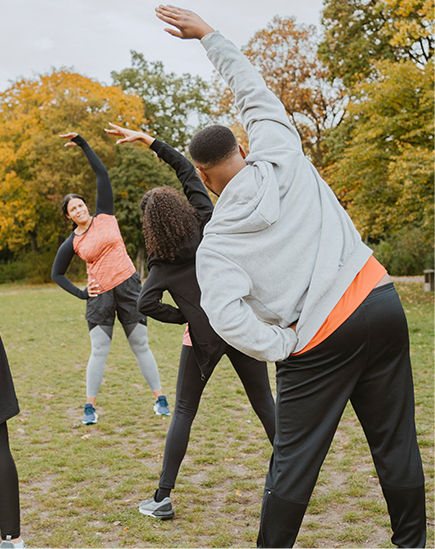
As a group fitness instructor, it is both your responsibility and your privilege to help people feel supported and positive about their efforts and where they are on their personal health and well-being journey, and the ACE RRAMP Approach can serve as a practical method to help you meet that responsibility with a sense of caring, empowerment and inclusivity.

Free RRAMP Infographic

More ACE philosophies and frameworks

ACE Mover Method

Promotes lasting behavior change by fostering trust, empathy, and a client-centered approach.

ACE Integrated Fitness Training® (IFT) Model

A complete, systematic approach to exercise programming that combines assessments, behavior-change strategies, and fitness improvements, built on strong client rapport and connection.

ACE 7 Core Drivers of Healthy Living

A research-backed framework designed to help your clients build sustainable habits that support long-term well-being.