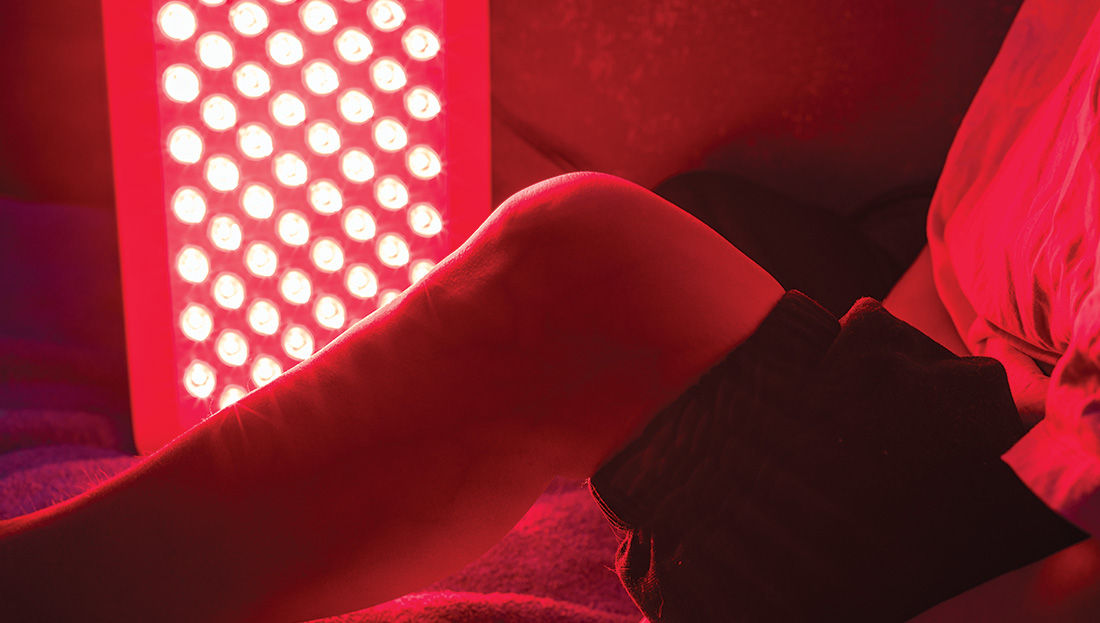
You’ve probably seen the ads: a glowing red mask that promises smoother, firmer skin while making the wearer look like they wandered out of a science fiction movie. Red light wraps, mats, infrared saunas and full-body beds are now marketed for everything from skin health to pain relief to exercise recovery.
That growing popularity creates a familiar challenge for health and exercise professionals. Clients hear the claims, see the devices and wonder whether red light therapy is worth the time and money. Your role is not to prescribe it, but to understand the evidence well enough to help clients ask better questions, recognize red flags and know when a qualified healthcare provider should be involved.
What Is Red Light Therapy?
Scientifically known as photobiomodulation (PBM), red light therapy applies red or near-infrared light to the skin using specific wavelengths depending on the application and goals. Evidence suggests that PBM may help reduce inflammation, influence how the nervous system processes pain-related signals and support tissue repair.
“Red light therapy is a noninvasive treatment that uses low-level red light to stimulate cellular activity in the body,” explains Tara Phaff, DPT, a functional medicine physical therapist, describing one theory of how PBM works. “The light is absorbed by mitochondria in cells, helping to increase energy production—ATP— which can reduce inflammation and improve circulation and tissue repair.” ATP, or adenosine triphosphate, helps supply energy for many cellular processes.
The science is complex, but the basic idea is fairly simple: Certain wavelengths of red and near-infrared light appear to interact with the mitochondria, the energy-producing structures inside cells. That interaction may influence cellular energy production, blood flow and inflammation-related signaling, which is why researchers are exploring PBM for pain, tissue repair and recovery.
“I started using red light therapy based on a recommendation from a physical therapist I was working with, who’s also a lymph drainage specialist, and a naturopathic doctor that I see,” says Beverly Aldrich from Lyman, New Hampshire. “The physical therapist has [a red light wrap] that she would use to do targeted therapy on me for the herniated discs in my back, as well as bursitis and hip pain.”
Aldrich was so convinced of its effectiveness in the clinic that she bought a red light mat to use at home. “I’ve noticed that using the red light therapy daily for 20 to 30 minutes has helped with hair regrowth after two surgeries last year,” she says, and adds that she’s also experiencing less inflammation in her back and legs, and less pain, numbness, and tingling in her lower back, legs, and feet. “It’s helped the chronic joint pain that I have and speeds up recovery from muscle soreness after exercise. Even my kids use it when they are really sore after sports practice or intense exercise, and when having growing pains.” It is important to note that Aldrich’s experience is anecdotal and should not be interpreted as a guarantee of similar results, particularly for symptoms such as numbness, tingling, postsurgical hair loss or chronic pain, which should be evaluated by an appropriate healthcare professional.
As PBM has gained popularity with consumers, some medical professionals are also exploring how it may complement clinical care. “As a physical therapist, one of the reasons I like red light therapy is its ability to support pain reduction,” says Phaff. “In clinical practice, I’m always looking for tools that complement movement and manual therapy, and red light fits well into that model.”
Phaff notes that many of her patients report decreased pain and improved tolerance to exercise when it’s used consistently alongside rehab. “I also appreciate how simple it is for patients to use outside the clinic,” says Phaff. “For select patients, I will recommend home units so they can maintain consistency between sessions.”
Research has identified some applications for red light therapy for active adults and athletes, too, says Sarah Pflugradt, PhD, RDN, CSSD, CSCS. “One of the most promising effects of red light therapy is its impact on ATP production in mitochondria, which can be beneficial for everyone who is physically active,” says Pflugradt.
Red Light Therapy for the Skin
Perhaps the most popular device on the market is the red light mask. Manufacturers of these products claim that they reduce fine lines and wrinkles, promote healthier, younger-looking skin and may even cure acne. But what does the research show?
Phaff highlights one study that found PBM improved visible signs of skin aging, especially fine lines and wrinkles, skin texture and elasticity, dermal collagen structure and overall skin rejuvenation. Researchers noted that when participants discontinued use of the mask, the results—reversal of visible signs of skin aging—lasted for about one month. This suggests that, while PBM may have temporary benefits, ongoing use may be needed to maintain results.
Other studies using red light therapy for the skin have come to similar conclusions, including improved reparative processes, reduced inflammation and modulation of the cellular microenvironment.
But PBM isn’t just for wrinkles. Research is also exploring its use for skin conditions like psoriasis, eczema, rosacea, acne and alopecia, and suggests PBM is showing promise in these areas when used as an adjunct therapy with other treatments, though not as a replacement for them.
If One Modality Is Helpful, Does Two Double the Benefits?
Some fitness chains, like Planet Fitness, are combining PBM with whole-body vibration training. WBVT has been shown to have benefits of its own, but does this mean that combining the two modalities will increase the benefits of each?
“There is currently no strong clinical research specifically examining the combined use of red light therapy and vibration plate training,” says Phaff. “Most of the evidence base for each modality exists independently. Red light therapy has been studied for its effects on cellular energy production, reducing inflammation and improving tissue recovery, while vibration plate training has been researched for its role in improving neuromuscular activation, strength, balance and functional performance.”
Although the two therapies have not been formally tested together, they are sometimes paired up based on the idea that they could offer complementary benefits, says Phaff. “Red light therapy works at the cellular level to support energy production and recovery signaling, while vibration training provides stimulation that activates muscle contractions and circulation.”
Other Uses for Red Light Therapy
Most clients will hear about red light therapy because of skin care or recovery, but the research conversation is broader than that. PBM is also being studied for pain, inflammation and tissue repair, which is where the topic becomes especially relevant, and more scope-sensitive, for health and exercise professionals.
“Photobiomodulation has also been shown in many studies to temporarily reduce pain and inflammation in those with musculoskeletal pain or osteoarthritis…so, the applications for this with active adults are very promising,” says Pflugradt.
Research suggests that PBM may help reduce joint pain, swelling and stiffness in people with osteoarthritis or rheumatoid arthritis, and a recent systematic review and meta-analysis found that PBM may reduce pain and disability in people with knee osteoarthritis. It is also being studied for chronic pain conditions, including fibromyalgia and peripheral neuropathies, such as diabetic neuropathy.
The key word here is “studied.” PBM should not be presented by health and exercise professionals as a treatment for arthritis, neuropathy or other medical conditions. Rather, this research helps explain why clients may be asking about it, why some rehabilitation clinics and wellness facilities offer it and why referral to a qualified healthcare provider is appropriate when pain, numbness, tingling or disease-related symptoms are part of the conversation.
For exercise professionals, one of the most practical areas of interest is recovery. PBM is being studied for skeletal muscle repair and may be an effective intervention for managing delayed-onset muscle soreness (DOMS), with potential effects on reducing pain, supporting muscle strength and decreasing markers of muscle damage. Shorter recovery times may help explain why some gyms now offer PBM onsite and why collegiate and professional teams have used PBM for years.
Researchers are also exploring PBM in more specialized clinical areas, including neurodegenerative diseases, bone density and spinal cord injury. Those applications are outside the scope of practice for health and exercise professionals, but they reinforce an important point: PBM is not one simple wellness trend with one simple answer. The evidence varies by condition, protocol and population, so the most helpful response is often to help clients separate promising research from broad marketing claims.
Red Light Therapy: Precautions and When to Refer
As with anything, there are always precautions that should be noted. “Red light therapy has a strong safety profile and is widely considered low risk,” says Phaff, “though it is typically recommended to use caution in individuals with photosensitive conditions, those taking photosensitizing medications, or when applying light directly over known areas of cancer.”
But what if you have cancer and want to use PBM? “[Some evidence suggests] that photobiomodulation does not appear to initiate cancer and has no clinical evidence of promoting tumor progression,” says Phaff, “although caution is advised when applying light therapy directly over areas of active malignancies due to theoretical and not proven risks.”
If a client has or has had cancer, it’s important that they check with their healthcare team before using PBM, as Aldrich did. As a breast cancer survivor who experiences lymphedema, she has found PBM helpful, and emerging evidence suggests it may help reduce breast cancer–related lymphedema when used as part of appropriate clinical care.
Regarding pregnancy and breastfeeding, there is not enough research to determine whether PBM is appropriate, so caution is warranted. Pregnant and breastfeeding women should talk with their healthcare provider before using PBM.
Protocols for Red Light Therapy
One challenge in interpreting PBM research is the wide variability in treatment protocols, outcome measures and follow-up duration, which limits the ability to develop standardized care protocols.
“Wavelength matters because it determines how deeply light can penetrate, and there isn't a clear consensus on dose, [including] how many minutes and how often red light therapy should be done,” cautions Pflugradt.
Clinical studies vary widely in the wavelengths, power output, treatment frequency and total treatment duration they use. That variability makes it difficult to create one standard recommendation for red light therapy. For clients, the practical takeaway is simple: Device details matter, and more is not automatically better.
Clients who are considering a home device should look for products that clearly disclose wavelength, power output and intended use. They should also discuss PBM with a qualified healthcare provider, particularly if they have a medical condition, take medications that may increase light sensitivity or are considering PBM for pain, injury or disease-related symptoms.
The Bottom Line
The bottom line is not that red light therapy is either a miracle tool or a waste of money. The more useful answer is that the evidence is promising in some areas, especially skin health, pain and recovery, but it is not equally strong for every claim, device or population. “Some of the research in this area is inconclusive, and most of the studies have small sample sizes, so more robust clinical trials need to be done to solidify PBM as a go-to therapy,” says Pflugradt.
When clients ask about red light therapy, help them slow down the decision-making process. What are they hoping it will do? Is the goal cosmetic, recovery-related or tied to pain or a medical condition? Are they taking medications, pregnant, breastfeeding, managing cancer or dealing with symptoms that need medical evaluation? Those questions keep the conversation practical, evidence-informed and within scope.








 by
by