






ACE-SUPPORTED RESEARCH: Promoting Healthy Eating Habits With the ACE Mover Method™
Certified™: August 2026

Healthy eating goals often sound simple—eat more vegetables, eat more fruit and add more fiber—but for many clients, turning those intentions into lasting behaviors is anything but simple. For health and exercise professionals, that gap creates an important opportunity: The conversations that happen during training sessions may be a practical way to help clients make meaningful nutrition changes while still keeping the client’s goals, needs and values at the center of the process.
The ACE Mover Method™, the cornerstone of ACE’s client-centered approach to personal training, is designed for exactly this kind of behavior-change conversation. Built on rapport, trust and empathy, the method uses purposeful communication and collaboration to help clients identify what matters to them, uncover barriers and take ownership of realistic next steps. In this ACE-supported study, Lance Dalleck, PhD, and Chance Wiening, BSc, of the Applied Exercise Science and Performance Program at Western Colorado University, examined whether brief, individualized coaching using the ACE ABC Approach™ could help clients improve their healthy eating habits—specifically their consumption of fruits, vegetables and fiber—when embedded into a personalized exercise program. As the results suggest, those brief conversations may have had an outsized impact, helping participants make meaningful gains in the very eating habits most closely tied to long-term health.
The ACE Mover Method philosophy offers a way for health and exercise professionals to get people moving toward a better quality of life through purposeful communication and collaboration. It is founded on the following tenets:
- Each professional interaction is client-centered, with a recognition that clients are the foremost experts on themselves.
- Powerful open-ended questions and active listening are utilized in every session with clients.
- Clients are genuinely viewed as resourceful and capable of change.
Exercise professionals can apply the ACE Mover Method through the ACE ABC Approach™:
- Ask open-ended questions: This involves asking powerful questions to identify what the client hopes to accomplish by working with an exercise professional. Open-ended questions are the key to sparking this discussion.
- Break down barriers: This step involves asking more questions to discover what potential barriers may get in the way of the client reaching their specific goals. Questions like “What do you need to start doing now to move closer to your goals?” and “What do you need to stop doing that will enable you to reach your goals?” can be very revealing.
- Collaborate: This final step is all about collaboration as the client and exercise professional work together to set SMART goals and establish specific steps to take action toward those goals. Allowing the client to lead the discussion of how to monitor and measure progress empowers them to take ownership of their personal behavior-change journey.
The Study
Researchers recruited 24 nonsmoking participants to perform a 10-week personalized exercise program based on the ACE Integrated Fitness Training® (ACE IFT®) Model. Prior to the beginning of the study, all participants completed baseline testing, including assessments of anthropometric measures and cardiometabolic risk factors. In addition, the talk test was performed to identify each participant’s first and second ventilatory thresholds, which were used to determine personalized intensity levels. Finally, each participant completed an assessment of their eating habits using the Simple Lifestyle Indicators Questionnaire.
The 24 participants were randomized into one of the following groups:
- The ACE Mover Method group completed the exercise training program and received weekly, client-centered nutrition educational sessions during their workouts.
- The control group completed the exercise training program, but without the nutrition educational sessions.
The personalized exercise training program was comparable to that used in previous ACE-supported research. Each participant consulted with a team of health and exercise professionals and was assigned a Western Colorado University undergraduate or graduate student who served as their personal trainer. The student personal trainers worked directly under the supervision of qualified MSc- and PhD-trained exercise physiologists. The team designed and progressed an appropriate personalized exercise program using the evidence-based ACE IFT Model guidelines for both Cardiorespiratory and Muscular Training. The student personal trainers coached members during their exercise sessions, provided motivational support, engaged in spotting and ensured that proper exercise techniques were used.
The ACE Mover Method intervention consisted of approximately 10 minutes of coaching embedded into each exercise session. The student trainers received education on the ACE Mover Method and were provided with samples of how to integrate the ACE ABC Approach into participant interactions. It’s important to highlight the fact that each participant’s intervention was personalized to their unique goals and needs related to healthy eating, specifically their consumption of fruits, vegetables and fiber. To facilitate this, all participants underwent a baseline interview, including the completion of a medical history questionnaire.
Dr. Dalleck provides an example of how the ACE Mover Method conversations sounded: The trainers would begin by asking basic open-ended questions, such as, “What, if anything, would you change about your diet and nutrition?” or “What areas of your diet do you think you could improve?” A sample response might be, “I skip breakfast most days of the week” or “I eat bacon and eggs every morning.” From there, the trainer would help the participants explore barriers to eating a healthier breakfast by asking, “What’s preventing you from eating a balanced breakfast of oatmeal or whole-wheat toast with honey, plus some fruit?” Perhaps it’s lack of time or a lack of knowledge about how to shop more healthfully at the grocery store. Finally, the trainer and participant would collaborate to develop ideas to overcome those barriers, specific to each client’s situation and goals.

Dr. Dalleck highlights the variability in how these interactions looked for each client. For one, the ACE ABC Approach conversation for a particular goal might have taken place over a single 10-minute conversation, moving through open-ended questions, barriers and collaboration during the cool-down of a session. For another, this conversation may have taken place over the course of multiple sessions or even the full duration of the study. He explains that this is the result of the personalized nature of those interactions. “We often talk about the ACE ABC Approach in terms of a single five- or 10-minute conversation. I think knowing that it can look different for different ACE Pros and various clients is really important.”
One final note about the application of the ACE Mover Method in this research. In addition to the one-on-one training sessions, some participants attended weekly group exercise classes where they were reminded to continue identifying barriers to their personalized healthy eating goals. This led to some great conversations among the participants, during which they traded stories and shared suggestions on how to overcome certain barriers. Many of the participants had comparable goals and challenges, so these conversations were very helpful.
After the 10-week program, all of the baseline assessments were repeated.
The Results
The physical and physiological characteristics of the participants are presented in Table 1. After 10 weeks, cardiometabolic health improved for both the ACE Mover Method and the control group. With the exception of waist circumference, the changes from baseline to 10 weeks across various cardiometabolic variables were similar for both groups.
Table 1. Key Health Changes After 10 Weeks
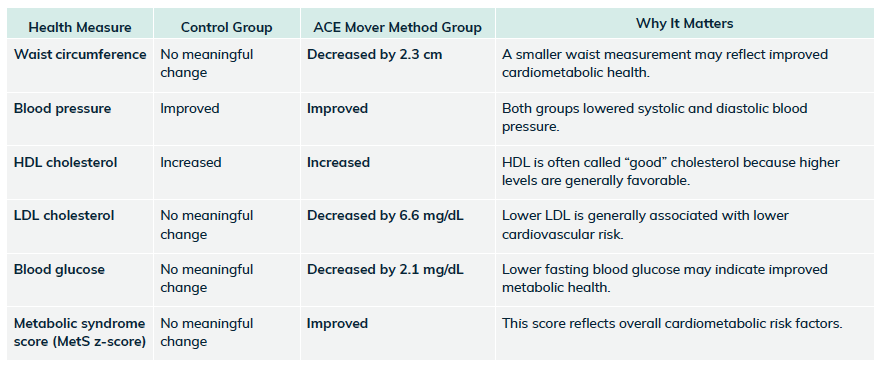
Note: The ACE Mover Method group showed significantly greater improvement than the control group in waist circumference. Both groups improved blood pressure and HDL cholesterol. Only the ACE Mover Method group showed significant improvements in LDL cholesterol, blood glucose and metabolic syndrome score. HDL = High-density lipoprotein; LDL = Low-density lipoprotein

What is the Significance of the MetS z-score?
Traditionally, researchers looking into training responsiveness have used maximal oxygen uptake, or VO2max, to quantify improvements in cardiorespiratory fitness, which provides a very narrow view. In contrast, the metabolic syndrome score (MetS z-score) combines a number of cardiometabolic risk factor values, including blood pressure, circumference measures, blood glucose, high-density lipoprotein and triglycerides, into a single score. The primary benefits for inclusion of the MetS z-score are twofold: (1) it acknowledges that there is a continuum to cardiometabolic risk within each individual and (2) it provides a more sensitive tool for assessing individualized training responsiveness following an exercise intervention.
“By broadening the assessment of training responsiveness using the MetS z-score, researchers are better able to capture the true benefits of an exercise program,” explains Dr. Dalleck.
Think about it this way: If you were working with a client on a long-term exercise program, would you be better served by monitoring progress using a single value such as body weight or a combination of several different measures of cardiorespiratory fitness, muscular fitness and even quality of life?
In this research, the Mets z-score changed significantly only in the ACE Mover Method group. The elements of this score, which are listed above, can certainly be impacted by exercise, but the focus on dietary habits and the resulting changes in fruit, vegetable and fiber consumption—which is explored below—positively modified participants’ cardiometabolic profile beyond what was seen in the control group.
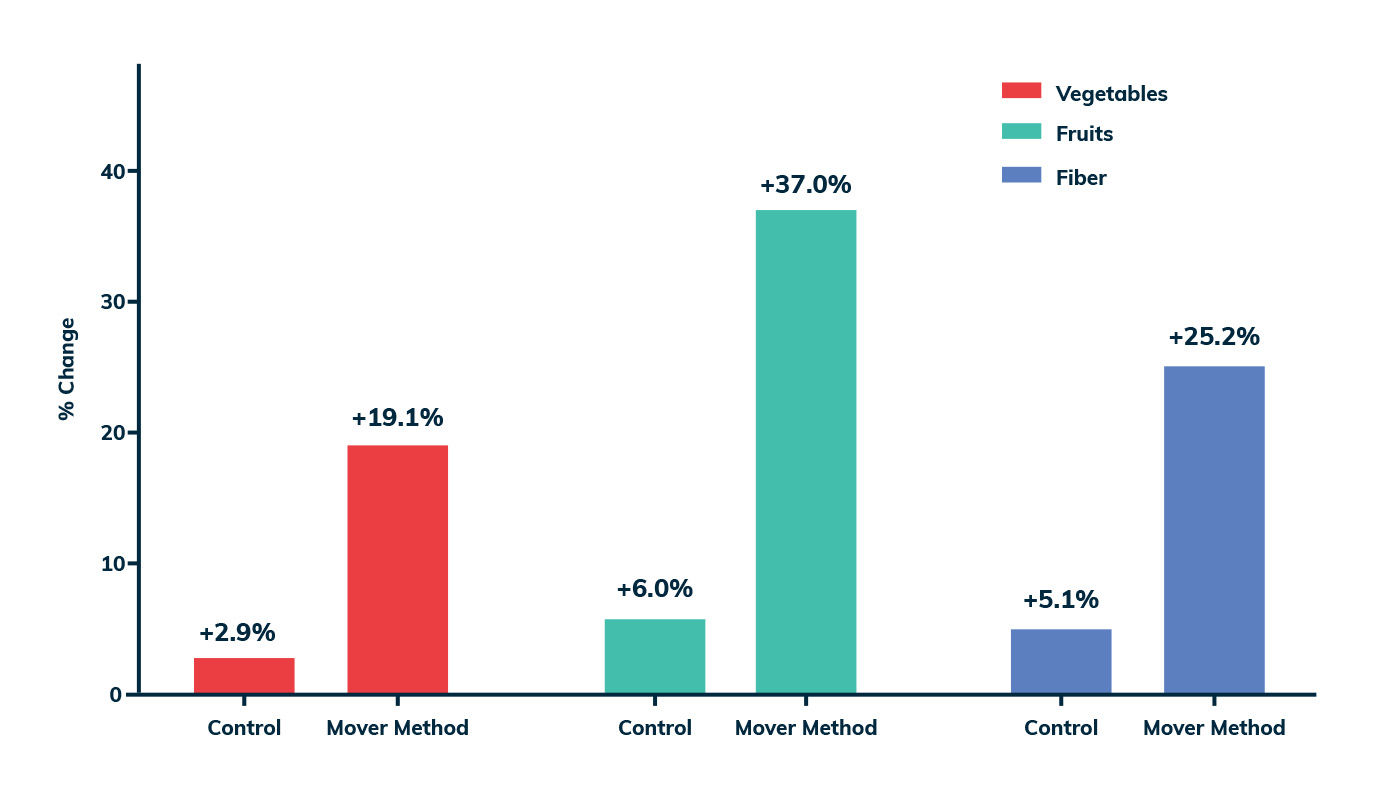
The healthy eating habit scores at baseline and 10 weeks are presented in Table 2. Healthy eating scores were similar at baseline between groups. In the control group, there were no significant changes between baseline and 10 weeks in any healthy eating category. In contrast, in the ACE Mover Method group, there were significant improvements from baseline to 10 weeks within all healthy eating categories. The percentage change from baseline to 10 weeks are presented in Figure 1.
Table 2. Healthy Eating Habits After 10 Weeks
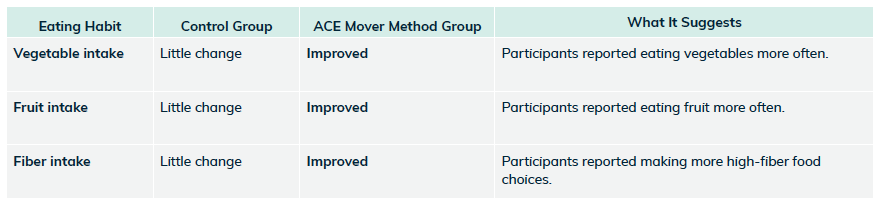
Figure 1. The percentage change in healthy eating categories from baseline to 10 weeks in control and ACE Mover Method groups
The Bottom Line
It is estimated that fewer than 10% of adults in the U.S. meet guidelines for the consumption of each of the foods/nutrients looked at in this study. That is, fewer than 10% eat enough vegetables, fruits or fiber on a daily basis.
Why is this important? “All of those categories are really strongly correlated with hypertension, risk of diabetes, risk of obesity and risk of heart disease,” explains Dr. Dalleck. “There’s ample evidence of the relationship between those categories of nutrition and different chronic disease risk factors.”
Helping a client eat more fruits and vegetables or add more fiber to their diet may seem like a small victory, but it has a real impact on their health, now and into the future. Participants in the ACE Mover Method group had a five- or sixfold greater percentage change across the three healthy eating categories, as you can see in Figure 1. That is a tremendous difference.
There is one final note that Dr. Dalleck wanted to share with ACE Professionals. The student trainers who led the exercise sessions and conducted the ACE ABC Approach interventions were undergraduate and graduate students who were trained using ACE content from The Exercise Professional’s Guide to Personal Training, which speaks to the ability of ACE Pros to feel comfortable applying these strategies, even if they are newcomers to the industry. It does not require years of experience or extensive continuing education to implement the ACE philosophies—it just takes practice and a willingness to actively listen to clients’ needs, goals and values and then coach and train them accordingly.
This study provides one more piece of evidence that the ACE Mover Method and ACE ABC Approach are practical strategies that drive real-world results.
This ACE-supported study was first published in the peer-reviewed International Journal of Research in Exercise Physiology.



More Articles
- Certified™: August 2026
Seeing Red: What the Research Says About Red Light Therapy
Contributor
- Certified™: August 2026
Throw, Catch, Slam: Smarter Medicine-Ball Training
Contributor