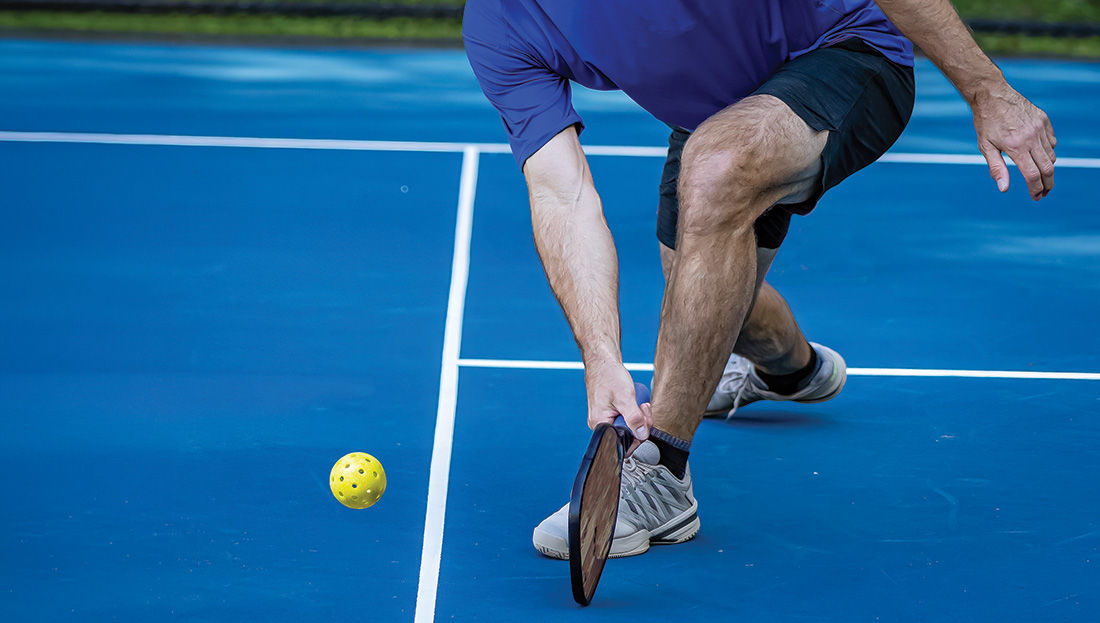
Your client may never walk into a session and say, “I really need to improve my agility.” But they may tell you they want to keep playing pickleball without feeling a step behind. They may want to move more confidently on a hiking trail, react quickly when a dog darts in front of them or feel steadier when navigating a crowded sidewalk. An older adult client may simply want to trust their body when an unexpected misstep requires a quick response.
All of these situations call on some combination of balance, coordination, strength, power and the ability to respond to changing circumstances.
Agility is often associated with athletes cutting across a field, changing direction on a basketball court or chasing down a tennis ball. But the ability to quickly adapt movement in response to the unexpected has value far beyond sport. For health and exercise professionals, agility training offers another way to prepare appropriately screened clients for the unpredictable movement demands of both recreation and everyday life.
It also can make a workout considerably more engaging. Instead of always knowing exactly what movement comes next, a client may need to respond to a partner's cue, change directions or adjust the movement on the fly. Suddenly, the body and brain are working together in a different way.
Ready for Anything
A widely used definition describes agility as rapid whole-body movement involving a change in speed or direction in response to a stimulus. That last part helps distinguish agility from a simple change-of-direction drill.
Consider a client running through a predetermined pattern of cones. The exercise may require quick acceleration, deceleration and changes of direction, making it valuable change-of-direction training. But the client already knows where to go.
Now, imagine standing in front of the client and randomly pointing left or right, calling out a color or moving in a direction the client must mirror. The physical task may look similar, but the client has to perceive the cue, decide how to respond and then execute the movement. That reactive element brings the exercise closer to true agility.
A 2026 systematic review and meta-analysis examining agility training in team-sport athletes reinforces the importance of this connection between perception and movement. The researchers found that agility-specific training improved reactive agility performance, although they cautioned that much of the available evidence comes from soccer and basketball populations and may not generalize to every population.
You don't need to turn every client into an athlete to use the concept of reactivity. A verbal “left” or “right,” an unexpected stop signal or a simple partner-mirroring exercise can introduce reaction and decision-making into movements a client already knows.
Why Agility Belongs in the Program
Agility places demands on several components of fitness at the same time. A quick change of direction may require the client to control momentum, stabilize the body, produce force in a new direction and maintain awareness of what is happening around them. Add an external cue and the client also has to process information and select an appropriate response.
That combination is one reason agility training has attracted attention as an integrative exercise strategy for older adults.
Researchers have proposed that strength, balance, endurance and other physical capacities do not always have to be trained in isolation. Real life frequently asks the body to use several of them simultaneously. Walking through an airport while pulling a suitcase, stepping around an obstacle while having a conversation or reacting when footing unexpectedly changes are all multicomponent tasks.
Research published in 2023 put that idea to the test. In a yearlong randomized controlled trial, 79 healthy older adults were assigned to either an agility-training group or a control group. The agility group participated in two 60-minute sessions each week that combined strength and coordination exercises with stop-and-go movements, changes of direction, dual-task activities and decision-making challenges.
In this study, agility training produced small improvements in gait under single-, dual- and triple-task conditions, lower-body power, single-leg balance and reaction time on one of the cognitive tests. The intervention did not improve every measure that was assessed, which is an important reminder that agility training is one component of a well-rounded program rather than a replacement for every other form of exercise. Still, the results provide encouraging evidence that a multicomponent approach can influence several abilities relevant to physical function.
The study also highlights something health and exercise professionals already know from working with clients: Training does not always have to separate strength, balance, coordination and cardiorespiratory fitness into neat categories. When appropriate for the client and their goals, combining those demands can more closely resemble the way people actually move.
Agility, Balance and Falls
The ability to respond effectively when balance is challenged becomes increasingly relevant with age. More than one in four U.S. adults age 65 and older report falling each year, and falls remain the leading cause of injury in this population.
Exercise plays an important role in fall prevention, but this is an area where careful language and appropriate scope of practice are essential. Agility training should not be presented as a stand-alone solution for preventing falls.
International fall-prevention guidelines recommend programs that challenge balance and incorporate functional movements such as sit-to-stand exercises, stepping, multidirectional walking and changes in walking speed. These programs are individualized and progressed according to ability, and they commonly include strength training as well.
There is also growing interest in reactive balance training, which requires a person to respond to an unexpected challenge to balance. A systematic review and meta-analysis of 29 trials found that participants who completed reactive balance training were less likely to experience a fall than those in control groups. The training groups also experienced fewer falls overall, meaning the benefits extended beyond reducing the number of people who fell to reducing the total number of falls, including repeat falls. The researchers did report more adverse events among participants who performed reactive balance training. These included issues such as pain, muscle soreness or fatigue, dizziness, anxiety and injuries during training, though nearly all were classified as mild or moderate. This reinforces the importance of appropriate screening, supervision and progression.
For an apparently healthy client with an appropriate level of balance and movement competency, this research supports including suitably scaled stepping, directional and reactive exercises as part of a comprehensive program. Clients with recurrent falls, substantial balance limitations or other concerns that require clinical evaluation may need referral to a physical therapist or other qualified healthcare professional before you introduce more challenging reactive exercises.
The goal is to challenge the client's ability without creating a situation in which the exercise itself presents unnecessary risk.
What Happens to Fast, Reactive Movement With Age?
Aging affects the neuromuscular system in ways that can influence strength, power and movement control. A motor unit consists of a motor neuron and the muscle fibers it controls. With age, the number and function of motor units can change, and research suggests that fast-twitch, or type II, muscle fibers are particularly vulnerable to age-related denervation and atrophy.
The body can compensate to some degree. Surviving motor neurons may reconnect with muscle fibers that have lost their original nerve supply, creating larger remodeled motor units. But that compensatory process is not unlimited, and age-related changes within the neuromuscular system may contribute to reductions in strength, power and the ability to produce rapid, precise movement. Research continues to examine these changes.
Exercise supports muscle function throughout life, and research continues to explore how physical activity may influence motor-unit remodeling and reinnervation. The human evidence in this area is still developing, so it would be too strong to suggest that agility exercises can directly prevent age-related motor-neuron loss or sarcopenia. What health and exercise professionals can confidently do is continue training the physical abilities clients use to move effectively: strength, power, balance, coordination, mobility and, when appropriate, speed and reactivity.
That creates a much more useful programming question: How can you safely give clients opportunities to move, react and adapt?
Using the ACE Integrated Fitness Training® Model
The ACE IFT Model provides a useful framework for answering that question. The Muscular Training component progresses from Functional Training to Movement Training and then to Load/Speed Training. Functional Training emphasizes postural stability, kinetic chain mobility and joint function. Movement Training develops efficient performance of the primary movement patterns. Load/Speed Training increases muscular force production and, when appropriate, movement speed. ACE programming guidance uses this progression to help professionals meet clients where they are and advance them appropriately.
The five primary movement patterns provide the foundation for many of the movements that appear in the agility workout below.
|
Primary Movement Pattern
|
Examples
|
|
Bend-and-lift
|
Squats, hip hinges and deadlift patterns
|
|
Single-leg
|
Lunges, step-ups and other unilateral or asymmetrical lower-body movements
|
|
Pushing
|
Horizontal, vertical and other upper-body pushing movements
|
|
Pulling
|
Horizontal, vertical and other upper-body pulling movements
|
|
Rotation
|
Rotational and counter-rotational movements involving the limbs, torso or whole body
|
Agility is typically a full-body experience. Multiple segments of the body are moving while other areas provide stability, and the client may be accelerating, stopping, reaching, rotating or rapidly changing direction. Many of the exercises in this workout therefore combine several movement patterns.
The workout also integrates agility with cardiorespiratory training. Depending on how it is programmed, it can challenge coordination, endurance, strength and power as well.
Quality Before Fatigue
“Fatigue makes amateurs of us all” is a useful phrase to remember when programming this type of training. Even a highly skilled person may become less coordinated and precise as fatigue increases.
For athletic clients, learning to execute sport-specific skills while fatigued may sometimes be part of the training goal. For most clients, however, movement quality should guide the amount of rest. When the primary goal is agility, you want clients practicing successful responses rather than repeatedly rehearsing sloppy ones.
Use enough recovery between exercises and sets for the client to maintain control, particularly when introducing unfamiliar movements or reactive cues. A well-conditioned client training for a sport may eventually perform some of these exercises under greater fatigue, but that progression should follow demonstrated competency.
This distinction also allows you to use the same workout for very different clients. One person may move quickly and explosively, while another performs the same pattern at walking speed. One may jump in response to your cue, while another steps and holds the landing position. Both can be working on the ability to control movement and respond to information at a level appropriate for them.
The Workout
This workout features four giant sets, each consisting of three exercises. Perform each exercise within a giant set for 30 seconds of work followed by 30 seconds of rest. After completing each giant set three times, perform the corresponding combined cardio-agility exercise for one minute, followed by one minute of rest before beginning the next giant set.
Treat those time intervals as starting points rather than requirements. Adjust work and recovery periods according to your client's conditioning level, movement competency and goals. A newer client may perform shorter work intervals and need considerably more recovery. The objective is to provide enough challenge to stimulate adaptation while preserving successful performance.
For well-conditioned clients seeking a greater cardiorespiratory challenge, the combined cardio-agility exercises can eventually be incorporated into the giant sets and performed three times. You also can vary the order of the giant sets over time so clients experience the exercises at different points in the workout.
For exercises that use a kettlebell, select a load that allows the client to maintain control and respond effectively. A lighter object can be substituted when appropriate. If cones are unavailable, other visible markers can be used to establish direction or boundaries.
Solo Workout
*For the unidirectional version, the eyes and head remain oriented forward as the client moves through the pattern. During the moving-directional version, the client turns the body to face the direction of travel.
Partner Workout
The partner versions in the workout below add unpredictability to several exercises. One person acts as the "leader" and provides the movement or verbal cue while the "follower" responds. Switch leader and follower roles with each repeat of the giant set.
*For the crouching reach, the numbers can represent the left hand, right hand, left foot and right foot. Once the client becomes comfortable with the pattern, periodically change the associations so the response cannot simply become memorized. †Maintain the staggered foot position and opposite-arm reach until “switch” is called.
The partner workout demonstrates how easily a predetermined movement can become reactive. You do not necessarily need a complicated drill, flashing lights or specialized equipment. Sometimes a random verbal cue is enough to change the demand.
Scale the Challenge to the Client
The exercises as written can be demanding, particularly the directional jumps, squat thrusts, plank variations and plyometric movements. They should not automatically be used with every client simply because the broader concept of agility can benefit a wide range of people.
Start with the client's current abilities and modify speed, impact, range of motion, base of support and complexity as needed. A directional jump can become a directional step followed by a controlled hold. Figure 8 cone runs can become brisk figure 8 walks before progressing to shuffling or running. A floor-based mountain climber may be elevated to a bench or wall. A twisting squat thrust can be performed with a controlled step-back instead of a jump. A rapid partner-mirroring drill may begin with slow lateral steps.
You can also separate the physical and cognitive challenges before combining them. First teach the movement pattern until the client can perform it with control. Next, introduce a predictable cue. Finally, when the client is ready, make the cue random.
This progression is particularly useful for clients who are new to multidirectional training. Speed is only useful when the client can manage it.
For this type of exercise, a simple sequence might begin with forward, backward and lateral stepping. From there, add changes in walking direction or speed. Once the client demonstrates control, introduce an external cue such as a color, number or hand signal. The exercise can become increasingly reactive without ever requiring the client to jump, sprint or perform a high-impact drill.
Train the Ability to Adapt
Life rarely gives us perfectly arranged cones or advance notice of which direction we will need to move. A ball takes an unexpected bounce. A grandchild suddenly changes direction. A hiking trail becomes uneven. Another player reaches for the pickleball you thought was yours. A foot lands slightly differently than expected.
Strength, cardiovascular fitness, mobility and balance all help prepare clients for those moments. Agility adds another piece by asking them to use their physical abilities while responding to changing information.
For some clients, that may mean moving explosively in response to a sport-specific cue. For others, it may be as simple as stepping quickly and confidently in a new direction. The ACE IFT Model gives you a framework for deciding where each client belongs on that continuum and how to progress the challenge.
When agility training is appropriately scaled, it can add variety, play and real-world movement demands to a program without losing sight of safety or the client's goals. The result is training designed not just for movements you can predict, but for all the moments when life asks the body to react.







 by