







Better Choices, Better Health: How Exercise Supports Safer Decision-Making
Certified™: June 2026

Healthy living is often the result of making the best choice you can as often as you can. No one makes it to the gym for every workout, chooses the healthiest item on every menu or makes it to bed on time every day, but making those types of decisions as consistently as possible can lead to better health and fitness in the long term. That said, the “best” choice is not always quite so obvious, which is why having the ability to access, understand and implement quality information is so important.
“Making Safer, Informed Choices” is one of the ACE 7 Core Drivers of Healthy LivingTM, defined as making decisions that reduce health risks and promote long-term well-being. In practice, this driver includes how adults assess risk, interpret health information and choose behaviors that protect health (e.g., safer substance-use decisions, safer movement and injury prevention, use of preventive care, and day-to-day choices that lower chronic disease risk). Because “informed” choices depend on a person’s ability to find and use trustworthy information, the concept overlaps with health literacy, defined by the Centers for Disease Control and Prevention (CDC) as the ability to find, understand, and use information and services to inform health-related decisions and actions, and by the World Health Organization (WHO) as the capacity to access, understand, appraise and use health information and services.
Katie Heinrich, PhD, whose research focuses on improving lives through addiction recovery, sense of community, exercise and physical activity, explains: “Being able to critically appraise information and ask questions to determine its authenticity and evidence base is important. Encourage clients to check whether the information is someone’s opinion or something based on peer-reviewed evidence or practice, such as citing a research paper or professional organization. Helping clients understand the risks and benefits of health-related information is also important. Just because a source is choosing to highlight a specific diet or type of exercise doesn’t mean that it will work for everyone. It’s also helpful to encourage clients to identify the social and environmental influences that play a role in their health decisions. If certain settings always lead to poor health choices, the client may need to reorient themselves to a different setting that makes healthy choices easier to make.”
ACE proposes that regular physical activity and exercise can strengthen the ability to make safer, informed choices through multiple mechanisms: improving executive function (i.e., planning, inhibitory control and cognitive flexibility), supporting neurobiological pathways linked to self-regulation, improving mood and stress physiology, and creating social contexts that reinforce protective norms. In adults, exercise is a practical “keystone” behavior that can strengthen safer, informed choices by improving cognitive control, stress and sleep regulation and social support, thereby reducing risky behaviors and supporting sustained health-protective decision making across the ACE 7 Core Drivers of Healthy Living.
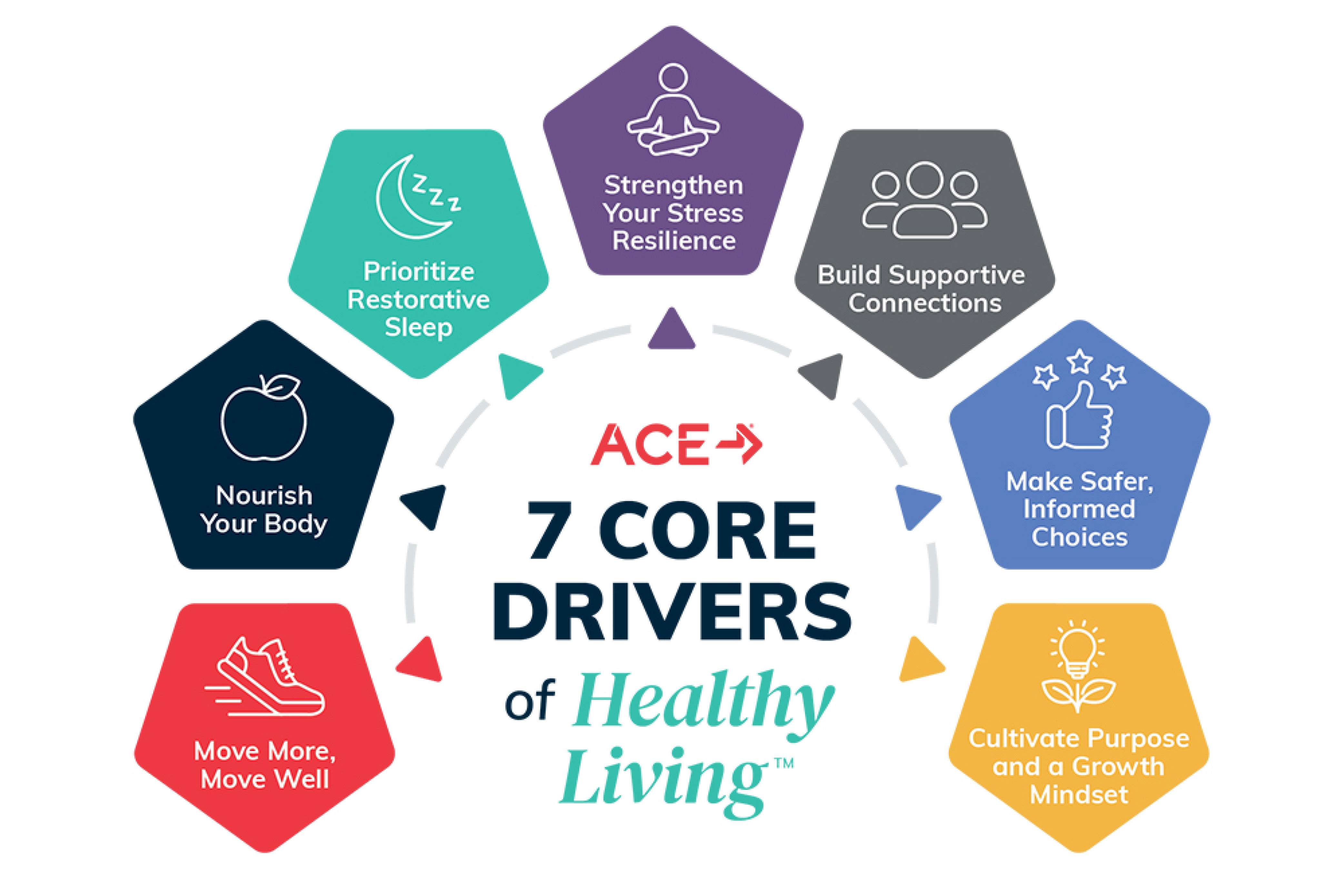
ACE 7 Core Drivers of Healthy Living
1. Move More, Move Well – Engage in regular physical activity and exercise that supports strength, mobility and long-term vitality.
2. Nourish Your Body – Choose balanced, healthy nutrition patterns that fuel daily living and overall well-being.
3. Prioritize Restorative Sleep – Get quality sleep that promotes recovery, cognitive function, emotional balance and immune health.
4. Strengthen Your Stress Resilience – Use effective coping skills and strategies that support emotional well-being and adaptability.
5. Build Supportive Connections – Cultivate positive relationships and a sense of community that enhance motivation and health.
6. Make Safer, Informed Choices – Make decisions that reduce health risks and promote long-term well-being.
7. Cultivate Purpose and a Growth Mindset – Clarify personal purpose and values, and foster a mindset that supports consistency, resilience and lasting behavior change.
While “safer choices” is sometimes discussed in the context of avoiding obviously harmful behaviors, ACE’s definition is broader: it is about consistent decisions that reduce risk and promote long-term well-being—especially when life is stressful, time is limited or health information is confusing. This broader framing matters because most real-world risk is not caused by one catastrophic choice; it is shaped by repeated small decisions about sleep, food, stress coping, movement and social environments that accumulate over months and years.
“Each day your clients are faced with numerous decisions that affect their health,” says Dr. Heinrich. “These include what to eat or drink, whether or how to move their body and how they respond to daily stressors. Some healthier responses they’ll make without any conscious effort, such as parking and walking if they don’t want to pay for a closer parking spot. In other situations, they may have to consciously make themselves choose a healthier alternative, such as going to their exercise class after a night of poor sleep. While this can be difficult, deliberately choosing the healthier choice will help them feel better in the long run.”
Definition and Scope of Making Safer, Informed Choices
As explained above, within the ACE 7 Core Drivers, “Make Safer, Informed Choices” is defined as making decisions that reduce health risks and promote long-term well-being. In practical terms, making such choices is an ongoing decision-making process in which individuals (a) seek and evaluate trustworthy information, (b) weigh near-term rewards against long-term consequences and (c) choose behaviors that lower exposure to harm while increasing the likelihood of sustained well-being.
“Safer” implies risk reduction, which commonly includes avoiding or reducing harmful substance use, adopting preventive care, reducing sedentary time, practicing safer movement to reduce injury risk and making nutrition and sleep choices that reduce cardiometabolic and mental health risks. Importantly, safer does not mean zero risk; it means choosing options with a more favorable risk–benefit profile, aligned with one’s values and health context.
“Informed” implies the capacity to locate, understand, and use health information and services, a skill known as health literacy, which is shaped by societal systems and can reinforce inequities if information environments are not inclusive.
Of course, knowing what to do and actually doing it are two very different things. As Dr. Heinrich explains, “Knowing what you should do to be healthy and then following through is one of the hardest aspects of behavior change. Knowing what to do often does not translate into doing it. However, working with clients to make plans (and back-up strategies) can help bridge the gap between knowledge and action. Key strategies include encouraging clients to celebrate small wins, reflect on how they feel both physically and mentally when they make healthier choices and focus on redirecting rather than feeling bad if they fail to make the healthy choice. Each choice is a new opportunity to benefit their health.”
To help clients apply this concept in real time, ACE Certified Professionals can access the Healthy Decision-Making Worksheet at the bar at the top of this page. This guided reflection tool can help clients compare options, identify risks and benefits, and choose a realistic next step. Encourage your clients to consider how stress, sleep, emotions, social pressure, access to resources and past experiences may influence their choices. The worksheet can be used during a session or as a take-home reflection tool. For urgent, unsafe or high-risk situations, clients should be directed to appropriate medical, mental health, emergency or crisis-support resources.
How Physical Activity Supports Informed Decision-Making and Risk Reduction
Regular exercise supports safer, informed choices through neurocognitive, physiological, behavioral and social pathways. As the evidence presented in the following sections suggests, physical activity strengthens the underlying systems required for good decisions: cognitive control, emotional regulation and stress recovery.
Neurocognitive Mechanisms: Executive Function and Cognitive Control
Executive function includes skills such as inhibition control, working memory and cognitive flexibility, which directly support decision-making related to safer choices. Research has shown that exercise improves general cognition, memory and executive function across populations. While effect sizes vary by age and intervention characteristics, the overall direction consistently indicates that regular physical activity can strengthen the mental processes required for informed decision-making.
Executive Functions and Safer Decision Making
|
Executive Function |
Definition |
Example |
How it Supports Safer Decision-Making |
|
Inhibitory Control |
The ability to pause, resist impulses and think before acting |
You’re at a party and someone offers you another alcoholic drink after you’ve already had one. You feel social pressure to accept. Instead of automatically saying yes, you pause and think about your plan to drive home safely. You decline and switch to water. |
Inhibitory control allows you to override the immediate impulse (fitting in or seeking pleasure) in favor of a safer long-term outcome (avoiding impaired driving). It creates a critical “pause” between urge and action, which is often the difference between risk and safety. |
|
Working Memory |
The ability to hold and manipulate information in your mind while making decisions |
While at the grocery store, you’re considering a packaged snack. You remember your goal to reduce sodium intake because of elevated blood pressure. You compare the nutrition label to that goal and choose a lower-sodium option. |
Working memory helps you keep health goals, medical advice or safety guidelines active in your mind while evaluating choices. It connects past knowledge (doctor’s advice, nutrition education or fitness goals) to present decisions, helping you align actions with long-term well-being. |
|
Cognitive Flexibility |
The ability to adapt thinking or behavior when circumstances change |
You planned to go for an outdoor run after work, but a thunderstorm rolls in. Instead of skipping exercise altogether, you pivot to an indoor workout or take a brisk walk at the gym. |
Cognitive flexibility helps you adjust without abandoning your goal. It prevents “all-or-nothing” thinking (“I can’t run outside, so I’ll do nothing”) and supports safer alternatives. This flexibility reduces high-risk behaviors that can arise from frustration, rigid thinking or unexpected changes. |
Safer decision-making isn’t just about knowing what’s healthy. It’s about being able to act on that knowledge.
- Inhibitory control protects against impulsive risks.
- Working memory keeps health goals front and center.
- Cognitive flexibility helps navigate obstacles without derailing progress.
Together, these executive functions form the mental foundation for consistently making informed, lower-risk choices in daily life, whether related to nutrition, substance use, exercise, sleep, stress or safety behaviors. In short, strong executive function skills turn good intentions into healthier actions.
Neurobiological Mechanisms: Neurotrophic Support
Research trials in older adults have found that exercise training increases resting levels of brain-derived neurotrophic factor (BDNF), a protein in the neurotrophins family linked to neuronal processes such as memory, cognition and nerve growth. The most meaningful improvements were seen when individuals exercised three to four times per week at moderate to vigorous intensity for at least 12 weeks. By increasing BDNF, regular exercise may provide neuroprotective benefits, supporting brain health and cognitive function as people age. While BDNF is not a direct “decision-making hormone,” higher neurotrophic support is consistent with better neuroplasticity and the cognitive resilience that helps people make safer choices under pressure.
Behavioral Mechanisms: Mood, Self-Regulation and Craving Management
Exercise can reduce depressive symptoms, which are major risk factors for unhealthy coping patterns and impaired decision-making. Studies conducted with people meeting clinical cutoffs for depression found exercise to be an effective treatment, with walking/jogging, yoga and strength training showing meaningful reductions compared with controls. In the general adult population, higher step counts are associated with lower risk of depression. A systematic review and meta-analysis of 33 observational studies, including 96,173 adults, found that accumulating more steps per day was linked to fewer depressive symptoms. The researchers found that individuals taking 5,000 or more steps daily reported fewer depressive symptoms compared with those taking fewer than 5,000 steps per day. These findings are noteworthy because they reinforce the notion that even a highly accessible activity such as walking can support mental health.
Exercise also interacts with risky behaviors more directly. For tobacco dependence, meta-analytic evidence indicates that acute exercise can reduce cravings and withdrawal symptoms, even if long-term cessation rates may not differ without additional interventions. For alcohol use disorder, randomized trials have reported that exercise interventions were associated with improvements in alcohol dependence indicators and improved mental health and stress outcomes. These findings support a cautious but practical inference: exercise can function as a harm-reduction support, especially when paired with evidence-based clinical care.
Physiological Mechanisms: Stress, Autonomic Balance and Sleep
Stress and sleep strongly shape decision quality such that when people are exhausted or stressed, they are more likely to revert to short-term coping behaviors. Exercise supports stress regulation through measurable biological pathways. A systematic review and meta-analysis focused on adults with psychological distress found that certain exercise modalities (notably yoga and multicomponent exercise, which integrated both aerobic and resistance elements) were associated with cortisol reductions, consistent with improved regulation of stress.
Exercise also affects autonomic balance, which is a term used to describe the dynamic interplay between the sympathetic and parasympathetic nervous systems. A review of randomized studies found that long-term exercise interventions can improve heart-rate variability, which is an indicator of autonomic balance, suggesting improved autonomic regulation. Together, these adaptations can support calmer recovery after stress—conditions under which safer choices are more likely.
Sleep is another key factor in supporting safer, informed choices. Better sleep supports cognitive function and emotional regulation, strengthening the capacity to process health information and resist risky impulses. Further, exercise enhances sleep quality. A meta-analysis of studies conducted with the general population found that exercise improves an individual's feeling of rest and recovery after waking up and the number of times they wake up during the night. Mind-body exercise, aerobic exercise, and a combination of aerobic and resistance exercise ranked well for sleep improvement.
Case Study: From Reactivity to Strategic Response
How Sleep, Exercise and Stress Coping Translate into Smarter Decisions
Maria is a 42-year-old project manager going through a high-pressure product launch. In the past, during stressful periods and after several nights of poor sleep, she noticed a pattern: she skipped workouts, grabbed fast food late at night, snapped at colleagues and had a glass (or two) of wine to “unwind.” When exhausted and overwhelmed, she defaulted to short-term coping behaviors that left her feeling worse.
This time, she takes a different approach. She commits to a consistent sleep routine aiming for seven to eight hours per night, shutting down screens by 9:30 p.m. and keeping a regular bedtime. She also schedules three weekly exercise sessions, including one yoga class and two moderate-intensity cardio and strength workouts.
Within a few weeks, Maria notices she feels calmer during tense meetings. When a last-minute problem arises, her heart isn’t racing as intensely, and she’s better able to pause before reacting. Instead of firing off a defensive email, she drafts a measured response and reviews it before sending. After a stressful day, she chooses a 20-minute walk to decompress rather than stress-eating or drinking alcohol.
By protecting her sleep and using exercise to regulate stress physiology, Maria is improving her autonomic balance and lowering her stress hormone levels, creating a mental and physiological state that supports clearer thinking. Rather than reacting impulsively, she is able to consider long-term consequences, align with her health goals, and make safer, more intentional decisions.
In short, healthy sleep and regular exercise don’t just improve how she feels, they create the biological and psychological conditions that make better decision-making more likely.
Interactions With the Other ACE Core Drivers
ACE emphasizes that the 7 Core Drivers are interconnected; progress in one driver can create “ripple effects” across others. For safer, informed choices, the interaction pattern is especially important because decision-making is context-sensitive: sleep debt, chronic stress, isolation and poor nourishment can all impair the ability to choose well even when people “know better.”
Move more, move well. This driver is not only about energy expenditure; it is the platform through which many decision-supporting mechanisms operate. When adults build consistent, safe movement routines aligned with WHO/CDC guidelines, they strengthen physical capacity, improve mood and sleep, and practice the skills of planning and self-monitoring that transfer to safer choices in other domains.
Nourish your body. Food choices are a primary arena for safer, informed decisions (e.g., alcohol moderation, minimizing ultra-processed foods, aligning intake with goals). Exercise interacts with nutrition by increasing attentional focus on health, reinforcing routines and supporting coaction, where adopting one healthy behavior increases the likelihood of adopting another. Importantly, “informed” nutrition choices also require health literacy because food environments can be misleading and label claims complex.
Prioritize restorative sleep. Sleep loss deteriorates emotional regulation and cognitive processing, making impulsive, short-term decisions more likely. By improving sleep quality, exercise supports the mental bandwidth needed for safer, informed choices. This interaction is bidirectional: better sleep also improves exercise adherence and seemingly the capacity to engage in planned, safe physical activity.
Strengthen stress resilience. Stress is one of the most common trouble areas for risky coping choices (e.g., binge drinking, smoking relapse, overeating, skipping workouts). Exercise supports stress-system regulation via cortisol and autonomic pathways, making recovery from stress more efficient and reducing the likelihood of impulsive, reactionary decisions. Stress resilience may improve decision quality by reducing cognitive load, supporting more deliberate and values-guided choices.
Build supportive connections. Social environments can amplify either risk or protection. Supportive relationships increase accountability, reinforce norms, and provide practical help for behavior change. At a community level, social support interventions are recommended for increasing physical activity, and these supportive structures can also provide protective norms that support safer decisions. More broadly, social connection is an independent predictor of mental and physical health and can influence how people perceive risk and prioritize health behaviors—an important context for informed choices.
Cultivate purpose and a growth mindset. Purpose and mindset shape whether people interpret setbacks as evidence of failure (“I can’t change”) or as part of learning (“I can improve”). Growth mindset proponents believe that people can develop their abilities, attributes and traits in meaningful ways and research shows that growth mindset interventions are increasingly used in health contexts. Purpose and meaning relate to health-protective outcomes and can strengthen motivation for safer decisions. Individuals with more purpose in life may have healthier outcomes, in part, through healthier inflammatory profiles, including lower c-reactive protein, a measure of non-specific inflammation in the body. In applied settings, mindset-based interventions can reduce fear-driven avoidance and increase physical activity in symptom-sensitive populations, such as those suffering with painful osteoarthritis, supporting safer movement choices.
Equity Considerations and Community Supports
A core insight from both the WHO and CDC is that “informed choices” are not solely an individual responsibility. Health literacy is shaped by education access, community resources and how organizations communicate; the WHO explicitly notes that health literacy follows a social gradient and can reinforce inequalities if systems do not support equitable access to understandable information. The CDC similarly frames organizational responsibility for health literacy as part of advancing health equity. This has important implications for practice: a program can be evidence-based yet inequitable if it assumes free time, safe neighborhoods, internet access, transportation or prior positive exercise experiences.
Equity-informed practice therefore requires designing “safer choices” supports that are feasible across contexts. For healthy adults, the WHO recommends at least 150 to 300 minutes of moderate-intensity aerobic activity per week (or 75 to 150 minutes vigorous), plus muscle strengthening, and emphasizes inclusion across ability and chronic condition status. The CDC echoes this guidance and provides implementation-oriented resources for adults. Practically, this means practitioners should offer multiple pathways to reach meaningful movement doses: shorter bouts, low-cost modalities, indoor options during extreme weather, and adaptations for disability and chronic pain—so that safer choices remain achievable rather than idealized.
Community supports and policy shape whether movement is safe and realistic. The Community Preventive Services Task Force recommends built environment approaches that combine transportation system interventions with land use and environmental design to increase physical activity. The CDC similarly emphasizes community design strategies and points to policies such as Complete Streets and Vision Zero that can make walking, biking and rolling safer—directly aligning physical-activity promotion with injury prevention and risk reduction. In other words, safer, informed choices become easier when communities reduce structural risk with safe sidewalks, connected routes, accessible parks and inclusive public spaces.
Finally, programs that intentionally build social supports such as walking groups and buddy systems are recommended as effective ways to increase physical activity. From a safer-choices lens, these supports can also reduce isolation and strengthen protective norms. This is consistent with evidence that social connection is a major health predictor and can shape risk perception and health behavior prioritization.
Conclusion
ACE’s “Make Safer, Informed Choices” driver emphasizes decisions that reduce risk and promote long-term well-being—an aim that depends not only on knowledge, but also on the cognitive and emotional capacity to act on that knowledge consistently. Regular physical activity supports this capacity through improvements in executive function and cognition, neurobiological support (including brain activation patterns and BDNF), stress-system regulation, better sleep and social contexts that reinforce protective norms. At the same time, the ability to make safer choices is shaped by health literacy and equity. Organizations and communities must create information and environments that are understandable, accessible and safe.
For practitioners, the most defensible approach is not to treat “safer choices” as a separate add-on to exercise programming or a lecture about risk. Instead, exercise programs can intentionally support safer, informed choices by practicing decision-making skills, strengthening supportive connections, tailoring plans for sleep and stress realities, and tracking outcomes that clients understand and can use. More informed and safer choices can be supported through exercise programs that build self-regulation skills, strengthen supportive environments and improve health literacy in ways that are understandable and actionable. When implemented in an equity-informed framework, this approach aligns with the ACE principle that healthy living is created by the dynamic interaction of all seven drivers—and that progress is built through consistent, realistic decisions, not perfection.



More Articles
- Certified™: June 2026
ACE-Supported Research: Hot or Cold? What Works Best for Exercise Recovery
- Certified™: June 2026
Stop Chasing Motivation: A Behavior-First Way to Build Exercise Adherence
Contributor
- Certified™: June 2026
Mix It Up: What New Research Suggests About Exercise Variety and Lifespan
Contributor
- Certified™: June 2026
How to Safely Use High-Intensity Interval Training With Older Adult Clients
Health and Fitness Expert