






Moving With Purpose: How Physical Activity Builds a Growth Mindset
Certified™: July 2026

Healthy living is rarely driven by a single habit. Instead, it emerges from a pattern of daily behaviors that reinforce and strengthen one another over time. When people connect these behaviors to something meaningful in their lives, they are far more likely to sustain them.
For example, when physical activity is viewed as a values-based practice and a learning process, it strengthens an individual’s purpose and supports a growth mindset while also improving sleep, stress regulation, social support and the cognitive resources that make long-term healthy living more sustainable.
Within the ACE 7 Core Drivers of Healthy Living framework, the driver titled “Cultivate Purpose and a Growth Mindset,” which is defined below, is one of seven interconnected lifestyle behaviors, such that progress in one driver can create “ripple effects” across others—especially when physical activity is used as an entry point.
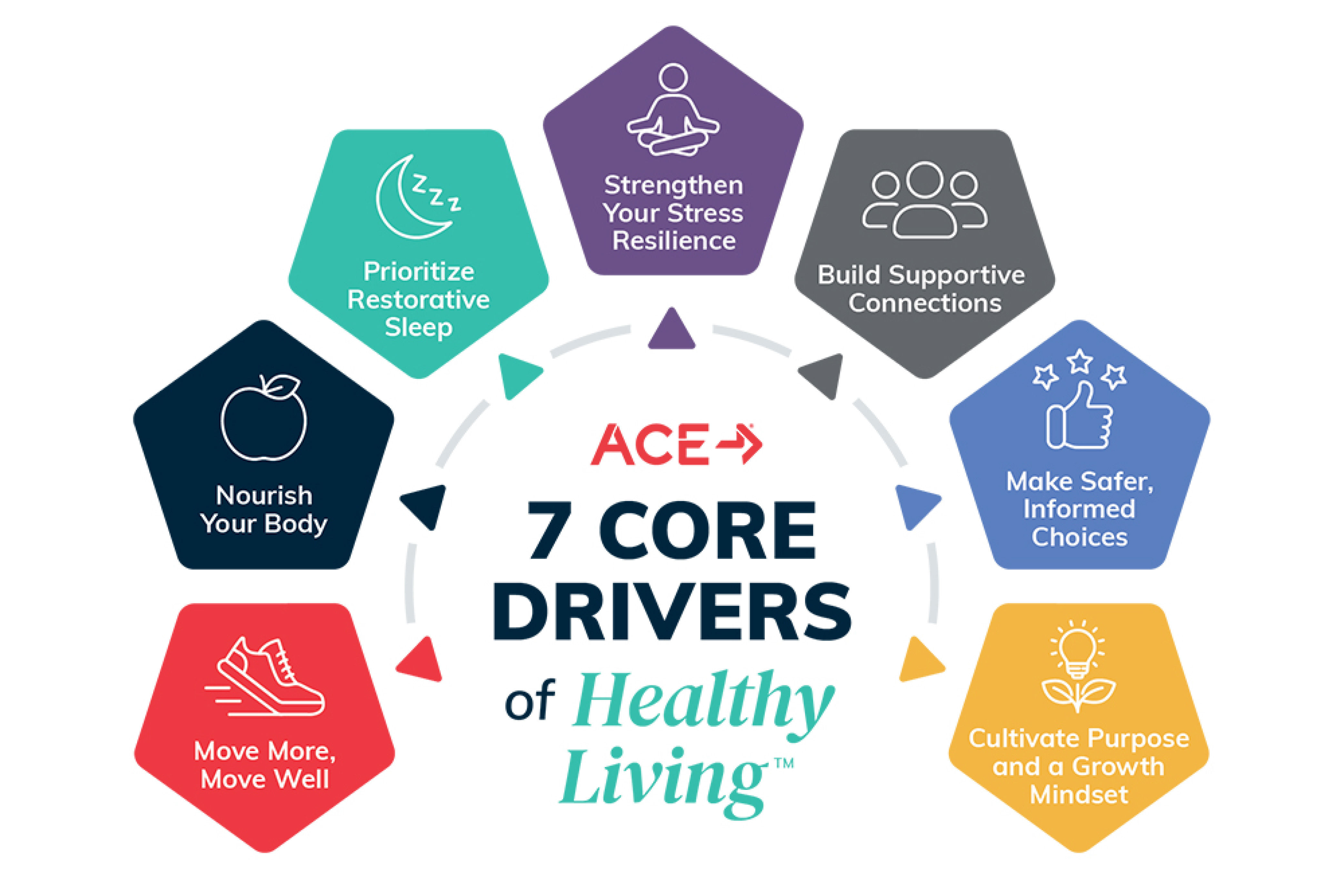
ACE 7 Core Drivers of Healthy Living
1. Move More, Move Well – Engage in regular physical activity and exercise that supports strength, mobility and long-term vitality.
2. Nourish Your Body – Choose balanced, healthy nutrition patterns that fuel daily living and overall well-being.
3. Prioritize Restorative Sleep – Get quality sleep that promotes recovery, cognitive function, emotional balance and immune health.
4. Strengthen Your Stress Resilience – Use effective coping skills and strategies that support emotional well-being and adaptability.
5. Build Supportive Connections – Cultivate positive relationships and a sense of community that enhance motivation and health.
6. Make Safer, Informed Choices – Make decisions that reduce health risks and promote long-term well-being.
7. Cultivate Purpose and a Growth Mindset – Clarify personal purpose and values, and foster a mindset that supports consistency, resilience and lasting behavior change.
Research supports two practical considerations for exercise and health professionals in their efforts to help clients cultivate purpose and a growth mindset.
First, purpose and physical activity reinforce each other in daily life. When people are more active than usual, they report higher momentary purpose (i.e., day-to-day feelings of having a direction), and when they feel more purposeful, they are more likely to be active later. Emerging research also suggests that having a strong sense of purpose—feeling that life has meaning and direction—is linked to better physical health, lower risk of chronic disease and longer life. Purpose may support healthy behaviors by helping people connect difficult daily choices, such as regular exercise, healthy eating, quality sleep and preventive healthcare, to larger personal goals.
Second, regular physical activity supports growth mindset-related processes that are strongly linked to long-term adherence, including self-efficacy, learning from setbacks and autonomy-supportive motivation. A growth mindset is based on the belief that abilities and skills can improve with effort, learning and persistence. A related psychological variable is grit, or the ability to keep working toward long-term goals, even when progress is slow or obstacles arise. In many ways, a growth mindset supports grit: When people believe they can improve through effort, they are more likely to interpret setbacks as feedback rather than failure and to stay committed through difficult moments. Successful aging has been associated with higher levels of grit, which may help people adapt to the developmental challenges of growing older.
Together, purpose, growth mindset and grit help explain why setbacks do not have to derail long-term behavior change. Purpose clarifies why healthy behaviors matter, growth mindset shapes how people interpret challenges, and grit reflects their ability to stay engaged despite those challenges.
ACE Definition and Scope
The key tenet of the ACE 7 Core Drivers of Healthy Living is interdependence: improvements in one driver can amplify improvements in others, and physical activity is often a practical starting point for creating such ripple effects.
Within this framework, cultivating purpose and a growth mindset includes two linked approaches:
Clarify Personal Purpose and Values
Purpose and values help people decide what to prioritize when life is busy or stressful. In health research, purpose has been associated with lower subjective stress, healthier inflammatory profiles, as measured by C-reactive protein, and lower mortality risk in older adults. These findings do not mean “purpose alone” guarantees health; rather, they suggest purpose functions like a psychological resource that supports health-protective patterns. According to Cedric X. Bryant, PhD, FACSM, Chief Executive Officer at ACE, “Purpose gives healthy behaviors a reason to exist. When people connect daily choices—like being physically active, eating well or getting adequate sleep—to something meaningful in their lives, those behaviors become easier to sustain because they are tied to who they want to be and how they want to live.”
Foster a Growth Mindset That Supports Consistency and Resilience
As noted earlier, a growth mindset is a learning orientation founded on the belief that abilities and capacities can be developed through effort, learning and persistence. In health behavior change, this matters because setbacks are a normal part of the process. Challenges such as missed workouts, injuries, stress spikes, schedule disruptions and plateaus are obstacles that everyone navigates from time to time. A growth mindset supports the ability to interpret these events as feedback rather than failure, which protects consistency and helps the person return to the plan.
Together, purpose and a growth mindset provide the “why” and the “how” of sustainable change. Physical activity offers a practical way to apply both in daily life.
Why Physical Activity Is a Catalyst for Purpose and a Growth Mindset
ACE highlights physical activity as a strong starting point for the Core Drivers because movement can build momentum and strengthen other behaviors. This is especially relevant given population-level gaps: According to the Centers for Disease Control and Prevention (CDC), only about one in four U.S. adults meets both aerobic and muscle-strengthening guidelines, and the World Health Organization (WHO) reports that about 31% of adults worldwide did not meet recommended activity levels in 2022.
From a purpose-and-mindset perspective, physical activity is a “catalyst” because it makes change visible and repeatable as a result of the following factors:
It turns values into action. A value like “being present for my family” becomes concrete when someone walks after dinner most nights to reduce stress and improve health. If family members join, the activity can also strengthen connection, turning purpose into a visible, repeatable behavior.
It supplies short feedback loops. Exercise provides immediate feedback about effort, progress and capability (e.g., “I walked 10 minutes more than last month”). These mastery experiences are a direct foundation for a growth mindset and self-efficacy.
It supports brain and mood health. The CDC summarizes that physical activity benefits brain health, including thinking and emotional well-being, and the National Institutes of Health (NIH) point to biological pathways that help explain cognitive benefits of exercise. These benefits matter because people are more likely to make values-based choices when they have stronger cognitive control and better mood regulation.
It creates social structure. Many exercise contexts (e.g., walking groups, classes and recreational activities) naturally build supportive connections—an ACE Core Driver that strongly predicts adherence and resilience. Community-level evidence recommends social support interventions for increasing physical activity.
Mechanisms: How Exercise Supports Purpose and a Growth Mindset
Purpose and a growth mindset are psychological outcomes, but they are supported by systems in the brain, body and social environment. Physical activity can strengthen these systems through several mechanisms (Table 1).
Neurocognitive Mechanisms
Purposeful, consistent behavior depends on executive function, which includes skills such as planning, inhibitory control and cognitive flexibility. A recent analysis of randomized evidence found that exercise improves general cognition, memory and executive function across populations. Similarly, the CDC highlights that physical activity supports thinking and learning, and the NIH has described biological pathways (e.g., exercise-related hormones and signaling) linked to cognitive benefits in mechanistic research.
In practical terms, stronger cognitive control supports purpose-and-mindset behaviors like following through on planned workouts, adapting plans after disruptions and resisting all-or-nothing thinking after a setback.
Physiological Mechanisms
Purpose and growth mindset are harder to sustain when stress systems are chronically activated. Purpose in life is associated with lower subjective stress across multiple samples, as well as healthier inflammation markers, suggesting purpose may relate to both psychological and physiological resilience. Exercise, meanwhile, is supported by strong evidence as a mental health intervention: a large review of the literature found exercise reduces depression symptoms in adults meeting clinical thresholds, with modalities like walking/jogging, yoga and strength training showing meaningful effects. The NIH also summarizes evidence that physical activity is linked with fewer depression symptoms, reinforcing its role as a mood-regulation tool that can increase capacity for values-based action.
Behavioral Mechanisms
Growth mindset becomes durable when it is backed by repeated experiences of “I tried, I learned and I improved.” Exercise provides these mastery experiences and strengthens self-efficacy, a central predictor of persistence. A systematic review and meta-analysis found that exercise interventions improve perceived self-efficacy in adults, including task self-efficacy. Self-efficacy is the “bridge” from motivation to maintenance. That is, people are more likely to stay consistent when they believe they can succeed with effort and strategy.
Social Mechanisms
Purpose often involves relationships and community, and exercise environments can supply those connections. Social support interventions are recommended in community settings (e.g., buddy systems, walking groups) based on evidence that they increase physical activity and improve fitness outcomes. These social supports reduce isolation, provide accountability and create identity-reinforcing norms (e.g., “people like me show up”). These social pathways strengthen resilience when motivation dips.
“Many people discover that pursuing health goals alongside others creates a powerful sense of accountability and encouragement,” explains Dr. Bryant. “Tackling challenges together often strengthens motivation and reminds us that progress is not just an individual journey—it’s something communities can support and celebrate together.”
Table 1. Summary of Major Mechanisms That May Support Purpose and Growth Mindset
|
Mechanism Pathway |
Supportive Factors |
|
Exercise → improved cognition/executive function |
Better planning, flexible coping, follow-through |
|
Exercise → reduced depression symptoms |
More emotional stability and “bandwidth” for values-based choices |
|
Exercise → increased self-efficacy |
Enhances persistence and reinforces a learning-oriented mindset |
|
Exercise ↔ purpose in daily life |
Reinforcing loop between movement and purpose |
|
Mindsets about physical activity → behavior and affect |
Positive beliefs shape engagement and perceived benefits of being active |
|
Growth mindset ↔ mental health |
Bidirectional relationship fosters psychological resilience |
Evidence Linking Activity to Purpose, Mindset and Long-Term Change
Physical Activity and Purpose
A key question is whether physical activity does more than correlate with purpose—does it relate to purpose in everyday life? A study that tracked adults ages 40 to 70 with accelerometers and brief in-the-moment check-ins found a two-way relationship: Being more active than usual predicted a stronger sense of purpose in the moment, and a stronger sense of purpose predicted later physical activity. This supports an applied interpretation: exercise can be both a generator of, and a consequence of, purpose.
At the population level, having a sense of meaning and direction in life is also associated with higher objectively measured physical activity (steps and movement intensity) in UK Biobank participants wearing accelerometers. While observational data cannot show cause, these findings strengthen the case for integrating purpose plus movement in adult health behavior programs, consistent with ACE’s ripple-effect logic.
Growth Mindset and Fitness
A fitness-specific mindset study found that “growth beliefs” about fitness predicted exercise frequency, with exercise self-efficacy and valuing exercise serving as mediators. This supports a practical coaching insight: if clients believe that improvement is possible and valuable, they are more likely to persist long enough to see results.
Another line of research tests “activity adequacy mindsets,” or beliefs about whether one’s activity is sufficient and beneficial. In a longitudinal randomized controlled trial using wearables, mindset interventions influenced affect, some behaviors (including diet-related outcomes), and some health-related measures without necessarily changing step counts. In practice, this suggests that how clients interpret their activity can influence motivation and well-being. As a health and exercise professional, you can ethically use this by helping clients notice real progress and benefits without exaggeration.
Self-Efficacy and Habit Formation for Long-Term Change
Even strong values and beliefs can fade under stress unless routines become easier. Meta-analytic evidence shows exercise interventions improve self-efficacy, and habit formation interventions can strengthen physical activity adherence. Together, these findings imply that cultivating purpose and growth mindset via exercise is most effective when programs build both: confidence (“I can do this”) and automaticity (“I do this because it’s part of my routine”).
Motivation quality also matters. A systematic review of Self-Determination Theory and physical activity concluded that competence and autonomous motivation are key determinants of physical activity, supporting values-based approaches over external control.
Coaching Strategies: Building Purpose and a Growth Mindset Through Exercise
The evidence points to a clear coaching opportunity: Design exercise experiences that help clients connect values to action, notice progress, adapt after setbacks and build routines that can survive real life.
“One of the most powerful things a coach can do is help a client connect their goals to their deeper values,” says Dr. Bryant. “When exercise aligns with what matters most—whether that’s staying active with grandchildren, maintaining independence or managing stress—it shifts from being another task on the calendar to something that genuinely supports the life they want to live.”
Values Clarification Plus Autonomy-Supportive Choice
Purpose begins with clarity. You can help clients identify what truly matters to them, whether that is independence, longevity, family, community involvement, strength or stress relief. Once values are identified, you can offer activity options that align with those values. For example, a client who values community might prefer group-based exercise, while someone who values independence may prefer individual training.
Providing options reinforces autonomy, which strengthens intrinsic motivation. Instead of touting a single “correct” workout, present meaningful choices that support the client’s identity and goals. When exercise is connected to personal values rather than external pressure, it becomes a meaningful choice the client owns.
Mastery Loops: Create “Learn, Improve, Repeat” Cycles
Growth mindset develops through repeated experiences of effort, feedback and improvement. You can design programs that intentionally create early wins and visible progress. This might include making appropriate progressions, tracking personal records or celebrating improved movement quality rather than just performance outcomes.
After each session, briefly highlight what the client improved: correct technique, increased endurance, better recovery or improved consistency. Over time, these moments of progress help clients see improvement as something they can observe, practice and build on.
As Dr. Bryant explains, “A growth mindset reminds people that progress in health and fitness is rarely linear. Setbacks are not signs of failure—they are opportunities to learn, adapt and continue moving forward. That perspective can make the difference between giving up and staying engaged over the long term.”
“Minimum Viable Workout” Plus Habit Cues
Consistency is essential for both grit and a growth mindset. However, life disruptions are inevitable. You can help clients develop a “minimum viable workout,” or a 10-minute default session that can be completed even on busy or stressful days. This might include a short walk, body-weight exercises or mobility work.
Pairing this with a consistent habit cue, such as a specific time of day, a calendar reminder or linking activity to an existing routine, helps strengthen automaticity. A clear backup plan keeps the routine intact on imperfect days and reduces the likelihood that one disruption becomes a full stop.
Supportive Connections by Design
Social support strengthens both purpose and resilience. You can intentionally create environments that foster connection, such as buddy systems, walking groups, partner drills or small-group check-ins. Even brief conversations before or after sessions can build rapport and belonging.
When clients feel supported, they are more likely to persist during challenging periods. These connections give clients accountability, encouragement and a sense of belonging when motivation dips.
Inclusive Design: Meeting Clients Where They Are
A growth mindset flourishes when programs are accessible and adaptable. You can tailor intensity, modality and environment to match the needs of older adults, individuals with disabilities or clients managing chronic conditions. Emphasizing that “some movement is better than none” reduces intimidation and promotes sustainable engagement.
Safe and appropriate progression is critical. Gradual increases in intensity and complexity allow clients to experience success while minimizing injury risk. Accessible progressions help clients experience success safely, making growth feel realistic rather than intimidating.
Activate the Community Environment
Purpose is often connected to participation and belonging beyond the gym. Encourage clients to explore safe walking routes, local parks, recreation centers or community events. Connecting clients to activity-friendly environments expands opportunities for movement and reinforces supportive connections.
By integrating clients into broader community resources, exercise becomes part of daily life rather than a standalone appointment. Community resources help clients carry movement beyond scheduled sessions and into the places where daily life happens.
Bringing It All Together
When coaches and trainers integrate values clarification, autonomy, mastery experiences, backup plans, social support, inclusive programming and community engagement, exercise becomes more than a fitness intervention (Table 2). It becomes a practical pathway for helping clients build purpose-driven routines, respond to setbacks with resilience and sustain healthier behaviors over time.
Table 2. Summary of Recommended Actions to Support Purpose and a Growth Mindset
|
Coaching Strategy |
What it Looks Like in Practice |
|
Values clarification plus autonomy-supportive choice |
Determine client values; offer activity options aligned with those values, such as individual- or community-based activities |
|
Mastery loops |
Provide progressions that create early success; track self-improvement; offer learning insights after each session |
|
“Minimum viable workout” plus habit cues |
Create a 10-minute default session for when unexpected events arise; have a clear backup plan |
|
Supportive connections by design |
Use buddy systems, walking groups, partner drills or small-group check-ins to build accountability and belonging |
|
Inclusive design (older adults, clients with disabilities and/or chronic conditions) |
Adapt intensity, modality and environment; emphasize “some is better than none”; support safe progression |
|
Community environment activation |
Encourage use of safe routes, parks and recreation centers; connect clients to activity-friendly community resources |
Purpose and Mindset in Action: Coaching for Lasting Change
Cultivating purpose and a growth mindset is not about positive thinking alone; it is about helping clients build habits that reflect their values and reinforce the belief that growth is possible. By connecting movement to meaningful goals, framing setbacks as learning opportunities and supporting realistic routines, exercise professionals and health coaches can help clients develop the purpose and mindset needed for lasting behavior change.
As this series concludes, Dr. Bryant offers the following:
“Health is rarely determined by a single habit. It grows from a collection of daily choices that influence and reinforce one another over time. The ACE 7 Core Drivers of Healthy Living reflect this interconnected reality—recognizing that movement, nutrition, sleep, stress resilience, supportive relationships, informed choices and a sense of purpose all work together to shape long-term well-being. Physical activity often serves as the starting point because it is one of the most accessible ways to begin building momentum toward healthier living. Ultimately, the goal of this framework is simple: to help exercise and health professionals guide people toward sustainable habits that support not only longer lives, but fuller and more meaningful ones.”



More Articles
- Certified™: July 2026
The Human Advantage: How Health and Exercise Professionals Can Thrive in the Age of AI
Health and Fitness Expert
- Certified™: July 2026
World Cup Ready: Soccer Training That Builds Speed, Strength and Stamina
- Certified™: July 2026
The Collagen Conversation: What the Research Shows and What It Doesn’t
- Certified™: July 2026
The Art of Connection: Communication Skills for Health and Exercise Professionals
Contributor
- Certified™: July 2026