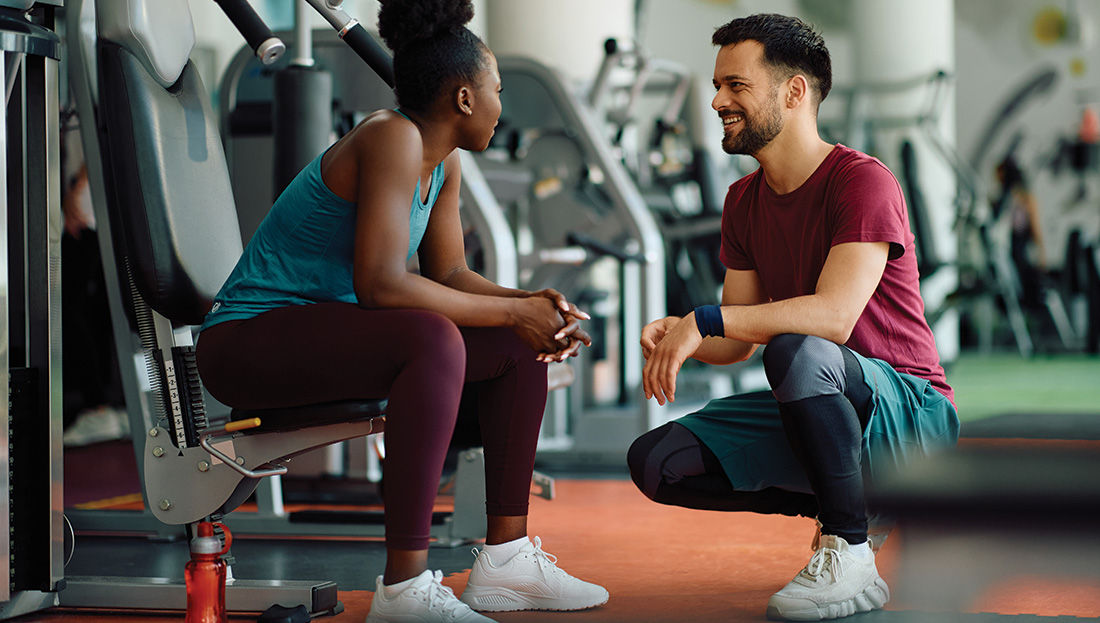
The young man’s biceps bulged from the sleeves of a fitted T-shirt, as he stood, arms crossed, near the lat pulldown machine, surveying the gym floor around him. He looked fit, maybe even a little intimidating.
He also looked a bit lonely.
“He’s one of the new trainers,” explained Reginald Fox, a veteran personal trainer at the same gym, who was working with a client nearby.
So why was he just standing there, looking slightly menacing? “He’s actually a nice kid,” Fox said. However, “management hired a bunch of new trainers like him and they don’t have clients.”
Why not? “That’s the thing,” Fox said. “They give these new trainers a list of new gym members, but they don’t give them any advice on how to approach these people [or] how to talk to them.”
That’s a pity. Because building a personal-training business means developing a skill that’s often overlooked, but just as important as knowing how to measure body fat or coach proper squat mechanics
Communication. As in, face-to-face interpersonal communication.
The Importance of Feeling Heard
“Training is a relationship business,” says executive communications consultant Raleigh Mayer. “Those relationships don’t always develop organically. If you are a career trainer, it’s up to you to build and maintain those relationships. Not only with clients, but with people who may not yet be your clients.”
And as we know, even from our personal lives, the most successful relationships tend to be those in which there is good communication.
How to Spark New Business
New trainer? Working the floor of the gym? Here’s how to spark some new business, from executive communications coach Raleigh Mayer, who also goes by the professional sobriquet, “The Gravitas Guru.”
- Make offers, but not corrections. Offer to help adjust a machine or find an accessory. “Make yourself useful,” says Mayer. “It’s not criticizing, it’s being supportive and helpful.”
- Be friendly, be courteous. “Even just a friendly wave to gym members you might recognize,” says Mayer. “Or it could be a compliment, like ‘that was a good set!’ Or just some conversational tidbit on the weather, on somebody’s cool new sneakers, on how the local sports team did last night, or a major local event.” Remember, you’re representing your business as well as the gym. “So, if you’re passive and distant, you’re sending the wrong signals.”
- Do not go on your phone while you’re on the floor. Nothing signals disinterest or says, “you’re not important” as much as someone looking at their phone.
- Solve a problem. Someone can’t figure out how to pair their phone with the treadmill’s software. Someone else is having trouble with the vending machine. It may not be in your job description, but that shouldn’t stop you from swooping in and helping—or least finding someone else on the staff who can.
- Remember that it’s less about approaching people, and more about being approachable. At one gym Mayer belongs to, the trainers make no eye contact and say nothing. “I feel unilaterally ignored,” she says. Yes, she realizes that the trainers’ primary focus should be on their paid clients, but, she notes, “Don’t ignore the potential clients!”
“It might be the most important skill for a trainer,” says ACE Certified Personal Trainer Norma Saulino, who started her career at Equinox and is now a successful independent trainer, working virtually from her home in New Jersey. “You might have two trainers, equally knowledgeable about programming and goal setting and so forth, but one may click with a client, and the other doesn’t, because they weren’t able to build a rapport. It’s hugely important.”
How do you—as either a gym-based or independent trainer—hone those interpersonal communications skills? How do you engage with gym goers or folks who want to get in shape? And how do you convince them you’re the right person to help them reach their fitness goals without sounding like a used car salesman hawking their wares?
This kind of communication doesn’t happen on an Instagram post. In fact, says Adam Wright of WrightWay Fitness in Mission Viejo, Calif., the first step toward being an effective one-on-one communicator is to resist the temptation to communicate…to talk, teach, mansplain, correct. “The first thing you need to do is listen,” Wright says. “Authentically listen. People can tell when you’re faking.”
Listen, think and be ready to offer help. As an example, Wright reconstructs the initial conversation he had with a woman—now a client—who dropped by his gym one day.
“She told me that since she and her husband split up, she’d been spending a lot of time at home when she’s not driving the kids around, and she’d gained 35 pounds. O.K., so now I know she’s a single mom, and she’s looking for a community. I have a better understanding of who she is, and how I might be able to help her.”
After further discussions, Wright suggested to the woman that small-group training—working with another client of Wright’s, also a mom and also someone trying to get back in shape after a period of inactivity—might be a good option for her.
And that’s what happened. In fact, Wright subsequently learned (again, because he listens) that the two women realized they had children in the same local elementary school. Another bond! They both enjoy working out together under Wright’s tutelage and they are both now valued clients.
“It was really just a matter of making her feel heard, and then connecting the dots,” he says.
Which is what Saulino did as a new trainer at Equinox, years ago, although it was after an initial misstep. The prospective new client was just a few months shy of her 30th birthday when she met Saulino, who asked her about her goals. What did she want to achieve in the gym? “She said, ‘Well, I want to get in shape,’” recalls Saulino. “Which is pretty vague. I’d have done better if I’d followed that up with ‘What would being in shape look like to you?’”
Instead, Saulino—also a certified nutrition coach—assumed that this young woman’s goal was to lose weight and started discussing an eating and activity program for her. At that, the new client burst into tears. Saulino was momentarily taken aback. She apologized and asked what she’d said to make her cry. “I don’t want to be a failure again,” said the young woman, who had apparently tried to lose weight on various occasions and through various approaches—none of them successful. Saulino quickly changed tack. “I said, 'That’s O.K. We don’t even have to talk about food or nutrition. There are many other things we can do to help you feel better and stronger, and more confident.’”
Instead of harping on weight loss, Saulino focused first on gaining strength. The young woman responded well and, a few months later, achieved the 30th birthday strength goal she had set for herself: She performed a 130-pound deadlift. “Her confidence soared,” recalls Saulino. “She blew past that goal, got stronger and did get in better shape.”
So, don’t make assumptions about what clients want or don’t want; or about why they’re in the gym. Their motivations are not going to become apparent unless you listen, ask questions and communicate with them.
And as a result, establish a relationship.
Why Establishing a Relationship is Essential
“People don’t really care, until they know you care,” says long-time trainer and group fitness instructor Karen Katz. “A relationship has to come first, especially when you’re asking someone to invest their money and time with you.”
Katz herself is a case in point: She has led a successful weekly, outdoor boot camp in New York’s Riverside Park since the early weeks of the pandemic in 2020. Over six years, she has built a loyal following. “You can work out anywhere these days—online, on YouTube—but people are still showing up at gyms, people are still showing up for classes like mine, because of the relationship,” she says. “People are still training in person because they know they have a person who cares about them.”
That kind of relationship is built not only through encouragement or enthusiasm, but through attention. It requires trainers to notice what clients say, what they don’t say and what may be happening beneath a short answer or a difficult mood.
Trainer Matt Sulam learned that lesson early. One of his first clients was a taciturn older man. “Our conversations would go something like this,” Sulam recalls. “`How are you feeling?’ ‘Horrible.’ `How was your day?’ ‘Terrible.’” As a young trainer, he didn’t know how to respond to those gloomy, one-word responses. It wasn’t until after a few sessions that the man revealed to him that his wife was battling cancer. From that experience, Sulam learned the importance of digging deeper—asking follow-up questions gently and tactfully, and making space for clients to share what they are ready to share.
While Sulam himself is an outgoing, high-energy trainer, he doesn’t believe those character traits are requisite for success in personal training. “You don’t have to be the life of the party,” he says, pointing to a long-time trainer he knew at a local gym. “He wasn’t funny, he wasn’t very personable, he didn’t talk much,” recalls Sulam. “But when he was doing a workout with someone, that person was the only person in the gym. His focus was completely on the client. And he had a good following, over a long period of time.”
Clearly, that trainer delivered the goods. He also understood something essential about communication: It is not always about saying more. Often, it is about being present enough to understand what a client needs and how best to support them.
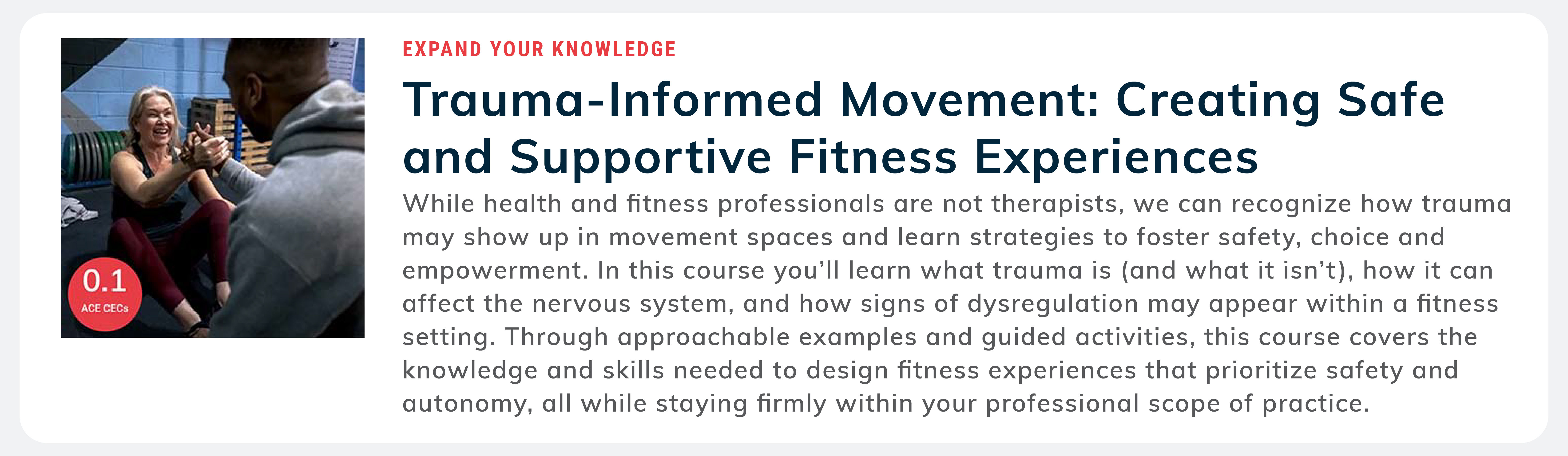
That kind of connection is not built by standing on the gym floor with arms crossed, aloof. “You have to be able to connect with people at some level," says Fox. For new trainers, that should be encouraging news. Communication is a skill and, like any skill, it can be practiced. A wave, a helpful offer, a thoughtful question or a moment of focused attention can be the beginning of trust—and trust may be what turns a gym member into a client, and a client into someone who keeps coming back.
Practice Your People Skills
If talking to strangers on the gym floor feels awkward, you’re not alone. Many new trainers feel uncomfortable or anxious about starting an in-person conversation with someone they don’t know. The good news: You can train for better communication the same way you train a squat, plank or deadlift—with practice, repetition and gradual progression. Here’s how…
Start small. Your first goal doesn’t have to be selling a training package or landing a new client. Begin with brief, low-pressure interactions: Make eye contact. Smile. Say hello. Give a genuine compliment, such as “Nice work on that set” or “That’s a great pace you’re holding.” The point is to become more comfortable being visible, friendly and approachable.
Practice one opening line. You don’t need a script for every possible situation. Choose one or two simple, natural phrases you can use often: “How’s your workout going today?” “Can I help you find anything?” “Have you used that machine before?” The more you practice, the less forced it will feel.
Make it about helping, not selling. People can feel when they are being pitched. Instead of approaching someone with the goal of signing them up, approach with the goal of being useful. Offer to adjust a machine, find a piece of equipment, explain where something is located or answer a quick question.
Ask one follow-up question. When someone responds, resist the urge to jump in with advice right away. Ask one more question: “What are you working on today?” “How long have you been coming here?” “Is there anything you’re trying to get more comfortable with?” Follow-up questions show interest and can turn a brief exchange into a real conversation.
Expect some conversations to be short. Not everyone will want to talk, and that’s O.K. A short answer is not necessarily rejection. The person may be focused, tired, shy or simply in a hurry. Stay friendly, give them space and try again with someone else later.
Set a daily communication goal. Just as you might track sets and reps, track your communication practice. For example: “Today I will greet five members, offer help to two people and ask one person a follow-up question.” Over time, those small interactions build confidence.
Remember: You are not trying to become the loudest or most outgoing person in the gym. You are trying to become someone people feel comfortable approaching. That begins with small, consistent moments of human connection.




 by
by