





World Cup Ready: Soccer Training That Builds Speed, Strength and Stamina
Certified™: July 2026
The FIFA World Cup arrived in North America this summer, with matches across Canada, Mexico and the United States, and the timing could not be better for health and exercise professionals. Soccer participation in the U.S. has been climbing steadily, with data from the Sports & Fitness Industry Association showing outdoor soccer participation reached 16.8 million people in 2025, an all-time high, while indoor soccer reached 6.6 million participants, also a record.
That means more clients may be coming to you with a familiar request: “I want to get in shape for soccer” (or football, if you happen to live outside the U.S.) Some will be adult-league players trying to feel sharper on Sunday mornings. Some will be parents who want to keep up with their kids, or former athletes rediscovering the game. Others may simply be inspired by what they are watching on TV and want a workout that feels athletic, competitive and fun.
The good news is that you don’t have to be a soccer coach to train clients for soccer, nor do you need to teach formations, tactics or how to bend a free kick around a wall. Your role is to help clients build the physical qualities that make soccer feel better: the ability to accelerate, decelerate, cut, jump, recover, repeat hard efforts and stay coordinated when fatigue starts to creep in.
Soccer is often described as an endurance sport, and that is true in one sense. Players are on the field for a long time and cover a lot of ground. But the moments that usually matter most are short, explosive and unpredictable. A player jogs, scans, shuffles, accelerates, stops, changes direction, jumps, lands, absorbs contact, passes, repeats and then has to do it again a few seconds later. A systematic review of professional soccer match demands found that high-speed running and sprinting are meaningful parts of the game, but not the whole game, which reinforces the need to train both the engine and the explosive moments layered on top of it.
In other words, soccer fitness is not just “go run more.” It is run, stop, turn, brace, jump, land and recover—with enough control to do it safely and enough capacity to do it again.
Make It Scalable for Every Client
Not every client who wants soccer training is young, fast or competitive. That is part of the opportunity. Soccer-inspired training can be scaled for many fitness levels because the ingredients are adjustable. Walking can become jogging. Jogging can become sprinting. A step-back lunge can become a lunge jump. A controlled cone walk can become a timed shuttle. A gentle pass-and-move drill can become a small-sided game.
For older adults or clients who are more interested in health than competition, the emphasis may be on balance, coordination, light agility, strength and social enjoyment. Research on recreational soccer has shown that small-sided soccer can act as a multicomponent form of training, challenging cardiovascular, metabolic and musculoskeletal systems. A 2014 study of previously untrained men ages 63 to 75 also found notable improvements after one-hour soccer sessions twice per week, including improved maximum oxygen uptake, interval exercise performance, muscle function and femoral neck bone mineralization.
That doesn’t mean every older client should start playing full-speed pickup soccer. It means the game’s movement ingredients—walking, jogging, turning, passing, reacting, balancing and lightly competing—can be powerful when they are programmed appropriately.
Start With the Warm-Up Your Client Actually Needs
A soccer-focused session should not begin with a few casual leg swings and then a sprint. The warm-up is essential for raising body temperature, rehearsing movement patterns, activating the hips and trunk, building single-leg control and preparing the ankles, knees and hips for cutting and landing.
This is where research on neuromuscular warm-ups is useful. A 2025 systematic review and meta-analysis found that the FIFA 11+ warm-up program, a structured injury-prevention routine that combines running drills with strength, balance and plyometric exercises, was more effective than conventional soccer warm-ups for improving dynamic balance, change-of-direction speed and vertical jump height in youth and adult soccer players. The program’s value is not only that it prepares players for practice; it uses the warm-up as a consistent dose of balance, strength, core control, plyometrics and movement technique.
For your clients, you can apply that principle without making the warm-up feel clinical. Begin with easy locomotion: jogging, backpedaling, lateral shuffling, skipping and carioca. Add dynamic mobility for the calves, hips, hamstrings and thoracic spine. Then layer in activation and control: glute bridges, dead bugs, side planks, body-weight squats, reverse lunges and single-leg balance reaches. Finish with low-level rehearsal of the day’s main movement, such as two or three easy accelerations, controlled decelerations or submaximal jumps.
The goal is readiness, not fatigue. You want the client to feel warmer, more connected and more coordinated than when the session started. If the client looks slower or sloppier after the warm-up, it was too much.
Teach the Brakes Before You Chase Speed
Many clients want “quick feet.” What they often need first is better braking.
Soccer requires the body to manage force in all directions. A client may sprint forward, plant on one leg, rotate the trunk, reach for a ball and then push off in a new direction. If they can’t decelerate with control, every agility drill becomes a gamble. The knee may collapse inward, the trunk may tip, the feet may get too narrow or the client may take several extra steps to stop. This is inefficient and can increase stress on the lower extremities.
When you introduce agility work, make the first goal clean movement. Use cones, lines or an agility ladder, but do not let the equipment become the point of the drill. The point is body position. Coach the client to keep the eyes up, chest proud, hips back and feet underneath the body. On a plant step, cue the client to “push the ground away” rather than simply reaching with the foot. On a deceleration, cue “quiet landing” or “stick the stop” before asking for more speed.
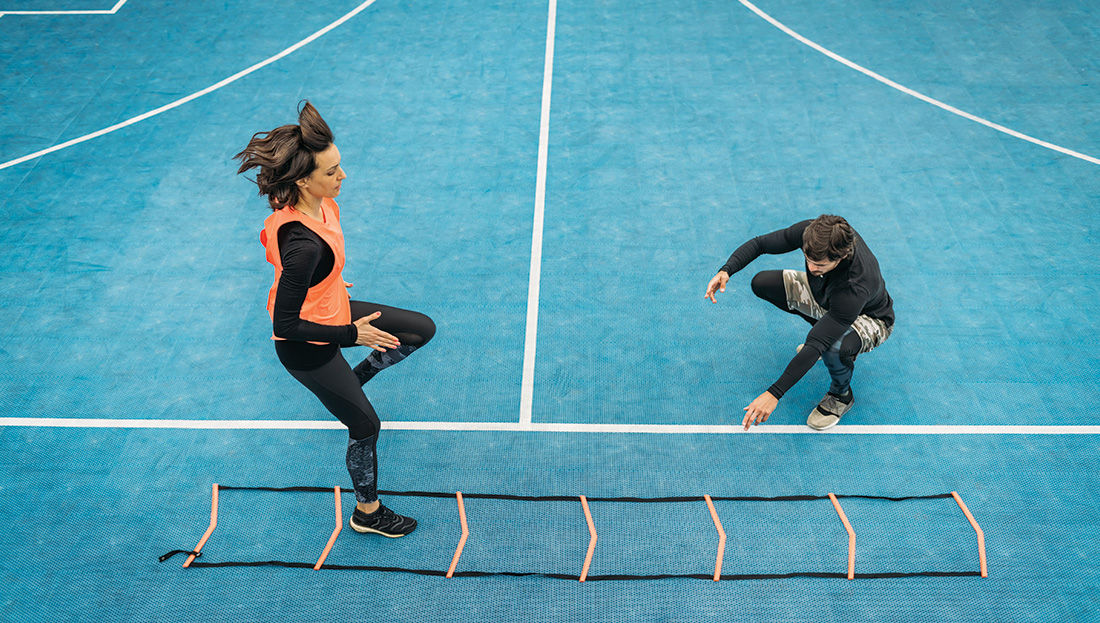
Ladder drills can be useful when they are treated as coordination and rhythm work rather than a magic fix for speed. For example, a client might move forward through the ladder using a simple two-feet-in pattern, then exit laterally toward a cone, touch the cone and return to the ladder. This adds a directional change without being overwhelming. A lateral ladder pattern can then progress to a forward-and-backward movement to mimic the constant repositioning that happens during play.
Cone drills are where you can make agility more soccer-like. The T-drill is a classic example because it trains for acceleration, lateral shuffling and backward movement while the client keeps the torso facing forward. That matters because soccer players often have to move in one direction while watching the play unfold somewhere else. Keep early reps smooth and controlled, then gradually add speed, a ball, a partner cue or a decision-making element.
The best agility drills have a purpose. If the client is learning to stop, give them enough rest to stop well. If the client is conditioning, use simpler patterns so fatigue doesn’t interfere with their mechanics. Once the client can move with control, make the drill more soccer-like by adding a cue: point left or right, call a color, toss a ball or have the client react to a partner’s movement.
Build Power With Jumps, Throws and Intent
Power is the quality that helps a client win a short race to the ball, jump for a header, recover from a stumble or change direction with authority. It does not require complicated exercises, but it does require intent. A lazy jump is not power training. A rushed medicine ball throw with poor posture is not power training. A tired sprint tacked onto the end of a punishing workout is not speed development.
Start with landing. Before box jumps, bounds or repeated jumps, make sure the client can land in an athletic position with the knees tracking over the toes, the hips back and the whole foot connected to the ground. A basic squat jump with a controlled landing may be enough for many clients at first. From there, you can progress to low box jumps, lateral bounds, split squat jumps or approach jumps.
Recent research supports the use of plyometrics, but it’s also a reminder that the dose matters. In a 2024 study of adult male soccer players, 100 foot contacts per session—a common way to track plyometric volume by counting the jumps, hops, bounds or landings performed during a workout—twice weekly for eight weeks was enough to improve jump and change-of-direction performance, although linear sprint performance was largely unchanged. For general fitness clients or recreational players, you will often use far less volume than that, especially at the beginning. Two to four sets of three to five high-quality reps can be plenty.
Medicine ball throws are a practical way to train power without the joint stress of high-volume jumping. An overhead medicine ball toss can connect the hips, trunk, shoulders and arms in a pattern that resembles a powerful throw-in. A rotational scoop toss can help clients practice producing power through the hips and trunk—the same kind of rotation they use when kicking, shielding the ball or turning away from an opponent. A chest pass can reinforce whole-body force transfer. Keep the ball light enough that the client can move fast. For many clients, that means 4 to 8 pounds, not the heaviest ball in the gym.
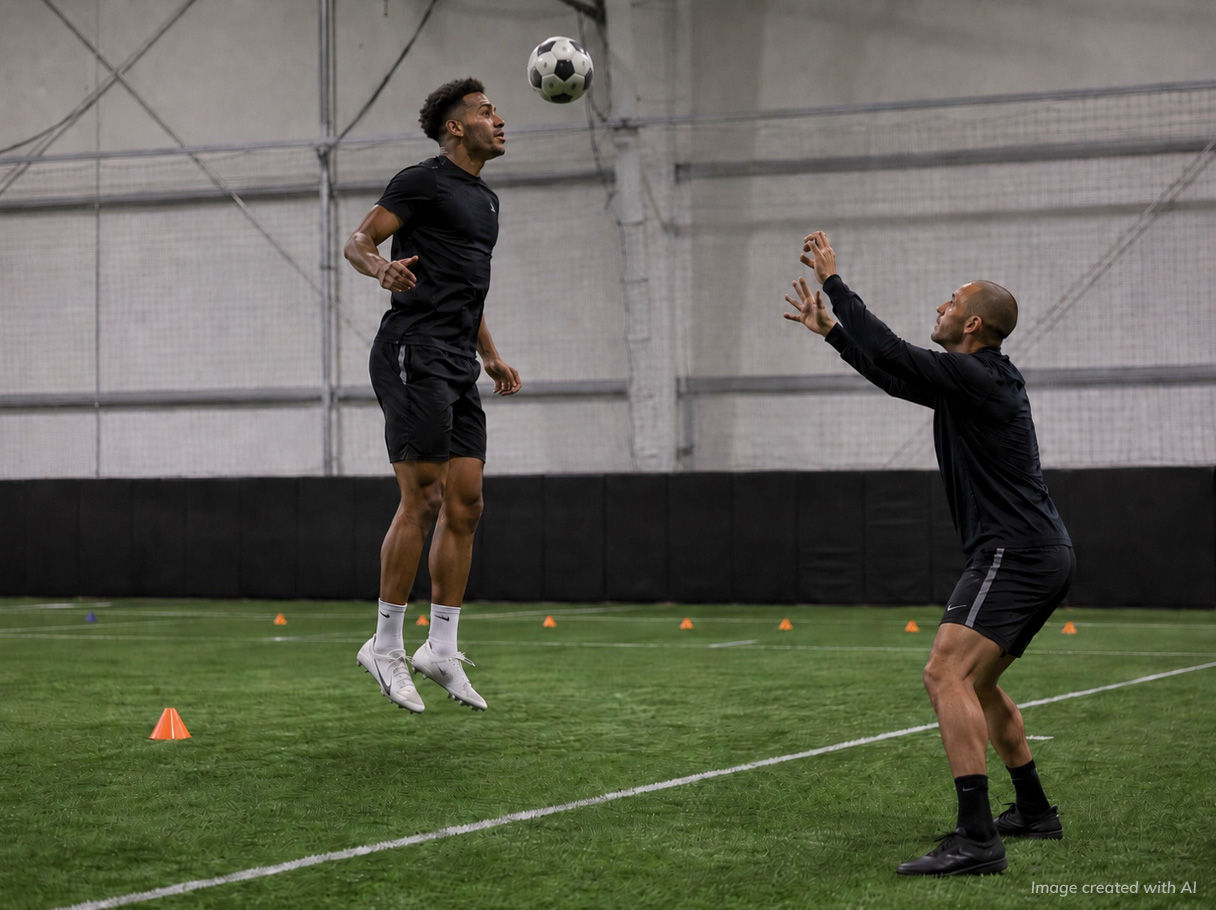
Soccer-style jump-and-land drills can also be useful, especially for clients who need to improve timing, body control and confidence in the air (Figure 1). Start with a visual or verbal cue to jump, then progress to a coach or partner tossing a ball slightly above the client’s head so they can jump, reach or lightly head the ball, and land with control. The goal is not contact or competition; it is helping the client jump, land and reset in a strong position, which makes the drill more relevant to soccer while still prioritizing safety and movement quality.
Figure 1. Jump-and-Land Drill
Strength Is the Support System
Soccer may look like running, but durable soccer performance is built on strength. The client needs strong hips to cut, strong hamstrings to sprint, strong calves and feet to tolerate repeated contacts, strong adductors to manage lateral movement, and a trunk that can transfer force without collapsing.
For most clients, the strength program doesn’t need to be complicated—it needs to be consistent. Prioritize lower-body patterns that carry over to the field: split squats, step-ups, rear-foot-elevated split squats, lateral lunges, Romanian deadlifts, hip thrusts and calf raises. Include hamstring-focused work, such as stability ball leg curls, sliders or, when appropriate, Nordic hamstring progressions. Add upper-body pushing and pulling, because shielding, balance and contact all involve the trunk and upper body. Finish with carries, Pallof presses, chops, lifts and other anti-rotation exercises that help the client resist unwanted movement.
The key is to schedule strength work in the week where it helps, not where it interferes. If a client has a match or hard soccer practice on Saturday, Friday is not the day for heavy split squats and high-volume plyometrics. For recreational players, one or two focused strength sessions per week can maintain progress without leaving them heavy-legged for the game they are trying to enjoy.
Research on repeated sprint ability also supports a blended approach. A 2024 systematic review and meta-analysis found that combined training approaches, particularly plyometric plus sprint training, may improve repeated sprint ability more effectively than single-mode training or routine training alone, although the authors noted a low to very low certainty of evidence. In practical terms, that means you don’t need to choose between strength, plyometrics, sprinting and conditioning. You need to incorporate each one in a way that makes sense for the client.
Acceleration Beats Top Speed for Most Clients
Top speed matters in soccer, but many of the most important actions happen over the first 5 to 15 yards. An individual who can take three powerful steps, stop under control and go again will feel more effective than the person who only trains long, steady runs.
Acceleration training should be fresh, fast and relatively low volume. Use short distances, full recovery and simple cues. A wall drill can teach body angle. Marches and skips can teach rhythm. Falling starts, split starts and kneeling starts can teach projection. Short hill sprints or light sled pushes can help clients feel the action of pushing the ground away.
Resisted sprinting can be especially useful when it is not overloaded. A 2025 systematic review and meta-analysis found that resisted sprint training significantly improved linear sprint performance, vertical jump ability and change-of-direction performance in athletes. For clients, the practical application is straightforward: use a sled, band or partner-resisted sprint for short accelerations, usually 10 to 20 yards, and keep the resistance light enough that the client still looks like they are sprinting.
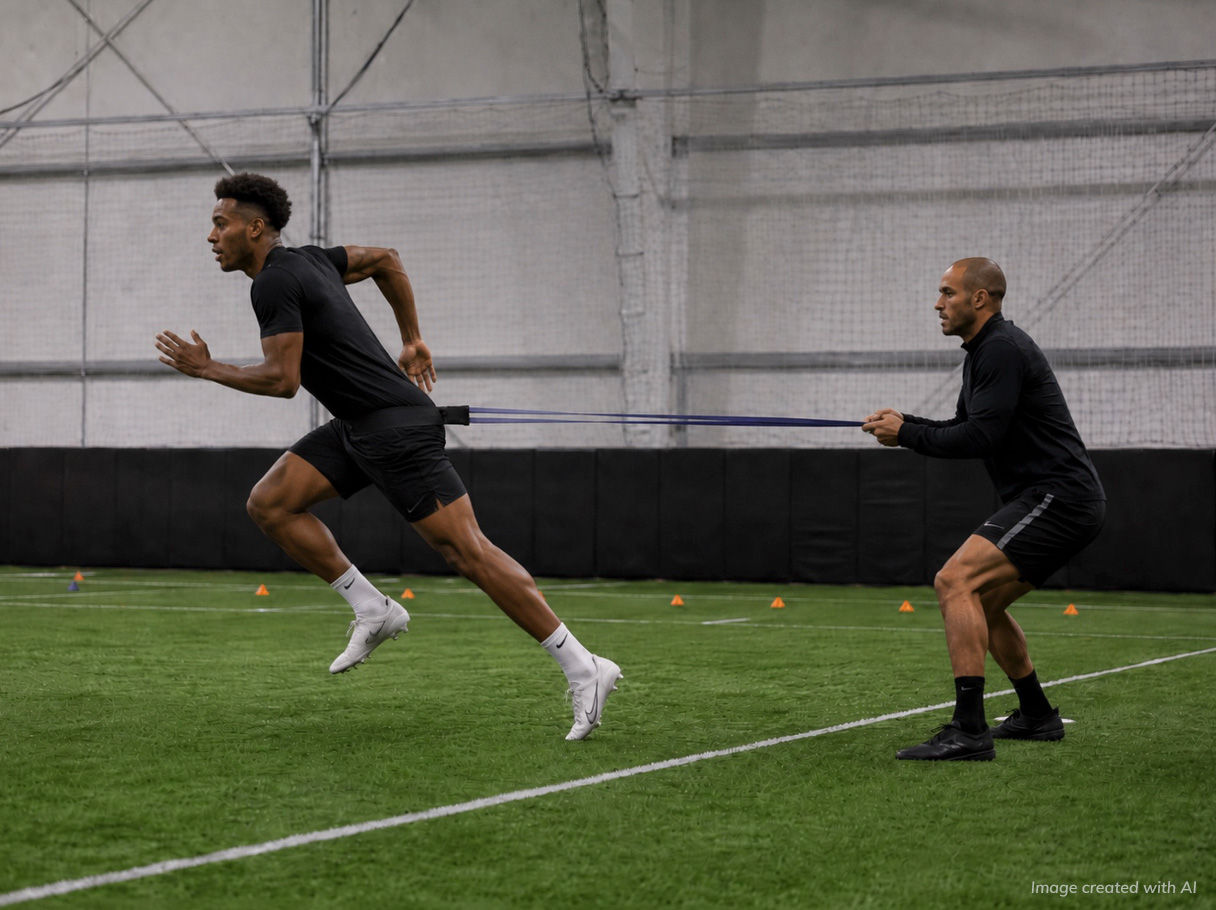
A partner-resisted sprint is easy to set up with a resistance band around the runner’s hips while the partner provides controlled resistance from behind (Figure 2). The runner should maintain a slight forward lean from the ankles, drive the arms, push through the ground and avoid folding at the waist. If mechanics fall apart, reduce the resistance or shorten the distance.
Figure 2. Partner-Resisted Sprinting
Do not turn every sprint into conditioning. Speed requires rest. If the goal is acceleration, a client may sprint for three to five seconds and rest 45 to 90 seconds before repeating. That may feel too easy to clients who associate hard workouts with constant fatigue, so explain the purpose: You are training the nervous system to produce high-quality force, not simply trying to make them tired.
Conditioning: Train the Game, Not Just the Gas Tank
Soccer conditioning should help clients handle repeated changes in intensity. Steady-state cardio can build a useful base, especially for clients who are deconditioned, but it is not enough by itself. Clients need intervals, shuttles and game-like work that require them to recover while still moving.
Small-sided games (matches played with fewer players) are one of the most soccer-specific conditioning tools because they combine movement, decision-making and technical skill. A three-on-three or four-on-four game can create repeated accelerations, decelerations and transitions without making the workout feel like a running test. But small-sided games are not always available to health and exercise professionals, especially in a gym setting or one-on-one session. In that case, you can borrow the structure without needing a full game.
A simple stop-and-start shuttle works well. Set cones 5 yards apart in a straight line. The client accelerates forward, touches down under control, retreats, then accelerates again. This pattern challenges acceleration, braking, backward movement and repeat effort. Keep the work bouts short enough that the client can move well, such as 15 to 30 seconds, and use active recovery that allows the next round to stay sharp.
Running-based high-intensity interval training also has a place. A 2021 systematic review and meta-analysis comparing small-sided games with running-based high-intensity interval training found that running-based intervals had a greater effect on sprinting performance, while the authors suggested small-sided games should be supplemented with other methods to develop key soccer capacities. This is a useful takeaway for trainers: Play is great, but it should not be the only tool.
For a recreational client, conditioning might look like six to eight rounds of 20 seconds of shuttle work followed by 60 seconds of easy walking. A more advanced client might perform two sets of six rounds, with two to three minutes between sets. Another option is a treadmill or field-based interval session that alternates one minute at a challenging run with one minute at an easy jog, then adds lateral shuffles or backward movement off the treadmill or on the field. The goal is not to mimic every second of a match, but to prepare the client to repeat quality efforts without losing movement control.
Add the Ball When It Helps, Not Before
A soccer ball can make a drill more engaging, but it can also make a drill messier. Add the ball when the client is ready for it.
For example, a close-quarter agility drill can start without a ball as a simple body-positioning exercise: one client shields space while you or another client provides light pressure. Then add the ball near the lead foot and ask the client to fake one way, rotate away and protect the ball with the body. The performance goal is not fancy footwork. It is balance, body control and the ability to create space.
Similarly, ladder drills can begin as footwork patterns, then progress to a ball touch at the end of the drill. Cone drills can begin with preplanned routes, then progress to a coach’s call or a pass. Sprint drills can begin from a stationary start, then progress to chasing a rolling ball. These small changes make training feel more like soccer without asking you to step outside your scope as a health and exercise professional.
Use the ball to increase engagement and decision-making, not to hide poor mechanics. If the client’s knees collapse, posture falls apart or footwork becomes chaotic, remove the ball and rebuild the movement.
A Sample 60-Minute Soccer Performance Session
The following sample session gives the client what soccer requires: preparation, coordination, braking, power, acceleration, strength and repeat-effort conditioning. It also keeps the workout varied enough to feel more like training for a sport than checking boxes in the gym.
- Begin with 10 minutes of movement preparation: easy jogging, lateral shuffles, backpedaling, dynamic hip mobility, glute bridges, planks and single-leg balance reaches. The final two minutes should preview the main workout with low-intensity accelerations and controlled stops.
- Move into 10 to 12 minutes of agility and deceleration. Use a forward ladder pattern into a lateral cone touch for three rounds of 15 to 20 seconds, resting for 60 to 90 seconds between rounds. Then, perform four to six T-drill reps, emphasizing clean stops, low hips and eyes forward. Keep the effort moderate at first and increase speed only when the movement stays organized.
- Next, spend 12 to 15 minutes on power and acceleration. Perform three sets of five overhead medicine ball throws, resting long enough for each set to stay explosive. Follow with four to six resisted sprints of 10 to 15 yards, using a band, sled or partner. Rest for 60 to 90 seconds between sprints. If the client is ready, add three sets of three controlled vertical jumps or lateral bounds.
- The strength block can be simple and efficient: two or three rounds of split squats, Romanian deadlifts, lateral lunges, rows and carries. Choose loads that challenge the client without grinding them down. This is especially important if they are also playing soccer during the week.
- Finish with eight to 10 minutes of conditioning. Use a stop-and-start shuttle for 15 to 20 seconds, then walk for 60 seconds. Repeat six to eight times. Cool down with easy walking, breathing and mobility for the calves, hip flexors, adductors and hamstrings.
We've created a soccer-inspired workout for ACE Certified Professionals to download and share with their clients. You can access this exclusive PDF by clicking on the bar at the top of this page.
Progress Without Making Every Workout Harder
The easiest mistake to make in soccer conditioning is to add intensity too quickly. Soccer already has a lot of moving parts. Clients need time to learn the patterns before you ask them to perform those patterns at speed.
A useful progression is to begin with movement quality, then add tempo, then add reactivity. In the first phase, drills are performed at about half speed. The client learns where to place the feet, how to stop, how to land and how to keep the trunk controlled. In the next phase, the same drills become faster and more rhythmic. Work intervals of 15 to 30 seconds can be appropriate here, as long as technique stays clean. In the final phase, add decision-making: a partner, a coach’s call, a ball, a target or a time challenge.
You can progress in several ways without simply making the workout exhausting. Increase speed, but not volume. Add a reaction cue but keep the pattern simple. Add a ball but reduce the distance. Increase the number of rounds but keep the intensity moderate. Shorten the rest only when the goal is conditioning, not speed. These choices are where your coaching matters.
For clients who are new to soccer or returning after a long break, two soccer-focused sessions per week may be enough. One can emphasize strength, power and acceleration; the other can emphasize agility, ball-based movement and conditioning. For clients who already play once or twice a week, your job is to fill the gaps without adding unnecessary fatigue. Ask when they play, how they feel afterward and what tends to break down first. Their answers will tell you whether they need more strength, more recovery, better conditioning or simply better pacing.
The Real Goal: Better Movement Under Pressure
The most effective soccer training doesn’t just make clients sweaty. It helps them move better when the workout gets unpredictable.
That is what separates soccer-inspired training from a generic circuit with a ball nearby. A good soccer session teaches clients to decelerate before they cut, land before they jump again, recover before they sprint again and stay aware of their surroundings while they move. It builds strength without stiffness, conditioning without mindless volume, and agility without chaos.
As the World Cup brings more attention to soccer, clients may come to you with excitement, curiosity or a little nostalgia. Meet them there. Use the energy of the sport to make training more engaging, but keep your programming grounded in what works: warm up well, build strength, train power, practice acceleration, condition in intervals and progress from simple to complex.
Your clients may never play in a stadium, and they do not need to. The win is helping them feel quicker, stronger and more confident the next time they step onto a field, join a pickup game or chase a ball with their kids. In that sense, soccer training is not only about the game. It is about helping clients rediscover the joy of moving like athletes.



More Articles
- Certified™: July 2026
Moving With Purpose: How Physical Activity Builds a Growth Mindset
- Certified™: July 2026
The Human Advantage: How Health and Exercise Professionals Can Thrive in the Age of AI
Health and Fitness Expert
- Certified™: July 2026
The Collagen Conversation: What the Research Shows and What It Doesn’t
- Certified™: July 2026
The Art of Connection: Communication Skills for Health and Exercise Professionals
Contributor
- Certified™: July 2026