






ACE-Supported Research: Hot or Cold? What Works Best for Exercise Recovery

Certified™: June 2026
Recovery from exercise and competition is a vital, but often underappreciated, component of a client’s overall training program, and it is especially important if your client performs high-intensity exercise or competes in sports or athletics. As a health and exercise professional, understanding the physiological concept of recovery is essential for designing optimal programs.
Many of your clients may be familiar with the idea of cold-water immersion as a means of recovery after exercise, but they may not know the proper temperature or duration to maximize benefits. Are they jumping in a frozen lake or settling into a cold bathtub? Same goes for hot-water immersion. Most people know the soothing feeling of easing into a hot tub after a workout or a hard day’s work, but they probably don’t know what’s happening in the body that is providing relief or how to go about using hot-water immersion as part of their normal routine.
Other questions arise, as well. Which is better for recovery, hot- or cold-water immersion? Do they work better for cardio or resistance training? How do they compare to the passive recovery that most of your clients are probably getting?
To answer these questions, we turned to Lance Dalleck, PhD, and Vaughn Hendrickson, MSc, of the High Altitude Exercise Physiology Program at Western Colorado University.
The Study
The researchers initially recruited 12 healthy, active men and women ages 16 to 50 years old, though three dropped out over the course of the study (one due to injury and two due to outside commitments). To establish a baseline for comparison, the researchers gathered body measurements, in addition to each participant’s maximal oxygen uptake (VO2max) and one-repetition maximum (1-RM) for the leg press exercise (Table 1).
Table 1. Physical and Physiological Subject Characteristics (mean ± SD)
|
Age (years) |
Height |
Weight |
Body-Fat Percentage |
VO2max (mL/kg/min) |
Leg Press 1-RM |
|
21.8 ± 4.5 |
69.2 ± 2.4 inches (175.8 ± 6.0 cm) |
183.4 ± 34.8 lb (83.2 ± 15.8 kg) |
20.8 ± 7.7 |
40.4 ± 4.9 |
709 ± 193 lb (321 ± 88 kg) |
Note: 1-RM = One-repetition maximum
The study itself consisted of six workouts, all of which followed the same protocol:
- Running trial to fatigue: After a three-minute warm-up, the treadmill’s speed and incline were adjusted so the participant exercised at 70% of their VO2max. It remained there until the participant signaled that they were done with the test, at which point they completed a cool-down.
- Wingate: The Wingate test is a 30-second all-out cycling sprint against high resistance. In this study, the participants pedaled at 60 rotations per minute (rpm) and then the researchers counted down from 3. On “go,” the participants pedaled as hard as they could. When they hit 120 rpm, the resistance would kick in and they were encouraged to go at maximum capacity throughout the 30-second period. They then completed a brief cool-down.
- Leg press to fatigue: After a 12-repetition warm-up, the participant leg pressed a weight equivalent to 80% of their 1-RM as many times as they were able to with proper form.
This workout allowed the researchers to evaluate the impact of recovery on three distinct elements of physical fitness: cardiorespiratory fitness, anaerobic power and muscular fitness, which, as Dr. Dalleck explains, mimics what typical gym-goers are often trying to accomplish with their workouts.
Remember, the objective of this study was to investigate the effectiveness of cold-water immersion and hot-water immersion as recovery methods. While the order of recovery methods was randomized, a participant might complete their six workout sessions under the following conditions:
- Workout 1 followed by cold-water immersion
- Workout 2 24 hours later
- Workout 3 followed by hot-water immersion
- Workout 4 24 hours later
- Workout 5 with passive recovery (this is the control session)
- Workout 6 24 hours later
For the hot-water immersion, the water temperature was kept at 104° F (40° C), while the cold-water immersion temperature was 54° F (12° C). Both immersion sessions lasted 12 minutes and researchers checked in every three minutes to ask how the participant was feeling on a thermal comfort scale.
What’s Happening in the Body During Hot- and Cold-Water Immersion?
It is important to understand the potential mechanisms underpinning the recovery process taking place during both hot- and cold-water immersion. According to Dr. Dalleck, they have different mechanisms by which they’re facilitating recovery. “Cold-water immersion can help with controlling inflammation and any modest tissue damage or swelling from a really high-intensity workout.” In contrast, he explains, “You’re getting increased blood flow from the hot-water immersion, as well as vasodilation, which is going to result in the removal of metabolic waste products that have accumulated. It can also help replenish our muscle glycogen stores and get us properly fueled for the next workout.”
The Results
For each of the three conditions (cold water, hot water and control), the researchers compared the participants’ performance at the workouts that featured the recovery methods (i.e., workouts 1, 3 and 5) to their performance 24 hours later.
Running Trial to Fatigue (Cardiorespiratory Fitness)
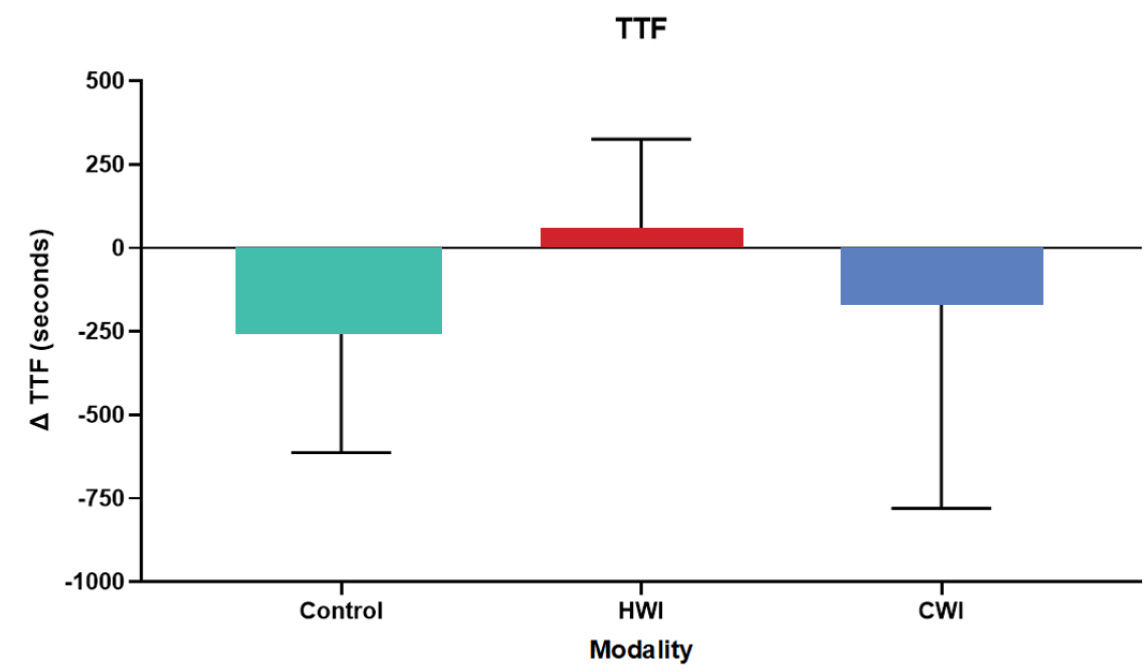
In the running trial, the researchers were measuring “time to fatigue” (TTF), which illustrates how long someone is able to sustain their performance before quitting the test. A longer TTF indicates better performance on the test.
- Control: TTF was 4 minutes, 11 seconds shorter in session 2 than in session 1 (22 minutes, 5 seconds vs. 26 minutes, 16 seconds), indicating that performance declined.
- Hot-water immersion: TTF was 58 seconds longer in session 2 than in session 1 (21 minutes, 9 seconds vs. 20 minutes, 11 seconds), indicating that performance improved.
- Cold-water immersion: TTF was 2 minutes, 46 seconds shorter in session 2 than in session 1 (20 minutes, 47 seconds vs. 23 minutes, 33 seconds), indicating that performance declined.
While hot-water immersion was the only scenario that led to the participants improving their performance from session 1 to session 2, these results were not statistically significant and both recovery methods were shown to be more effective than the control (Figure 1).
Figure 1. The change (Δ) in time to fatigue (TTF) between exercise session and +24-hour exercise session across recovery conditions [control vs. hot-water immersion (HWI) vs. cold-water immersion (CWI)]
Wingate (Anaerobic Power)
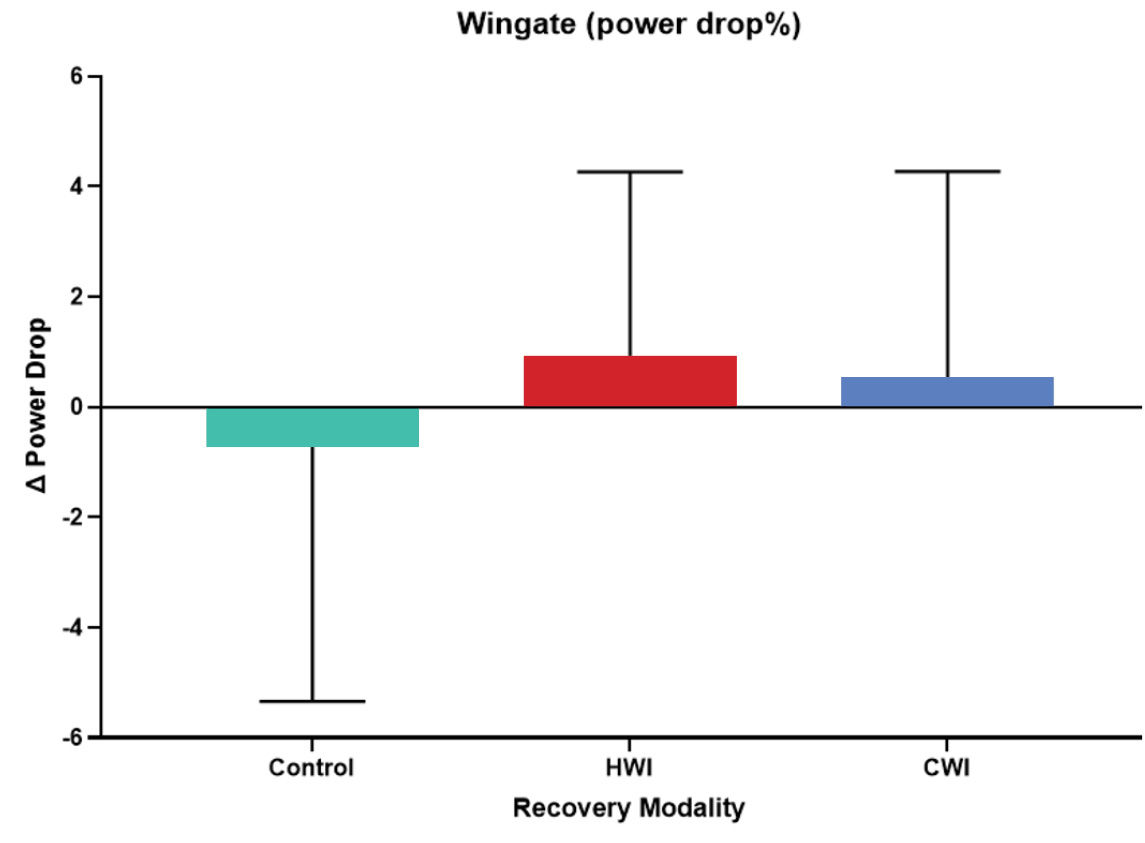
In the Wingate protocol, researchers measured the participants’ “power drop,” which illustrates how much their power declined over the course of the 30-second all-out effort. A lower power drop [measured in Watts (W)] means that the participant was able to sustain their effort more effectively than someone with a greater power drop.
- Control: The power drop was 0.7% greater in session 2 than in session 1 (61.2 W vs. 60.5 W), indicating that performance declined.
- Hot-water immersion: The power drop was 0.9% lower in session 2 than in session 1 (60.5 W vs. 61.4 W), indicating that performance improved.
- Cold-water immersion: The power drop was 0.5% lower in session 2 than in session 1 (60.3 W vs. 60.8 W), indicating that performance improved.
While performance improved 24 hours after both hot- and cold-water immersion recovery protocols, the differences were not statistically significant (Figure 2).
Figure 2. The change (Δ) in Wingate power drop (%) between exercise session and +24-hours exercise session across recovery conditions [control vs. hot-water immersion (HWI) vs. cold-water immersion (CWI)]
Leg Press to Fatigue
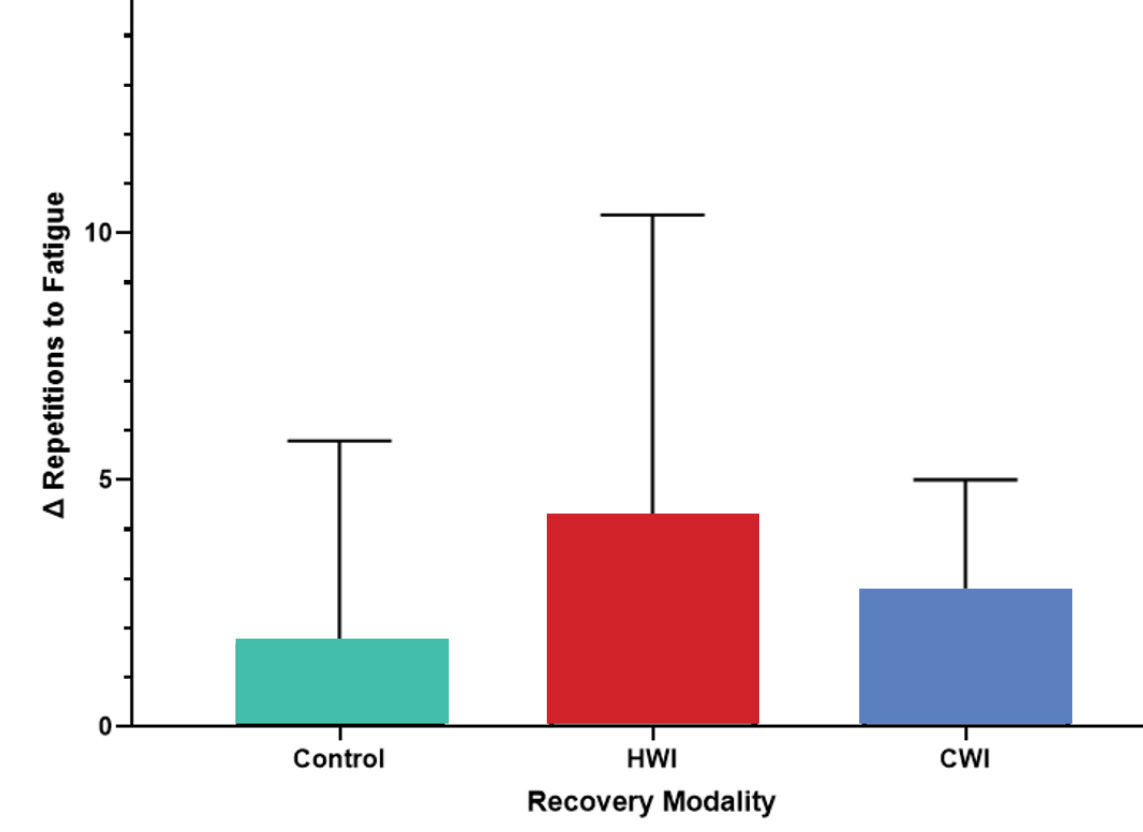
For this portion of the workout, the researchers were counting how many repetitions of the leg press each participant could perform at 80% of their 1-RM before reaching fatigue (i.e., “repetitions to fatigue”).
- Control: Repetitions to fatigue was 1.6 greater in session 2 than in session 1 (17.2 vs. 15.6), indicating improved performance.
- Hot-water immersion: Repetitions to fatigue was 4.2 greater in session 2 than in session 1 (21.9 vs. 17.7), indicating improved performance.
- Cold-water immersion: Repetitions to fatigue was 2.8 greater in session 2 than in session 1 (21.6 vs. 18.8), indicating improved performance.
While performance improved across all three conditions, only the improvement following hot-water immersion was statistically significant (Figure 3).
Figure 3. The change (Δ) in repetitions to fatigue on the leg press between exercise session and +24-hour exercise session across recovery conditions [control vs. hot-water immersion (HWI) vs. cold-water immersion (CWI)]
The Bottom Line
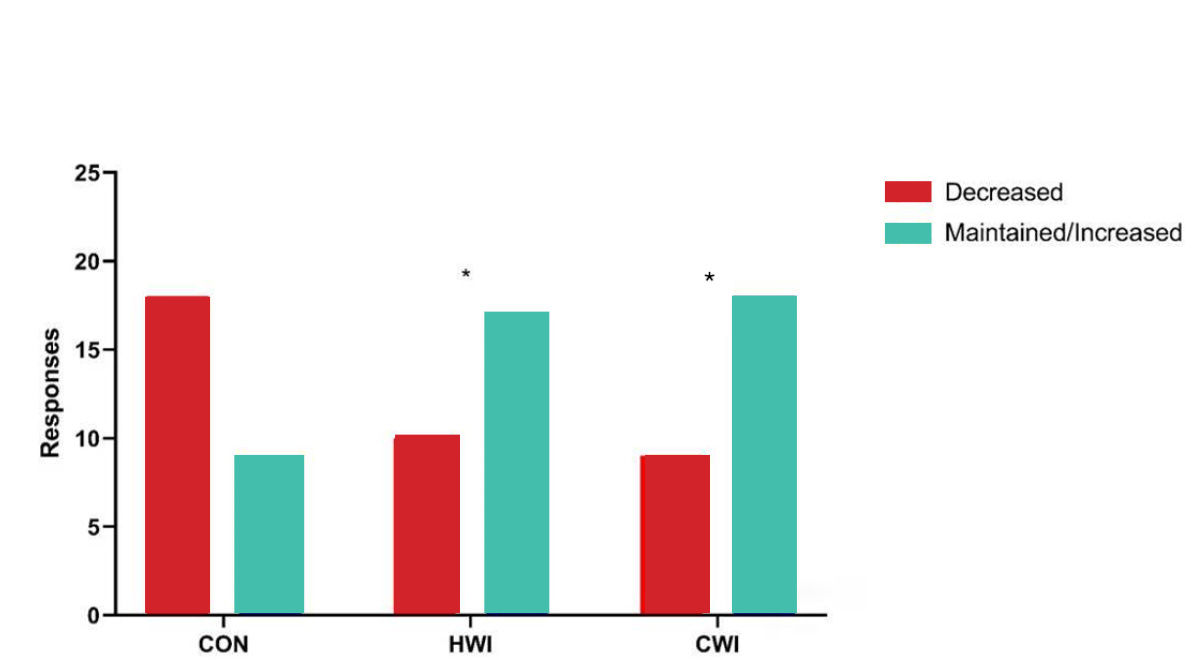
While the results of this study were primarily statistically insignificant, there was an interesting finding when looking at the likelihood of an individual maintaining or increasing their performance under each of the three conditions. Participants were about twice as likely to maintain or increase their performance following hot- or cold-water immersion than they were following passive recovery (i.e., the control). To be specific, following hot- and cold-water recovery, 63% and 67% of participants, respectively, exhibited maintained or increased performance, compared to only 33% of those in the control conditions (Figure 4).
Figure 4. The proportion of individuals who exhibited a positive change in exercise performance following either hot-water immersion (HWI) or cold-water immersion (CWI) was significantly greater than the proportion of those in the control group. * denotes p <0.05
What these findings tell us is that both strategies were effective in enhancing recovery and positively impacting subsequent performance. The fact that both cold- and hot-water immersion were effective will likely be welcome news for many of your clients, as they may have negative feelings or experiences with cold-water immersion, while the idea of a hot bath is soothing for most people.
It’s also important to note that the temperatures and durations used in this study were not extreme, as you can see in the following FITT recommendations, which were provided by the research team:
- Frequency: After each workout
- Intensity: 104° F (40° C) for hot-water immersion; 54° F (12° C) for cold-water immersion
- Time: 12 minutes
- Type: Both hot- and cold-water immersion were found to be safe and effective post-exercise recovery strategies.
Dr. Dalleck highlights that the 12-minute immersion sessions are something that health and exercise professionals can recommend to their clients—and that can be done at home in the bathtub. Importantly, the cold-water immersion is not an ice bath like you might see athletes doing post-competition and it’s certainly not your classic polar plunge. Cold tap water is around 60° F (16° C) in most places, so by adding ice or frozen water bottles, for example, clients can mimic the protocol used in this study.
The takeaway here is that both hot- and cold-water immersion provided adequate recovery and outperformed the passive recovery control following all three types of exercise. And, adhering to the FITT guidelines above does not require a hot tub or cold plunge at home, as the conditions can be easily replicated in the bathtub at home. This is all likely welcome news for clients who may think that more active forms of recovery are too time-consuming or expensive to add to their routines.



More Articles
- Certified™: June 2026
Better Choices, Better Health: How Exercise Supports Safer Decision-Making
- Certified™: June 2026
Stop Chasing Motivation: A Behavior-First Way to Build Exercise Adherence
Contributor
- Certified™: June 2026
Mix It Up: What New Research Suggests About Exercise Variety and Lifespan
Contributor
- Certified™: June 2026
How to Safely Use High-Intensity Interval Training With Older Adult Clients
Health and Fitness Expert