

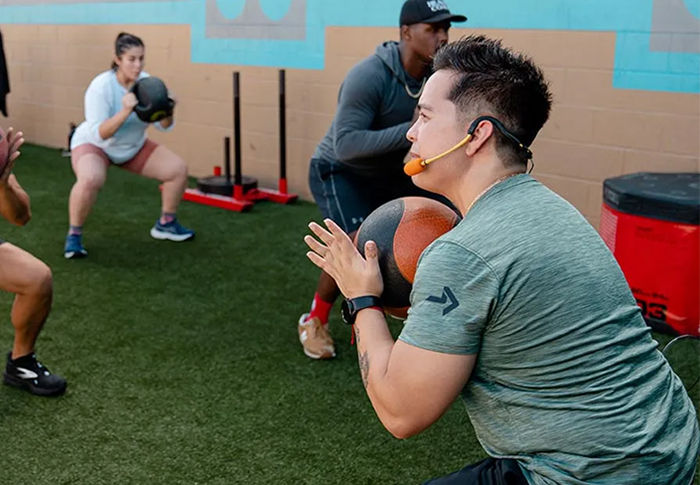





The ACE Workout Builder for Injury Prevention

Certified™: February 2026

Watch any sports analyst trying to predict whether a team is going to win the championship that season and you’ll hear them say the same thing every time: “Assuming they can stay healthy.” You can’t win the game if you can’t stay on the field, and the same holds true for long-term adherence to a physical-activity program. Staying injury-free is vital to continued participation.
Injury prevention is an often-overlooked component of exercise programming. Fortunately, exercises that support injury prevention can be seamlessly integrated into workouts without overhauling the program. In fact, in many cases it’s a matter of modifying existing exercises or simply calling attention to what the client is already doing so that they better understand the “why” behind the program and can focus their efforts. It’s all about building clients’ resilience so they can “stay on the field” and continue to pursue their physical activity–related goals.
Common Causes of Injury
From sprains and strains to Achilles tendinitis and shin splints, exercisers can experience a variety of common injuries. This article is not meant to imply that a particular exercise or workout can prevent any or all of these injuries. Instead, the idea is to better prepare the body for the rigors of exercise and to make sure each client’s body is ready to perform whatever tasks it is asked to do.

For example, if one of your clients plays in a weekend soccer league, you can design a program that prepares them for the demands of their sport (e.g., short sprints, quick changes in direction, cardiorespiratory endurance), and that not only improves fitness and performance but also helps prevent injuries. If another client is an older adult who wants to improve their ability to perform basic activities of daily living like climbing stairs and carrying groceries in from the car, the program should reflect and support those activities. As with all things fitness related, personalization of the program is essential.
There are several common causes of injury that can be addressed through exercise programming: lack of balance/proprioception, poor mobility, lack of stability, muscular imbalances, lack of muscular fitness and so on. Other contributors to injury risk include poor posture, repetitive stress, and dysfunction within any one of the ACE 7 Core Drivers of Healthy Living, so it’s important that you talk to each client about their lifestyle and behaviors outside the gym, as well, and then address what you learn through the collaborative exercise programming process.
Practical Programming Strategies
The goal of this article is to provide practical strategies for integrating injury-prevention exercises into your clients’ workouts without overcomplicating things. The first step in this process is a conversation with your client about injury prevention and why you’re including or modifying certain movements. Calling attention to injury prevention may cause your client to better understand the value of specific movements and exercises and perhaps enhance their focus.
The next step is to figure out how to layer the various elements described below into existing workouts without adding to the duration of the session. Let’s take a look at some practical strategies for integrating the various components that may help reduce your clients’ risk of injury.
Balance Training/Neuromotor Exercise:
- Improves proprioception, reduces fall risk and enhances joint stability
- Can be added to the warm-up, performed between strength-training sets, or achieved by modifying existing exercises to include balance challenges
- Sample exercises: single-leg stands or reaches, stability ball drills, and dynamic balance exercises like walking lunges with rotation and inverted flyers
Mobility Work:
- Maintains the range of uninhibited movement around a joint or body segment without compromising joint stability
- Can be included in the warm-up or cool-down
- Focus on the ankles, hips, thoracic spine and shoulders
- Sample exercises: hip openers (90/90 stretch), thoracic rotations, hip rotations, supine snow angels, and standing ankle mobilization drills
Stability Training:
Stability is the ability to maintain or control the movement or position of a joint. It is the combination of both stability and mobility that allows us to control our posture in different positions and to move efficiently.
- Includes core and joint stability
- Reduces strain and improves movement efficiency
- Can be paired with compound lifts or performed as accessory work to complement other core movements
- Sample exercises: planks (plank with knee drag, high plank T-spine rotation), anti-rotation drills (standing anti-rotation press, anti-rotation reverse lunge), glute activation (bridges, clamshells) and shoulder stability exercises (external rotation)
Strength and Movement Quality:
- Strong muscles protect joints by serving as shock absorbers and providing joint stability, while proper mechanics prevent overload.
- Emphasize alignment and proper breathing during exercises.
- Sample exercises: controlled tempo lifts and functional movement patterns (hinge, squat, push, pull), depending on what is determined to be functional for each client
Balanced Programming:
- Not to be confused with balance training, this involves ensuring that both sides of the body and opposing muscle groups are equally developed.
- Minimizes muscular imbalances by addressing all major muscle groups in all the directions in which they move
- A creative way to target opposing muscle groups is to use supersets, which target opposing muscle groups with little or no rest between sets.
- Sample exercise pairings include: chest press/bent-over row and seated leg extension/hamstrings curl
The Workout
Injury prevention doesn’t quite fit the mold of the other Workout Builder articles we’ve published here in CERTIFIED, as the idea here is to integrate the exercises or variations into clients’ existing workouts, not have them perform a standalone injury-prevention workout. That said, the ACE Workout Builder tool can be used to plan how you will accomplish that with each client.
In this example, we’ve used the Full-Body Workout (Body Area/Muscle Group) template. Step 1 is to fill out the following table with exercises a client can add to an existing exercise program to incorporate some of the strategies listed above. Then, before filling out the Full-body Workout table below, think about how you might introduce, pair with other exercises or modify some of those movements to further address the elements of injury prevention discussed in this article.
Exercise List
|
Upper Body |
Torso |
Lower Body |
||||
|
Chest |
Back |
Shoulders |
Arms |
Torso |
Hips |
Legs |
|
|
|
|||||
Full-Body Workout
|
Chest |
Back |
Shoulders |
Arms |
Torso |
Hips |
Legs |
|
Progress to |
Modify to TRX Single-arm row |
Superset |
Superset and |
Modify to |
Progress to |
Modify to |
|
Modify to |
Modify to |
Modify to |
Superset |
Modify to |
Perform between sets of |
Superset and |
|
Modify to |
|
|
|
|
Superset and |
|
Another option for layering in some of the elements mentioned above is to include them in a warm-up or cool-down. Here are some movements that can be integrated into both segments of a workout.
|
Downward-facing dog (shoulder and trunk stability) |
|
Bear crawl (shoulder mobility) |
|
Inverted flyers (balance and trunk stability) |
|
Sprinter pulls (balance) |
|
Spider walks (hip mobility) |
|
Prone runner (shoulder stability) |
|
Lateral crawl (shoulder and trunk stability) |
Conclusion
For athletes and casual exercisers alike, injury prevention is about more than “staying on the field.” It’s about having the ability to continue to pursue their health, fitness and performance goals without interruption. By integrating some of the exercises featured above—and don’t think you have to do this all at once—you can help clients improve their resilience while also improving their overall quality of life and well-being.
Nothing derails an exercise program like an injury, so encourage your clients to start thinking about injury prevention as a primary objective of their workout programs. Consistency is vital to success and staying injury-free means they can show up for themselves and the people they love every day as they work to develop healthy habits and keep moving forward.



More Articles
- Certified™: February 2026
Nutrition: A Core Driver of Healthy Living
- Certified™: February 2026
The Most Common Behavior-Change Traps (and How to Coach Through Them)
Contributor
- Certified™: February 2026
Menopause and Midlife Performance: What Endurance Athletes Want You to Know
Contributor