In an effort to help you more efficiently earn continuing education credits while you explore
CERTIFIED™, you can now take the quiz as you read. Get the latest, science-based information
while you earn 0.2 CECs.
Newly certified health coaches—like newcomers to just about any profession—are often struck by imposter syndrome. They question whether they know enough to be effective coaches and to guide their future clients to make lasting behavior change. Couple that with the need to become a businessperson and line up that first batch of clients and it’s easy to see how someone might get overwhelmed before they even get started.
The truth is, as an ACE Certified Health Coach, you already have the knowledge and skills needed to help people. And, as Amy Abell, NBC-HWC, ACE-CHC, Lead Master Instructor and Education Program Specialist at ACE, explains, you’re going to learn so much more along the way from your clients about health, behavior change, and their expectations about what a health coach does. Learning and growing together is part of the journey.
Abell explains that new coaches often get bogged down in thinking that they need to know more about nutrition, for example, before they can coach, and that can be a tremendous barrier at the outset. “You can’t possibly know everything there is to know before you get started, and that’s OK,” she says.
Abell’s advice? “Just start!”
This article maps out a week-by-week approach that will help you build confidence as you focus on a series of specific, doable steps. This timeline is not set in stone, so if you need to add a bit more time to achieve certain steps, that’s perfectly fine, but be sure to do so intentionally and remember to maintain accountability to yourself and your plan.
A Minimum Viable Coaching Business
Let’s explore the idea of what you need for a minimum viable coaching business—those things that are essential before you begin meeting with clients. Yes, branding, a logo, a welcome packet and a marketing plan are important, but they’re not all needed in the early days of your career.
Here is a checklist of must-haves before day 1:
A way for people to contact you: This could be a branded website, but it doesn’t have to be. It might just be a phone number or email address at first, or a way to contact you via social media.
A straightforward way to schedule sessions: There are coaching apps that could handle this for you, but you could get started by using the calendar in your phone.
A way to collect payment: An online platform or app is a great option, but Abell suggests coaches think about how their clients want to pay. Are you coaching college students or older adults? Different populations may have different preferences. If you are an ACE Certified Health Coach, you have access to YourCoach, a coaching business solution that can be used to accept payments, support accountability and track goal progress. For more information and to find your discount code, visit the ACE Pro Discounts section of your ACE account.
A way to record and securely store notes from coaching sessions: Be sure to have a password-protected system in place before meeting with your very first client.
A simple offer: This will likely evolve over time, but you could begin with pricing for a single session and a series of sessions. There’s no need to get fancy with curriculum development or long-term commitments.
A coaching agreement: Meeting with a legal professional to draft a coaching agreement tailored to you and your clients is vital.
Liability insurance: Even if you’re starting small, reducing the risk of liability is essential once you begin working with clients in any capacity. ACE offers discounted liability insurance for its certified pros.
Week 1: Building Your Foundation (and Your Confidence)
As you start out, focus on clarity, not perfection. Remember, the goal is to start coaching, not have your ideal business model established on day 1. Things will evolve over time as needed, but step 1 is to do the things necessary to get your coaching career jumpstarted.
Spend this first week working on the various elements of a “minimum viable coaching business” (see Sidebar). This will help you feel confident that you are ready not only from a coaching perspective, but also from a business perspective.
Abell suggests using your coaching skills in both planned and everyday conversations during this first week. This may include interactions with potential clients, but it could also involve chats with friends or family members where you use your skills to prompt meaningful conversation and build confidence.
Another good practice is to define the type of client you feel called to serve for now—no long-term niche decision required. Called an ideal client “avatar,” this should be viewed as a marketing tool, not something that limits your potential client pool, especially in these early days.
You may not be at the marketing stage just yet, but understanding yourself and your ideal client can help hone the language you use and clarify how you connect with people, Abell explains. Questions to ask yourself include: Who are you feeling called to help? How old are they? Seniors, parents with young children, working professionals? What are their genders? Where do they work? What does their free time look like? What are their primary health concerns?
You might also draft a simple personal mission statement or a one-paragraph “how I help” elevator pitch by outlining the types of service you will provide, the type of client you will serve and how you define success for your clients. Again, the idea here is not to start a big marketing campaign, but to spend time doing some deep thinking about how you see yourself as a coach.
Finally, on the last day of week 1, conduct a complimentary coaching session with a friend or family member and then solicit feedback to help you improve.
ACE Certified Professionals: Use the bar at the top of this page to access an exclusive bonus packet for this article, which includes a Guide to Starting a Health Coaching Business, an Ideal Client Avatar Worksheet and a Sample Coaching Agreement to help you clarify who you serve, set up essential business foundations and begin working with clients more confidently.
Week 2: Let the World Know You’re Coaching
“Shout it from the rooftops that you are starting your health coaching practice,” says Abell.
You might begin by brainstorming all the various circles of people you know or have known in your life, beyond your family and close friends. This might include former colleagues, childhood friends, friends from college, former teammates if you’ve played sports, etc. Of course, a great way to reach a lot of people is through social media.
Focus on small, authentic outreach by communicating about your new career. This should be about conversation, not promotion. Posting “I wanted to let everyone know that I recently became an ACE Certified Health Coach. I’m so excited to get started!” is a great way to let people know without being sales-y or jumping into a marketing voice. The goal here is to spread the word and build awareness. Another good practice is to include a small piece of advice or free content in your early social media posts so people see what kind of value you can bring.
Abell shares an experience from when she first got started as a health coach back in 2014. She created her first LinkedIn account, simply as another way to announce that she was opening her new practice. She had no experience on the platform and was reluctant to use it, thinking it probably wouldn’t be of much value. Within 30 days, a local fitness studio where she had previously been a member contacted her after seeing her profile, which led to a long-term contract as a health coach at that location.
Also, think about which social media platforms your “avatar” is likely using and let that guide your early efforts. You can’t be everywhere, so be strategic in where you decide to post. That said, LinkedIn should certainly be on your list as you work to build your business.
You might also think about attending some live events—from large trade shows to local health fairs—that will give you an opportunity to talk about what you do and connect with new people.
Finally, be sure to update your profile in your ACE account, which is a free service that allows people to find you using the Find an ACE Pro search tool.
The goal of week 2 is to become comfortable with visibility and with talking about what you have to offer as a health coach.
Week 3: Practice!
On the last day of week 1, you conducted a single coaching session. This week, set up a handful of complimentary coaching sessions with potential clients who fit your target demographic. After each session, ask the following questions:
How did it feel to work with me? What worked for you? What didn’t?
What can I do to make our work together more effective?
What changes would you like to make to how our sessions together are conducted?
What would you have wanted to understand better before embarking on a long-term coaching program with me?
You might also use a scaling question to have clients rate their session, then utilize follow-up questions to determine how you might be able to raise that score in the future. These questions show clients that you value their input, consider them partners and want to understand and address their concerns as you grow in this partnership.
Abell also suggests creating a “beta rate” package for these practice clients. You could offer a discounted rate for a limited time or a limited number of participants in exchange for testimonials and feedback.
The goal of week 3 is to build confidence in your skills, gather information from clients and create a repeatable process for intake and follow-up that you can use as you grow.
Week 4: Create a Simple Signature Offer
Time to get down to business, literally. You’ve reflected on what you want to be as a health coach and what type of clients you’d like to work with, you’ve completed the minimum viable coaching business checklist, you’ve conducted practice sessions and you’ve evaluated the feedback you received from those clients. It’s time to build off all that insight and get started.
A lot of new health coaches find it tough to have conversations about money with new clients, so it’s important to have a “beta mindset” early in your journey, with an understanding that you, your clients and the services you provide can and should evolve over time. Nothing you do now is set in stone, but you can draft starter offers for your initial clients. This might include a certain number of sessions or a timeframe during which you’ll be working together, plus any add-ons, like coaching resources or progress check-ins.
Then, figure out how you’re going to promote that offer. You might try emailing or calling your potential clients and be prepared with a follow-up script or message that keeps that initial conversation going.
Abell also recommends hosting a “grand opening” event, either virtually or in-person, that might include a presentation on a health-related topic or a discussion of what a health coach can do for their clients, a Q & A session, and some healthy snacks. You might also draft a press release or newsletter to email potential clients, networking partners or local, like-minded businesses.
The goal of week 4 is to create a basic offer, put it in front of potential clients, and then… “Just start.”
Final Thoughts
You can think of starting a business as similar to how you might tell your clients to approach their goals. You wouldn’t tell them to wait to become more physically active until they can commit to walking 150 minutes per week, or to wait to change their diet only when they’re able to commit to a seven-days-a-week meal plan. No, you would encourage them to get started by doing what they can do now—to start small and grow from there. That same approach can be applied at the beginning of your health coaching journey.
By the end of this 30-day launch plan, you will have announced your business, practiced with real clients, set up a viable coaching business, built your confidence, created your first offers, taken small and sustainable steps to begin your journey and, ultimately, started your coaching practice. Congratulations!
Abell offers one last piece of advice that builds on the theme of “just starting”: Keep going! What you’ll accomplish over this 30-day launch should set you off on a path toward success, but it’s essential that you adapt and modify your business and your approach to coaching as you learn lessons and gather more knowledge and skills. There may be times when you struggle, when you don’t feel like drafting any social media posts or don’t have the number of clients you’re hoping for. In those moments, remind yourself, “keep going!” There is tremendous power in perseverance and in showing up for your clients and for yourself every day.
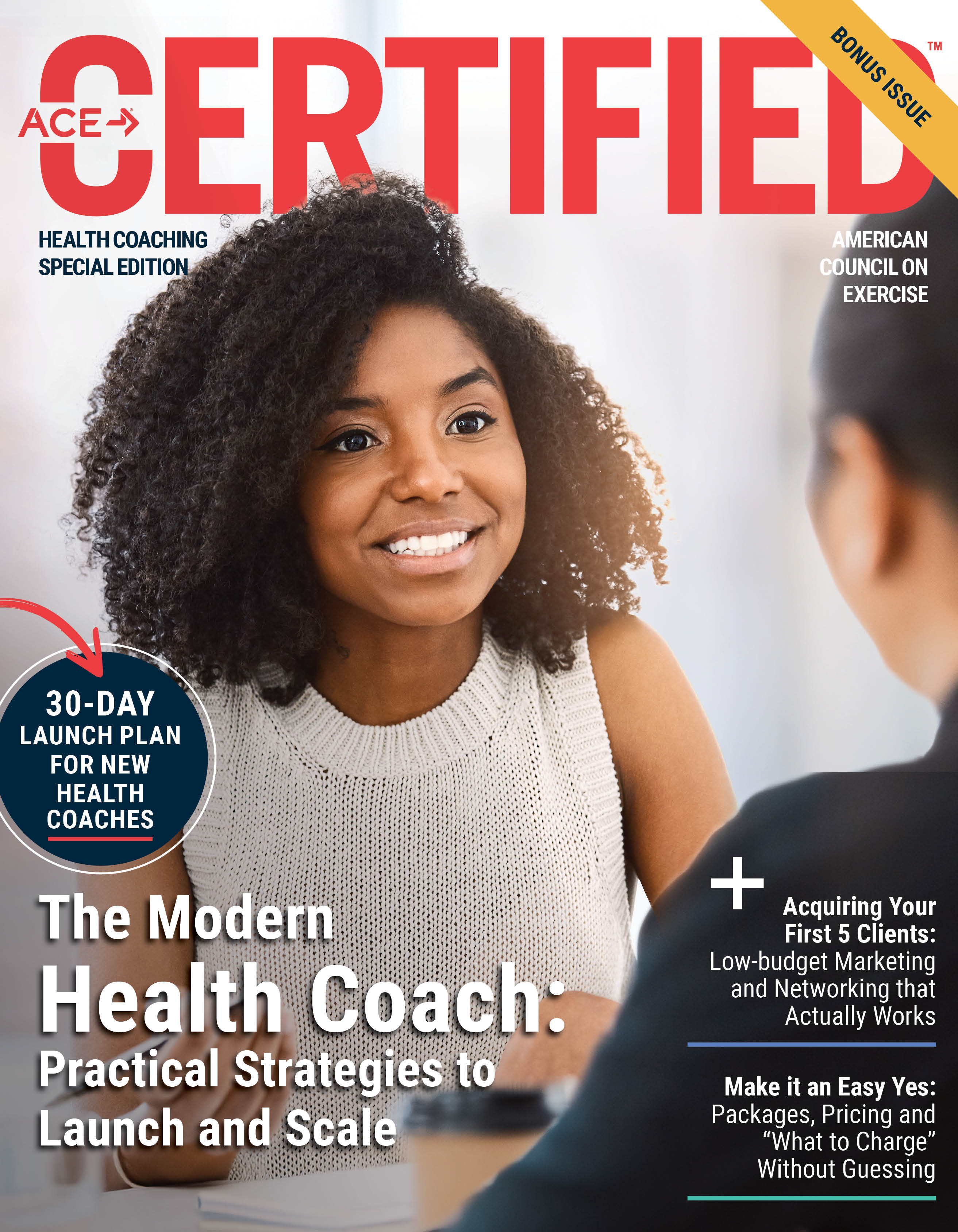
CERTIFIED™ is a free online monthly publication from ACE designed to equip certified fitness professionals and health professionals alike with the knowledge they need to continue growing.
Author
Daniel J. Green
Contributor
Daniel J. Green is ACE’s Senior Project Manager and Editor for Publications and Content Development. In addition to his work with organizations including the International Association of Fire Fighters and Agriculture Future of America, Daniel writes an ongoing blog series covering lifestyle change for NBCbetter.com. He has also written feature articles for local publications in Western North Carolina (WNC), including WNC Parent and WNC Magazine.
In an effort to help you more efficiently earn continuing education credits while you explore
CERTIFIED™, you can now take the quiz as you read. Get the latest, science-based information
while you earn 0.2 CECs.
Sign up to receive CERTIFIED™
CERTIFIED™ is a free online monthly publication from ACE designed to equip certified fitness professionals and health professionals alike with the knowledge they need to continue growing.







 by
by