The biggest obstacle facing many newly certified health coaches is getting over the fear of talking to people about what they do and the value of their health coaching services. In fact, many new coaches report feeling paralyzed by the thought of approaching an individual to deliver their “elevator pitch,” and say that answering the question, “What does a health coach do?” in a way that sparks genuine interest in coaching is easier said than done. Not to mention, coaches face the awkward moment of hearing, “Thanks, but no thanks,” in response to their impassioned pitch.
These concerns often leave coaches feeling overwhelmed, confused and stuck for long periods of time in the space between certification and the successful launch of their health-coaching businesses. Overcoming these obstacles to confidently and consistently introduce yourself and what you do is essential for landing your first paying clients and building a sustainable practice.
Fortunately, you have a deep toolbox of evidence-supported skills that can be mobilized to market yourself in a way that feels aligned with who you are and the value you bring as a health coach. The 5-step framework outlined in this article offers a flexible plan and approach for replacing the one-sided elevator pitch with an interactive, person-centered “engagement conversation.”
Leveraging the transformational qualities of your coaching skillset to offer a compelling “taste” of the coaching experience will create greater visibility and understanding of the work you do, spark quality relationships that build your network, and increase the likelihood that interactions with your target population will lead to long-term coaching relationships.
Leveraging the Power of Engagement
When Denise Mark, MPH, NBC-HWC, pivoted from working as a health coach in a corporate workplace setting to launching her solo coaching practice, she recognized the opportunity to lean into her coaching skillset to both navigate the newness of marketing and successfully engage the overwhelmed, early-stage changers she enjoys working with most. “I love talking to people about what is important to them about their health, and it is something I feel confident doing,” she shares. “Knowing I could invite people into conversations where they would be the focus made marketing myself less intimidating. I also experienced how these interactions seemed more comfortable and enjoyable for both me and the person I was talking to.”
Mark is describing the skill of “engagement,” defined by William Miller and Stephen Rollnick in their book, Motivational Interviewing: Helping People Change and Grow, 4th Edition, as "the process of establishing a mutually trusting relationship.” The skill of engagement uses coaching presence, curiosity and active listening to create an environment of safety and trust when talking to people about health behavior change. According to Jennifer Frey, PhD, and Ali Hall, JD, authors of Motivational Interviewing for Mental Health Clinicians, there is an added benefit to engagement related to these interactions and a coach's role as a partner and guide. “People who are engaged and activated are more willing, able and ready to invest in their own health promoting actions…they are also more likely to see us as allies in their change process.”
Mark’s experience highlights why engagement can feel both natural and energizing for coaches—and the research suggests it deserves a more intentional place in your marketing efforts. Unlike “pitching” your coaching services, engaging individuals who may be a good fit for what you have to offer feels like a warm invitation to talk about what is important to them and how you are positioned to help. It also allows you to frame the value of your services within the unique context of the person’s life, increasing the chances your offer resonates on a deeper level.
The Anatomy of an Engagement Conversation
Facilitating engagement conversations is as easy as leaning into the micro-skills (OARS) to demonstrate curiosity, coaching presence and empathic listening. Curious open-ended questions that pull for change talk are especially powerful. Research shows that people who are talking about change in a positive way are, in fact, talking themselves into changing. Here are some examples of effective inquiries:
- “What would your life be like if you were able to make this change?”
- “Tell me what is important to you about your health and well-being.”
- “Tell me about a time when things were working well in your life and wellness.”
Directionality, toward what is important and good in a person’s life, can inspire hope and increase motivation to embrace the change process.
The Power of Listening
Reflective listening is an essential skill in engagement conversations that can immediately foster a sense of connection. As people share a small part of their wellness story, reflections like, “It hasn’t been easy for you to find time for your own health,” and “You’d like to get to the gym more often, but getting started has felt difficult,” demonstrate empathy and a genuine desire to understand the person’s situation. Listening well in engagement conversations lays the foundation upon which trust, rapport and relationship can build over time.
Elevating Importance and Positioning Coaching as a “Painkiller”
Strategic adjustments to open-ended questions can elevate importance around a particular health desire or need, nudging readiness to change. Simply adding the word “now” to your inquiries such as, “What would be the outcome if you had support to better manage your diabetes now?” or “What is standing out to you right now as an area of your health you wish you could change?” heightens urgency, enabling you to position the coaching partnership as a path to getting what they want sooner than later.
You can also explore and clarify the individual’s obstacles and barriers to well-being. Known in marketing circles as “pain points,” people are often willing to invest in products they perceive as “painkillers.” Exploring, acknowledging and addressing their unique struggles ensures the interaction feels personal and allows you to create a powerful case for coaching as a “need to have” instead of a “nice to have.”
Stop Pitching and Start Engaging
Mark describes how this engagement approach has led to positive results, including embracing every outcome as a win. “Recently, I had two discovery calls with potential clients that felt successful. One led to a new client and the other to a positive discussion about referrals and permission to check in.” With potential clients who seem like a good fit but are a “maybe” or “no” for now, asking permission to follow up offers an opportunity to continue nurturing the relationship and demonstrating your value over time.
Craft Your Coach Introduction
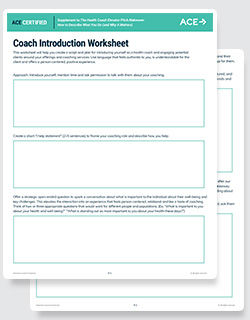
Now you are ready to craft your coach introduction using the Coach Introduction Worksheet, which you can download and print from the box on the right. The template will guide you to find language that feels authentic to you, is relatable to your target audience and leads to a positive, person-centered interaction. ACE Certified Professionals also have exclusive access to a Coach Introduction Sample Script, which can be downloaded by clicking on the bar at the top of this page. And be sure to check out the sidebar, “Coach Speak vs. Real Speak,” for ideas on translating familiar coaching terminology into language that resonates with populations outside the coaching profession. Using relatable language is key to building trust and rapport and meeting people where they are in their wellness journey.
It is important to use relatable language when engaging people in conversations around behavior change and the value of coaching. Think about your target population and what words and phrases would feel understandable, inviting and relatable. Avoid using terminology that may sound fun to you but turn your listener off.
|
“Coach” Speak
|
“Real” Speak
|
|
Alliance
Co-create
Wellness vision
Sustainable change
Evidence-based
Accountability
SMART goals
Flourishing/thriving
|
Partnership
Work together
Explore what is important to you
Healthy choices that stick
Supported by science
Stay committed
Intentions
Living your best life
|
A 5-Step Framework for Meaningful Engagement
Step #1: Approach
Approaching an individual and opening a conversation should feel like a warm invitation to talk. Asking permission, mentioning time and making a brief statement about your purpose honors the individual’s autonomy to engage or not, and can help both parties relax into the interaction.
Sounds like:
Coach Meg: Hi, Laura. I’m excited to share that I just became a certified health and wellness coach! I’d love to tell you a little bit about what I do and how I help support people to live a healthy lifestyle. Do you have a couple of minutes to talk?
Laura: Sure. I gotta say, I don’t have a lot of time for a healthy lifestyle these days.
Coach Meg: I get it! Sometimes taking care of yourself can feel like just one more thing to add to an already packed to-do list. That’s where coaching comes in. Actually, I love helping busy moms like you carve out time in their day to make themselves a priority.
Step #2: Ask an open-ended question
Offering an open-ended question early in the conversation shifts the interaction from a one-sided pitch into a person-centered dialogue. It is where the “taste” of the coaching experience begins. A curious question sparks thinking and self-exploration, which are essential to the behavior-change process, especially for people in the early stages who lack awareness around what is important to them and how to get started with their desired health behaviors.
Sounds like:
Coach Meg: I’m curious, Laura, what stands out to you right now as most important in your life and wellness?
Laura: Honestly, I rarely have time to give it much thought with all that’s going on at work and at home. I guess if I had to name something, I probably should be exercising more. I’ve really fallen off going to the gym, and as much as I don’t love the gym, I like how I feel afterwards.
Step #3: Listen actively
As highlighted earlier, the role of active listening in engagement conversations cannot be overstated. Listening strengthens engagement and fosters a sense of shared connection. More so, when people feel heard, understood and validated, they feel capable and open to the possibility of change.
During engagement conversations, listening goes beyond its role in coaching. You also listen intentionally to identify the individual’s desires, values and motivators, along with their most compelling pain points. Listening for statements like, “I won’t,” “I might,” “I will” and “I can” help you identify their stage of readiness. This ensures you avoid misaligning your value proposition by using intimidating words like “goals” and “accountability” when talking to people who are in earlier stages of change.
Sounds like:
Coach Meg: You’re juggling a lot with all the hats you wear in your life. Making yourself a priority is naturally the first thing to go. It sounds like getting away to the gym is something that helps you…if you could only figure out how to make it happen for yourself.
Step #4: Offer your value proposition
This dialogue provides insightful details or “golden threads” about the person’s life that enable you to strategically structure and personalize your coaching offer. Your value proposition is where you share brief details about how health coaching works and, more importantly, how your work together will alleviate painful obstacles and lead to desired outcomes. Here are a few tips for articulating an effective value proposition:
- Include language, ideas and “golden threads” shared by your client. This demonstrates listening, strengthens trust and rapport, and makes your offer feel personalized.
- Use “you”-focused language such as, “At the end of the program, you will be making healthier choices more consistently,” to enhance the person-centered feel of the interaction.
- Include phrases like “We will partner together,” “I am here to guide and support,” “You are the expert,” and “You know what’s best for you.” Motivational interviewing recognizes partnership language and autonomy support as integral to the behavior change process.
- Prioritize painting a hopeful picture of the destination over providing details of your coaching program. This will avoid overwhelming the individual and maintain the positive energy of engagement.
Sounds like:
Coach Meg: Feeling strong and capable are gamechangers for you and you also want to be a good mom to your kids. That’s how coaching can help. Just like you support others, it is about feeling that same support for yourself. If we were to work together, we’d partner to identify your bigger vision for what well-being could look and feel like in your life. We could make exercise a key focus, and coaching is also about exploring how all the dimensions of health, like sleep, nutrition and even things like social support, come together in living your best life. After working together for a few weeks, you will be amazed to find yourself making healthy choices that are more aligned with your values, including feeling empowered around your time and priorities.
Step #5: Ask for a takeaway
Pivoting the attention back to the individual by asking for their takeaway often facilitates what is known in coaching as a “generative moment.” A few short minutes of self-exploration can lead to powerful new insights and levels of awareness that elevate a person’s need and desire to change. At the very least, it is an opportunity for them to restate and reinforce what stood out as important to them and for you to strengthen and acknowledge their insights in return.
Sounds like:
Coach Meg: Thank you for sharing your story, Laura. I appreciate your openness. I’m curious, what’s something that stands out to you after our conversation?
Laura: I guess I am realizing that I feel better when I move more and how I probably need to figure out how to move myself up on my list of important things to take care of.
Coach Meg: That’s it! It might be fun for you to explore that idea more in the week ahead and see what you find. I appreciate our conversation and would love to follow up and check in to see how you’re doing. Would that be O.K.? I also have a fun monthly newsletter that might keep your thinking going. I’d love to add you to my email list.
Yes, No, Maybe So
Language in their takeaway often sends signals about their interest in coaching. It is important to recognize that people say “no” for a variety of reasons unrelated to you or the nature of your services. “I may” or “I might” indicate an opportunity to add them to your email list and begin a cycle of intentional follow-up. Of course, “I will” becomes an exciting acknowledgement that you and the potential client are a good fit, triggering the first steps in your client onboarding process.
10 Tips for Strengthening Your Engagement Muscle
There’s no doubt stepping into your professional identity and introducing yourself as a certified health coach feels scary and overwhelming in the beginning. Much like a muscle, you can strengthen your ability to guide impactful engagement conversations with consistent practice, repetition and gradual movement beyond your comfort zone. These 10 tips will help you develop a plan for consistent, deliberate practice.
- Embrace an “engagement” mindset. Let go of the pressure to “pitch” the value of your coaching services. Instead, seek to engage people in authentic and meaningful conversations around their health and well-being.
- Set a weekly goal for inviting people into engagement conversations. Commit to creating opportunities to practice and improve your coach introduction by proactively reaching out to three or more people each week with a warm invitation to talk.
- Begin in your comfort zone with colleagues, friends and family members. People you know are often willing to help. Feeling their support can ease the anxiety of talking to new people as you work to gain confidence and improve your skills.
- Give yourself permission to be bad. Getting over the need to be “good” or “perfect” can help you embrace a growth mentality, take risks with your approach and have more fun practicing this skill.
- Enter engagement conversations with the spirit of genuine curiosity. Curiosity is your secret weapon against the common jitters experienced when approaching new people. Set an intention to demonstrate genuine interest in exploring the individual’s experience.
- Seek honest and specific feedback. Encouragement feels good, but specific feedback is necessary to improve your skills. Ask the individual to identify one strength and one area for improvement to increase the effectiveness of your approach.
- Focus on process over outcome. Remove the burden of “landing the sale” when articulating your value proposition. Practice incorporating “golden threads” that personalize your offer, finding language that resonates with people and unapologetically articulating your “ask.”
- Reflect, revise, repeat. Spend time reflecting on your experience after each engagement conversation. What went well? Where did you experience feelings of flow and connection? What felt clunky or out of alignment? What did you learn about the individual’s interest or lack of interest in coaching? Use all your experiences as data to revise and elevate your approach next time around.
- Track your progress. Create personal metrics around your efforts to ensure consistent practice and accountability. You can track metrics such as the number of engagement conversations you have each week, the number of times you offered your value proposition and the number of engagements that led to longer discovery calls.
- Move beyond your comfort zone. Challenge yourself to move beyond your colleagues and friends to engage people with whom you are less familiar, even when you don’t feel ready. While the first few interactions may feel intimidating, each success makes you stronger and more confident in your process.
Embrace the Energy of Engagement
Angela Nedeff, RN, NBC-HWC, shares an epiphany she had as she worked to build her coaching practice supporting individuals who work in healthcare settings. “The conversations I have with people are where the rubber meets the road in my business,” she explains. “I realized that I needed to stop hiding behind my computer and social media presence and literally put myself out into the world where people could see and interact with me and what I have to offer.”
Nedeff’s “aha” moment is one you can embrace as you seek to increase your visibility and people’s understanding about your role and the value of health coaching. The 5-step framework for engagement conversations invites you to move beyond the traditional elevator pitch and lean into the meaningful impact of your coaching skillset, helping you effectively communicate the power of the coaching relationship. After all, actions speak louder than words.








 by
by