







The ACE 7 Core Drivers of Healthy Living: Physical Activity as a Starting Point
Certified™: January 2026

“Getting healthy” means something different to everyone. For one client, it may mean losing weight to manage type 2 diabetes or relieve knee pain. For another, it might involve improving function as they grow older. Or quitting vaping. Or getting more rest and being less stressed. Or feeling better connected with the people in their lives. As a health coach or exercise professional, your role is to help clients uncover what “healthy living” means to them and empower them to make behavior changes that support their goals.
What many clients don’t realize is that the behaviors that drive health—movement, nutrition, sleep, stress management, connection and more—are deeply interconnected. This realization can be a light-bulb moment for some clients.
For example, when people establish a regular exercise routine, they tend to want to start eating more healthfully to support their efforts. They may sleep better after a day that includes a tough resistance-training session. They may take a weekend hike with friends to reconnect, clear their mind and ease their stress. They may quit smoking to improve their relationship with their spouse or drink less alcohol as a way to cut calories.
One good habit can lead to the next, which is great news and makes intuitive sense. But, when you consider the complexity of health and fitness, it can be tough to know where to start with each client.
The ACE 7 Core Drivers of Healthy LivingTM is a framework we created to help you and your clients better understand those lifestyle behaviors that support overall health and well-being. Perhaps more importantly, this framework offers a practical guide that can help clients make meaningful, lasting lifestyle changes.
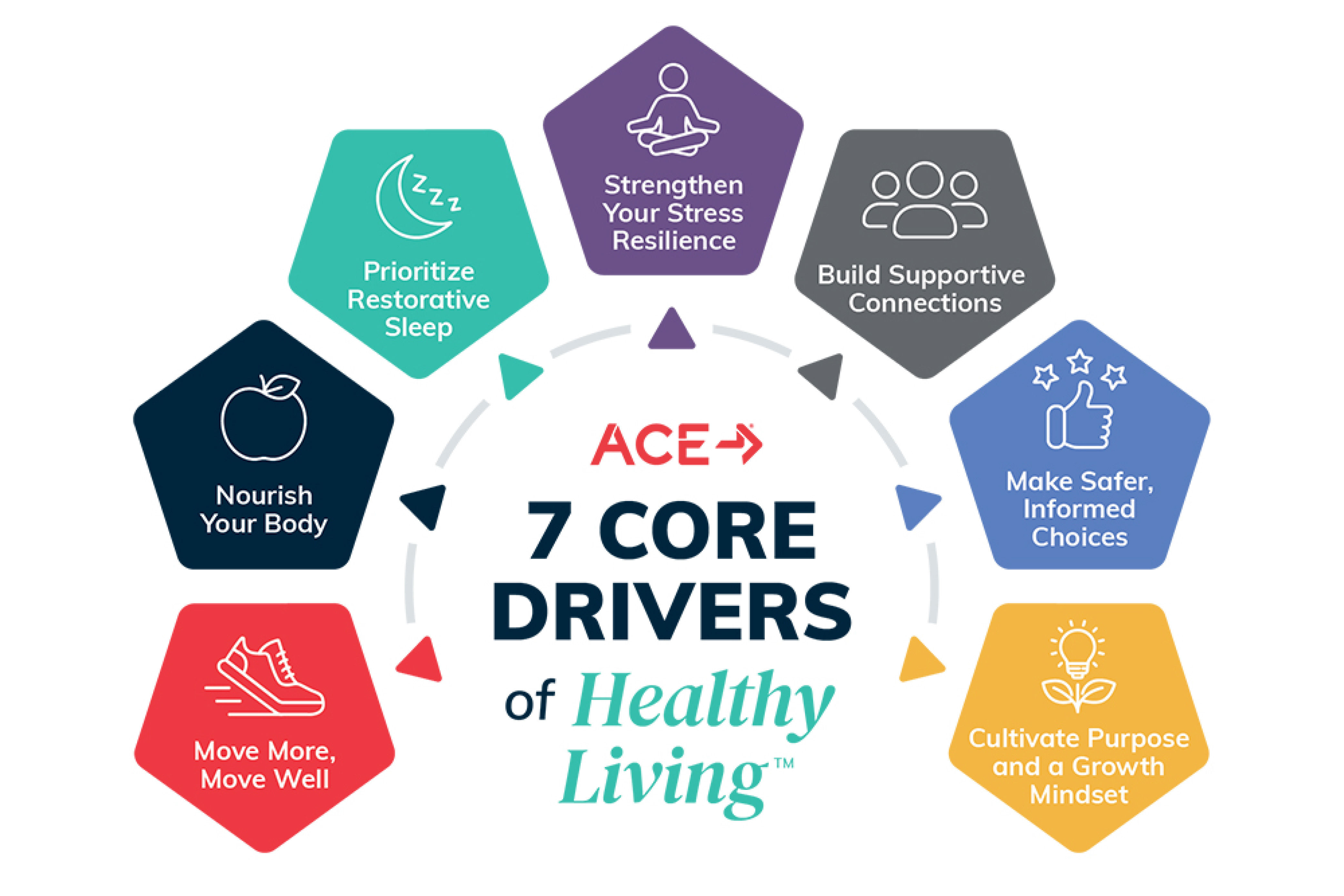
The ACE 7 Core Drivers of Healthy Living
1. Move More, Move Well – Engage in regular physical activity and exercise that supports strength, mobility and long-term vitality.
2. Nourish Your Body – Choose balanced, healthy nutrition patterns that fuel daily living and overall well-being.
3. Prioritize Restorative Sleep – Get quality sleep that promotes recovery, cognitive function, emotional balance and immune health.
4. Strengthen Your Stress Resilience – Use effective coping skills and strategies that support emotional well-being and adaptability.
5. Build Supportive Connections – Cultivate positive relationships, community and belonging that enhance motivation and health.
6. Make Safer, Informed Choices – Make decisions that reduce health risks and promote long-term well-being.
7. Cultivate Purpose and a Growth Mindset – Clarify personal purpose and values, and foster a mindset that supports consistency, resilience and lasting behavior change.
Importantly, these behaviors are not isolated boxes to check. Instead, they are interconnected, often overlap and help people adapt, recover and thrive.
What actually drives consistent exercise habits--and what makes people fall off track? In this video, ACE Senior Director of Science and Education Sabrena Jo breaks down the core drivers behind long-term health and well-being. You'll learn how to identify what's really motivating someone, what's getting in the way, and how to turn that insight into small, realistic next steps that build momentum.
As a health and exercise professional, understanding how to make practical use of these drivers is vital because most clients don’t struggle with changing behavior due to a lack of knowledge—rather, it’s usually because life is complicated. When you consider the broader context of being active, sleep habits, eating patterns, stress, relationships and the choices people make around substance use or other risks, you can deliver coaching that is more compassionate, personalized and effective.
Physical Activity as a Starting Point
Physical activity holds a unique place among these drivers, as it both influences and is strengthened by the others. Movement enhances sleep quality, reduces stress, strengthens social bonds, supports healthy nutrition and encourages behaviors that protect long-term health and can help people find purpose and a sense of personal growth. At the same time, the ability to move and be active depends on adequate rest, proper nourishment, effective stress management, meaningful relationships and balanced lifestyle choices.
By engaging in the lifestyle behaviors represented by all seven core drivers, individuals build adaptability and resilience—qualities that help them navigate life’s ongoing changes. ACE embraces an inclusive view of health and well-being, recognizing that people of all ages, backgrounds, abilities and life circumstances can thrive when these drivers work together in ways that reflect and honor their unique experiences and goals.
The ACE Perspective on Healthy Living
ACE views healthy living as the result of seven core drivers—how we move, eat, sleep, manage stress, connect with others, make informed choices, and cultivate purpose and a growth mindset, all of which interact dynamically to support long-term behavior change.
Talking to Your Clients About the Core Drivers
It’s important that you don’t get overwhelmed—or allow your clients to get overwhelmed—by the breadth of the seven drivers. No one is living perfectly across all seven behaviors, or even within the confines of each one. None of us make the right choice or display optimal behavior at all times, as even the most committed among us sometimes skip workouts, indulge on holiday treats, stay up late watching movies and so on. Long-term success with behavior change often means making the best choice you can as often as you can.
It’s all about meeting clients where they are. The drivers offer a full menu of health-supporting behaviors, but you don’t need to serve them all at once. Introduce the concept in very simple language, then ask clients which area feels most doable right now. Check out the ACE Mover Method example at the end of this article to see how this conversation might unfold.
Some clients are ready to focus on physical activity; others are exhausted and need help improving sleep before thinking about workouts. You’ll know where to start when a client expresses confidence, motivation and curiosity about a particular change. That’s where you’ll get momentum.
Start by simply asking curious, non-judgmental questions. Instead of telling clients what they “should” be doing, invite them to share how they’re currently sleeping, eating, moving, managing stress and connecting with others. Many people have the answers within them and just need space to reflect.
From there, you can help clients identify one small, realistic behavior they feel confident trying. Often, one tiny step opens the door to meaningful change.
Why Physical Activity Is Key
There is a reason why we chose to begin our discussion of the core drivers by exploring physical activity.
Physical activity is often a keystone habit—a single behavior that triggers positive changes in multiple areas of life. Moving your body can improve sleep quality, reduce feelings of stress, support healthy eating choices, strengthen social bonds, increase motivation for other healthy behaviors and help you find purpose.
In behavioral science, we call this coaction: when adopting one healthy behavior increases the likelihood of adopting another during the same time period. When physical activity and exercise become a habit, a certain amount of self-regulation is required, which then may carry over to controlled eating. Self-regulation theory suggests that if individuals practice reframing negative self-talk, anticipate and plan for “slip-ups,” document short-term goals and track their progress, those skills will become more robust and transfer more effectively from one context (e.g., exercise) to another (e.g., controlled eating).
Physical activity is a powerful starting point for long-term change. It boosts confidence, creates small wins and helps people feel better quickly. That emotional payoff encourages continued effort.
For many clients, getting healthier starts with getting moving.
The Evidence to Reframe the Conversation About Physical Activity
Physical activity and exercise are often discussed as means to burn calories and lose weight, but the evidence tells us that there is much more at play. The benefits of regular physical activity are seemingly endless, including contributing to the prevention and management of noncommunicable diseases, reducing symptoms of depression and anxiety, enhancing brain health and improving overall well-being. Of course, most clients don’t need to be sold on the idea of becoming more active, as we all know what we should be doing. What clients don’t often realize, however, is the additional behavior change–related benefits that physical activity can unlock.
For example, research shows that as few as three moderate-intensity exercise sessions are associated with significant reductions in depression, anxiety and fatigue in adults with obesity. When measured and tracked, this is not only reinforcing to most people in terms of adherence, but it also helps reduce the problem of emotional eating. In addition, the positive changes in mood that occur immediately after exercise can impact exercise adherence, which in turn can impact the other six core drivers of healthy living.
The question of how much physical activity a client needs can be answered only after a thorough discussion of their goals, abilities, time constraints and so on. The Physical Activity Guidelines for Americans tell us that to achieve substantial health benefits, adults should do at least 150 minutes of moderate-intensity cardiorespiratory exercise, 75 minutes of vigorous-intensity cardiorespiratory exercise or an equivalent combination of the two, along with muscle-strengthening activities on at least two days each week. However, that may not be possible for some clients and may not align with their goals or needs.
The good news is that while attaining 150 minutes of weekly physical activity is a laudable goal, far less movement is associated with substantial impacts on anxiety and depression, which, again, may translate into improvements in other drivers.
The takeaway here is that physical activity, while clearly an essential element of a healthy lifestyle, may be equally valuable as a gateway behavior that makes other lifestyle changes easier. Physical activity not only improves health on its own, but also increases the likelihood of success in other areas.
| One more thing: If you’re an ACE Certified Professional, we’ve created a really helpful worksheet for you to use with your clients. Together with your client, you’ll pick a starting point from a menu of options based on how important each activity is to the client, as well as their goals, interests, values and level of confidence. Working together on this should feel like a meaningful conversation between you and your client. You can access this bonus tool by clicking on the bar at the top of this page. |
Final Thoughts
One of the most important things to communicate, especially in fitness and health coaching settings, is that clients do not need perfection to benefit. The seven core drivers are about progress, not pressure, and about building sustainable habits rooted in self-care.
Small, realistic steps matter. A 10-minute walk, a vegetable at one meal, a consistent bedtime or connecting with a friend can make a measurable difference. When coaches, trainers and clients celebrate those wins, people feel more capable, and that feeling of capability, or self-efficacy, is one of the strongest predictors of long-term adherence.
If there is one message we hope readers take away, it’s this: Healthy living isn’t about doing everything at once. Rather, it’s about stacking self-selected, achievable behaviors that help people feel better, function better and enjoy their lives more. For many clients, becoming more physically active may be a powerful place to start.
Discussing the 7 Core Drivers With a Client
When beginning a behavior-change journey, clients often feel overwhelmed about how to get started. Health coaches and exercise professionals can use the ACE Mover Method and ACE ABC Approach to help clients find the clarity, confidence and motivation to take steps in the right direction. [Be sure to check out that link if you’re not familiar with the ACE Mover Method and ACE ABC Approach.]
In the following scenario, the client expresses a clear, yet non-specific long-term objective of becoming healthier and the exercise professional or health coach supports them in navigating the possible ways to accomplish their objective.
Scenario: You have recently begun working with a 50-year-old client who would like to become fitter and healthier as they get older. The client tells you that they have not prioritized their health in a long time, but concerns about poor health and illness have become more real as they watch their parents get older and face various health challenges.
Professional: What would you like to talk about today?
Client: I am interested in becoming healthier and taking steps to improve my overall quality of life now and in the future. To be honest, though, I am not sure where to begin. I know there are many things I could do differently but the thought of getting started feels overwhelming.
Professional: Improving your health and taking steps to improve your quality of life is important to you but getting started is overwhelming. What would help make getting started feel less intimidating?
Client: Well, it seems like my life is all out of sorts when it comes to my health and when I think about all the things I need to do to improve my quality of life, I get stuck and make no progress. I think that once I can get the ball rolling in the right direction it will be easier for me to change the way I am living. I really need help in simplifying everything that goes into being healthier and deciding where to begin. Is this something you can help me with?
Professional: Yes. Thank you for sharing with me more about the way you are feeling. Providing clarity and direction will help you to get moving in the right direction. I have a resource for you that breaks down what the American Council on Exercise calls the core drivers of healthy living that we can use to narrow your focus. Is that something you would be interested in?
Client: Yes. That sounds like a good way to keep things simple and not overcomplicate everything, which I definitely tend to do. I would really like to look at the resource you have and walk through it together.
Professional: Great! First, let’s talk a little bit about the seven core drivers and how they work together. The seven drivers are move more, move well; nourish your body; prioritize restorative sleep; strengthen your resilience; build supportive connections; make safer, informed choices; and cultivate purpose and a growth mindset. That seems like a lot, I’m sure, but please don’t think that you need to dive into all seven areas at once. It’s up to you to decide which of those feels most important and doable at the moment. The good news is, changing behaviors in one area can make it easier to do so in the others once you’re ready.
We can also use this resource to help you decide on a course of action. Let’s get started!
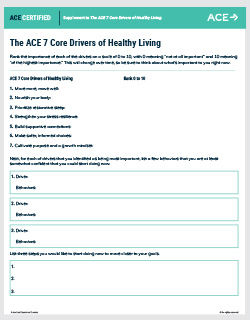
Please note that this client’s responses have been filled in. You can access a blank PDF to use with clients by clicking on the image in the sidebar on the right side of this page.
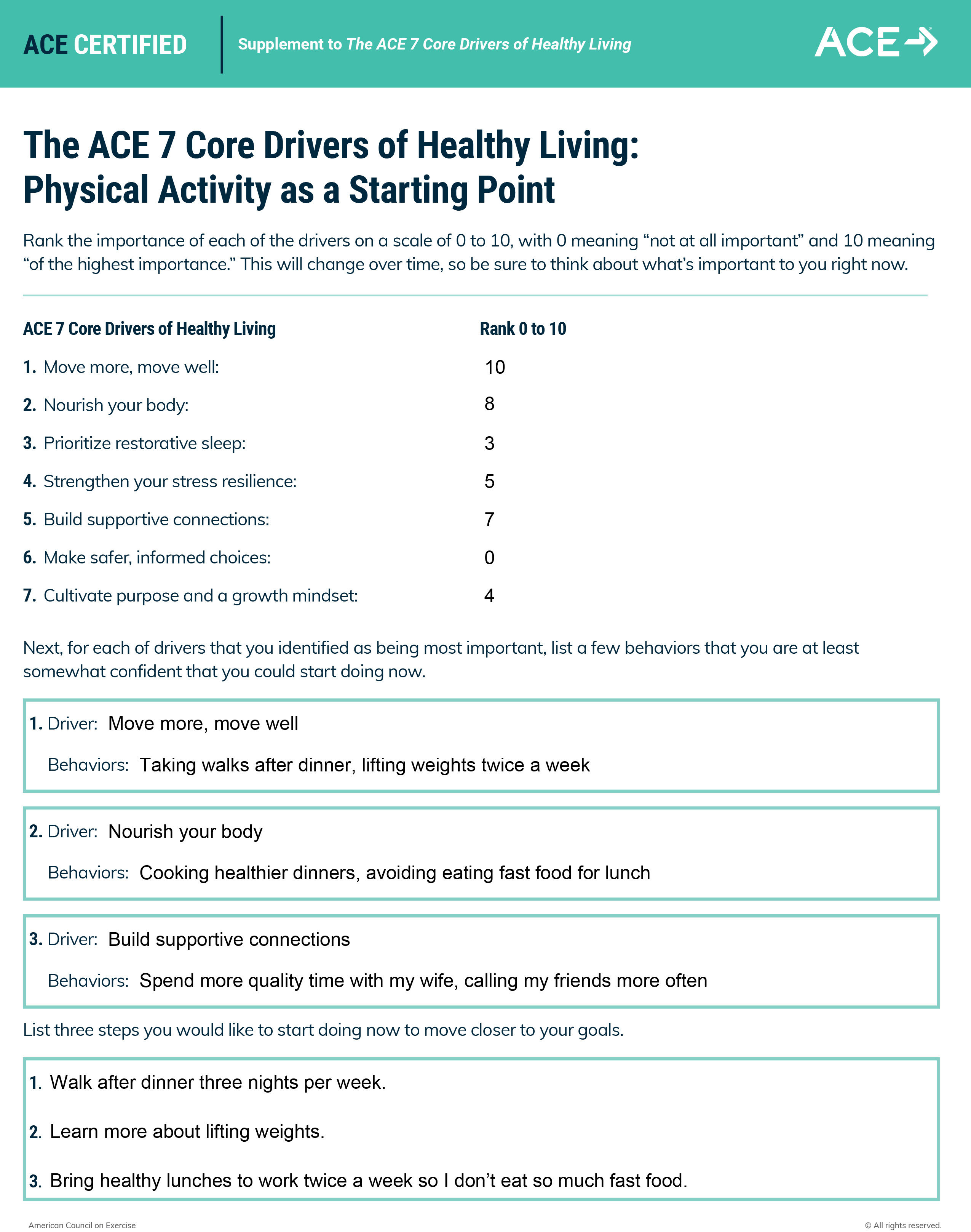
Professional: Great job with the form. Once you get started, I think you’ll find it interesting how the drivers start to support and intersect with one another. For example, you may find yourself more motivated to eat healthy lunches to support your workouts. And, you can use those evening walks as opportunities to reconnect with your wife and possibly relieve some stress.
Client: That was helpful to think about a healthy lifestyle being driven by core behaviors. Because of the challenges I am having with getting started, I want to begin with one at a time. The area of most importance and confidence for me right now is physical activity, so I’d like to map out a plan to start walking more and to learn about resistance training.
Professional: Fantastic! While continuing to keep things simple and thinking about how you may have been successful in the past with similar goals, what do you need to start doing to move closer to your goal?
Client: Great question. I have tried goals in the past related to getting more exercise, but nothing really stuck. I will talk to my wife about taking walks after dinner, as I’ve learned that I’m not great about doing it on my own. And, can we use our next session to put together a resistance-training program? I don’t know anything about lifting weights but would love to learn.
Professional: Sure thing, we can use our next session to teach you about weight training and create a simple workout to get you started. It seems that you’ve learned a lot from your previous experiences. What do you think your next steps are?
Client: I think I should be realistic and think about what feels possible now. Step 1 will be talking to my wife about walking a few nights each week. I’m confident she’ll be on board, and I think three nights a week is doable. Then, I’ll get started on that weight-lifting program. I’m pretty excited about that!


More Articles
- Certified™: January 2026
More Muscle, Less Guesswork: Smarter Training for Better Gains
Health and Fitness Expert
- Certified™: January 2026
Ask ACE: Sound Advice or a Social-Media Trend? Your Nutrition Questions Answered
Health and Fitness Expert