







Prioritizing Restorative Sleep: The Foundation for Recovery, Resilience and Movement
Certified™: March 2026

Restorative sleep is not a luxury or a passive state of “turning off.” It is an active, essential biological process that supports nearly every system in the body, including musculoskeletal recovery, metabolic regulation, cognitive performance, emotional balance and immune health. Yet, in our always-on culture, sleep is often one of the first health behaviors sacrificed in response to busy schedules, chronic stress and competing demands.
Within the ACE 7 Core Drivers of Healthy LivingTM, prioritizing restorative sleep is recognized as a key driver of health and well-being. Sleep does not operate in isolation; rather, it is deeply interconnected with how individuals move, eat, manage stress, connect with others, make informed lifestyle choices, and cultivate purpose and mindset. Among these drivers, physical activity shares one of the strongest and most reciprocal relationships with sleep. Regular movement supports better sleep quality, while adequate sleep enhances the ability to engage in consistent, high-quality physical activity and exercise.
“Sleep is a physiological necessity,” explains Christopher E. Kline, PhD, FACSM, FAHA, Associate Professor in the Department of Health and Human Development at the University of Pittsburgh, “and neglecting or deprioritizing sleep makes maintaining other healthy behaviors (e.g., exercising, consuming a healthy diet) much more difficult.”
As a health and exercise professional, understanding this bidirectional relationship makes it possible for you to design programs and deliver education that support sustainable, whole-person behavior change.
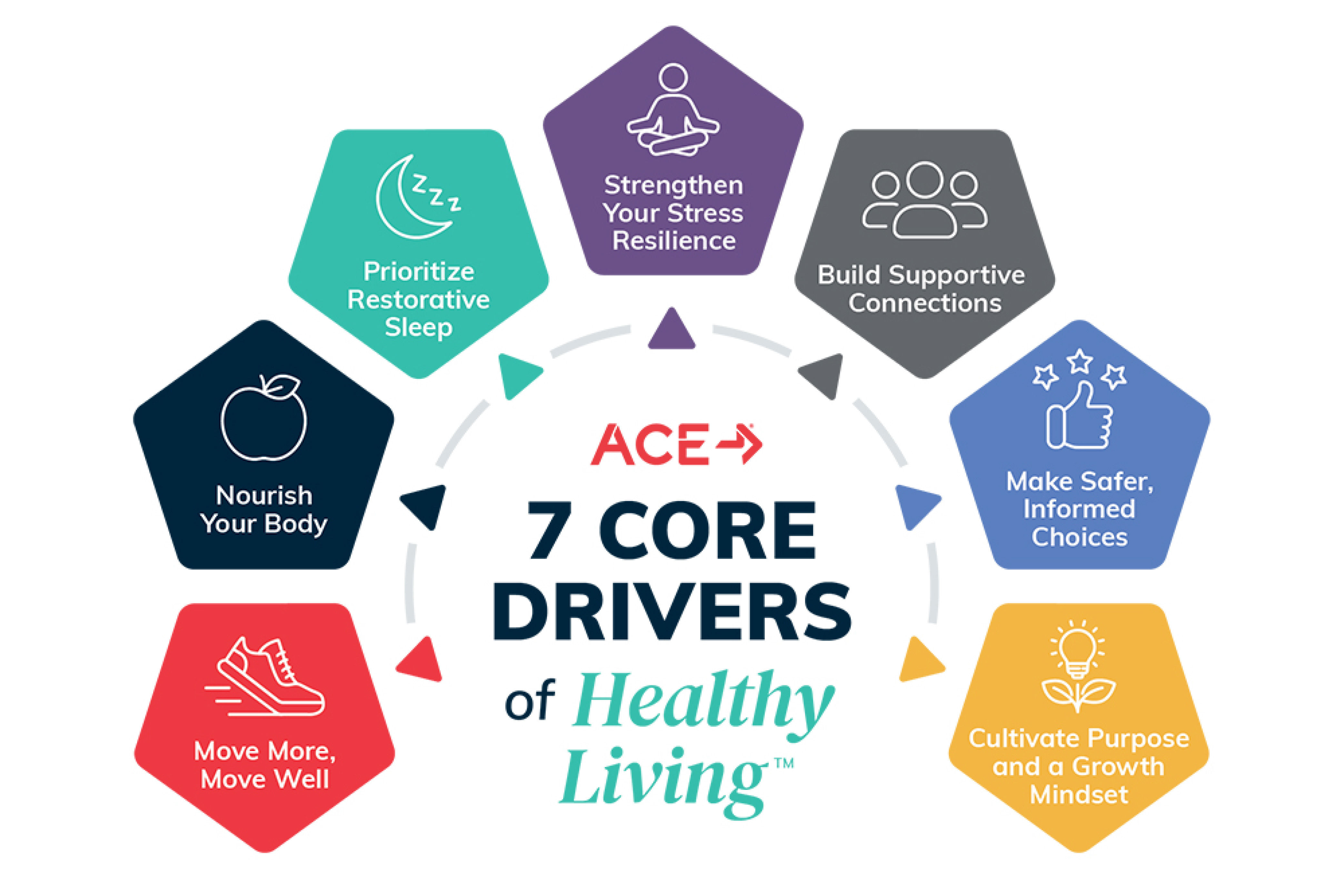
ACE 7 Core Drivers of Healthy Living
1. Move More, Move Well – Engage in regular physical activity and exercise that supports strength, mobility and long-term vitality.
2. Nourish Your Body – Choose balanced, healthy nutrition patterns that fuel daily living and overall well-being.
3. Prioritize Restorative Sleep – Get quality sleep that promotes recovery, cognitive function, emotional balance and immune health.
4. Strengthen Your Stress Resilience – Use effective coping skills and strategies that support emotional well-being and adaptability.
5. Build Supportive Connections – Cultivate positive relationships and a sense of community that enhance motivation and health.
6. Make Safer, Informed Choices – Make decisions that reduce health risks and promote long-term well-being.
7. Cultivate Purpose and a Growth Mindset – Clarify personal purpose and values, and foster a mindset that supports consistency, resilience and lasting behavior change.
Each of the four remaining ACE 7 Core Drivers of Healthy Living will be covered in upcoming issues of CERTIFIED, with strengthening your stress resilience coming up next in April. From there, we will work through the 7 Core Drivers in order, culminating with an article on how to help clients cultivate purpose and a growth mindset. The goal is to provide evidence-based, yet practical strategies that you can use with clients to improve their health and well-being.
What Is Restorative Sleep?
Restorative sleep refers to both the quantity and quality of sleep needed to support recovery and optimal functioning. While individual sleep needs vary, most adults require between seven and nine hours of sleep per night to maintain physical and cognitive health.
Key characteristics of restorative sleep include:
- Adequate sleep duration
- Consistent sleep and wake times
- Sufficient time spent in slow-wave and rapid eye movement (REM) sleep
- Minimal nighttime awakenings
- Waking up feeling refreshed and satisfied with sleep
- Sleeping at times aligned with the internal body clock (i.e., sleeping at night rather than during the daylight hours)
- Sustained alertness throughout the day
During sleep, the body prioritizes critical processes such as muscle tissue repair, glycogen replenishment, hormone regulation, neural consolidation and immune system maintenance. When restorative sleep is insufficient, these processes are compromised, increasing vulnerability to injury, illness, emotional dysregulation and chronic disease.
The Health Consequences of Poor Sleep
Chronic sleep deprivation and poor sleep health (e.g., irregular or inconsistent sleep schedules) are associated with a wide range of adverse outcomes, including impaired attention, reduced executive function, mood disturbances, metabolic dysregulation, weakened immune response and decreased physical performance.
From a behavioral perspective, insufficient sleep often initiates a negative feedback loop. Fatigue reduces motivation and self-regulation, making it more difficult to engage in physical activity. Reduced physical activity can further disrupt sleep quality, while heightened stress and emotional strain compound the cycle. Breaking this pattern often requires an integrated approach that addresses sleep, movement and stress simultaneously rather than in isolation.
According to research published by Dr. Kline, who is also a faculty member at the Center for Sleep and Circadian Science at the University of Pittsburgh, people who have poor sleep health or untreated sleep apnea and are trying to follow a behavioral intervention for weight loss are less likely to lose as much weight as people who get better sleep.
Dr. Kline also encourages health and exercise professionals to normalize the idea that everyone experiences an occasional night of disrupted sleep and to discourage overreaction. “A single night of poor sleep,” he explains, “is highly unlikely to have catastrophic health consequences.”
The ACE Perspective on Healthy Living
ACE views healthy living as the result of seven core drivers—how we move, eat, sleep, manage stress, connect with others, make informed choices, and cultivate purpose and a growth mindset, all of which interact dynamically to support long-term behavior change.
Physical Activity as a Support for Better Sleep
One of the lifestyle factors most consistently associated with improved sleep is regular physical activity. Meta-analytic and longitudinal research shows that individuals who are more physically active tend to fall asleep faster, experience longer and deeper sleep, and report higher overall sleep quality than their less active peers. Importantly, these benefits are observed across age groups and fitness levels, and even modest increases in activity can lead to meaningful improvements in sleep, particularly among previously inactive individuals.
Mechanisms Linking Exercise to Sleep
Physical activity supports sleep through multiple physiological and psychological mechanisms:
- Increased sleep drive: Exercise increases energy expenditure, strengthening the drive/need to sleep and facilitating sleep onset.
- Circadian rhythm regulation: Daytime physical activity, especially when performed outdoors, reinforces circadian signaling and promotes more stable sleep–wake cycles.
- Thermoregulation: Post-exercise reductions in core body temperature mimic the natural pre-sleep temperature decline, signaling readiness for sleep, when exercise is performed in the afternoon or evening.
- Stress reduction: Exercise reduces sympathetic nervous system activity and enhances parasympathetic recovery, lowering physiological arousal at bedtime.
- Mood enhancement: Regular movement is associated with reductions in anxiety and depressive symptoms, both of which are strongly linked to sleep disturbances.
Does Exercise Timing Matter?
A common concern is that exercising too close to bedtime may impair sleep. However, contemporary evidence suggests that the relationship between exercise timing and sleep is highly individual and context-dependent, with no consensus “best” time to exercise for optimizing sleep. Systematic reviews indicate that moderate-intensity exercise performed at various times of day does not negatively affect sleep for most individuals and may even improve sleep quality. Vigorous exercise performed late in the evening may delay sleep onset for some individuals, particularly if it significantly elevates heart rate or core body temperature, and may actually impair sleep in some people who are poor sleepers or who have insomnia. Others, however, experience no adverse effects. Rather than applying rigid rules, encourage your clients to observe how their own sleep responds to different exercise timing and adjust accordingly.
How Sleep Supports Physical Activity and Exercise
Just as physical activity supports sleep, restorative sleep is essential for maintaining consistent, high-quality movement and exercise.
Physical Performance and Recovery
Adequate sleep supports muscle protein synthesis, tissue repair, glycogen restoration, hormonal balance and neuromuscular coordination. When sleep is restricted, individuals experience declines in strength, endurance, reaction time and perceived exertion. In addition, recovery from training is slower, increasing the risk of injury and overtraining.
Motivation, Self-Regulation and Adherence
Sleep plays a critical role in self-regulation, which involves the ability to plan, initiate and sustain behavior. Insufficient sleep impairs executive function and increases perceived effort, making exercise feel more difficult and less rewarding. As a result, clients who are chronically sleep-deprived may struggle with exercise adherence, even when motivation and knowledge are present. Supporting sleep, therefore, becomes a powerful strategy for enhancing long-term consistency with physical activity.
Emotional Balance, Stress and the Sleep–Exercise Connection
Stress is one of the most common disruptors of sleep, and sleep loss amplifies emotional reactivity and stress sensitivity. Physical activity helps buffer stress responses by reducing baseline cortisol levels and improving emotional resilience. In turn, adequate sleep enhances emotional regulation, cognitive flexibility and coping capacity, making it easier for individuals to manage daily stressors without abandoning healthy routines. Within the ACE 7 Core Drivers of Healthy Living framework, strengthening stress resilience, prioritizing restorative sleep and moving more function as mutually reinforcing drivers.
Immune Health and Inflammation
Sleep and physical activity both play critical roles in immune function. During sleep, the body increases the production of cytokines involved in immune defense and tissue repair. Chronic sleep loss is associated with systemic inflammation and impaired immune responses. Regular physical activity complements these effects by improving immune surveillance and reducing chronic low-grade inflammation. On the other hand, insufficient sleep can blunt the immune benefits of exercise, highlighting the importance of balance between training and recovery.
Practical Strategies for Health Coaches and Exercise Professionals
As a health and exercise professional, you play a critical role in helping clients prioritize sleep. This is achieved not by acting as sleep clinicians, but by integrating sleep-supportive behaviors into coaching, client education and programming. The following six steps provide a foundation for addressing sleep as a core driver of healthy living:
- Normalize sleep as a performance and health behavior, framing it as essential for recovery, resilience and progress.
- Build awareness by encouraging clients to reflect on sleep duration, consistency and daytime energy.
- Use physical activity strategically as a tool for improving sleep, particularly through consistent moderate-intensity movement.
- Promote consistency over perfection, emphasizing small, realistic changes rather than rigid rules.
- Help clients see the connections among better sleep, improved workouts, faster recovery and enhanced motivation.
- Encourage clients to schedule sleep as part of their daily routines to enable them to plan ahead and establish a regular bedtime.
“The ironic thing about sleep is the harder you try to fall asleep, the less likely that will occur," explains Dr. Kline. "I often will tell people that they need to do what they can to ‘set the stage’ for restful sleep—but once they lie down with the intention of sleeping, they don’t have much voluntary control. It’s very much akin to the sports mantra of ‘controlling the controllables’—and, for sleep, that would entail prioritizing a stable sleep time from night to night, exercising each day, seeking out bright light in the morning and avoiding bright light in the evening, finding ways to minimize stress, especially in the hours leading up to sleep (e.g., yoga, relaxation, deep breathing), and optimizing the sleep environment (dark room, cool temperature, white noise, comfortable bedding).”
Progress, Not Pressure
A central message of the ACE 7 Core Drivers framework is that healthy living is about progress, not perfection. No one sleeps optimally every night, just as no one trains perfectly or manages stress flawlessly.
Encouraging adaptability, self-compassion and curiosity helps clients avoid all-or-nothing thinking. When sleep is disrupted—as it inevitably will be—clients can learn to adapt rather than disengage.
| One more thing: If you’re an ACE Certified Professional, we’ve created a helpful worksheet for you to use with your clients. Together with your client, you’ll pick an activity from a sleep menu of options based on how important each activity is to the client, as well as their goals, interests, values and level of confidence. Working together on this should feel like a meaningful conversation between you and your client. You can access this bonus tool by clicking on the bar at the top of this page. |
Conclusion: Restorative Sleep Supports Healthy Living
Restorative sleep is a cornerstone of health, influencing recovery, cognition, emotional balance, immune function and physical performance. Its relationship with physical activity is deeply reciprocal: regular movement supports better sleep, and adequate sleep enables better movement.
Within the ACE 7 Core Drivers of Healthy Living, prioritizing restorative sleep is not about adding another task to an already full to-do list. It is about recognizing sleep as a foundational behavior that makes other healthy choices more accessible.
For many individuals, improving sleep begins with small, supportive shifts—often starting with regular physical activity. When these drivers work together, individuals build resilience, adaptability and a healthier relationship with their bodies and their lives.
The ACE Perspective on Healthy Living



More Articles
- Certified™: March 2026
How to Design Balance Exercise Programs for Older Adults
Contributor
- Certified™: March 2026
Stop Counting, Start Coaching: 4 Simple Nutrition Upgrades for Clients
Health and Fitness Expert
- Certified™: March 2026
The No-Pressure Marketing Plan: Earn Clients by Sharing What You Know
Contributor