Every January, people promise that this will be the year they finally get healthy. Your clients buy new planners, sign up for challenges and map out detailed workout and nutrition plans. Yet by February, many of those same clients feel discouraged, “off track” and ready to give up—convinced that if they can’t do it perfectly, it’s not worth doing at all.
If that pattern sounds familiar, perfectionism may be at work. A perfectionistic mindset doesn’t just raise the bar; it turns every small misstep into proof of failure and every missed workout into a reason to abandon the goal altogether. As a health and exercise professional, you’ve probably seen this all-or-nothing thinking derail even your most motivated clients—and you may recognize it in yourself, too.
This article will help you spot the different faces of perfectionism, understand how they show up in health and fitness settings and learn strategies to coach clients—and yourself—toward progress rather than “perfection.”
What’s Wrong With Being a Perfectionist?
While what you consider perfect may be different from someone else’s idea of perfection, Andrew Hill, PhD, Associate Pro Vice Chancelor for Research at York St. John University in York, England, defines perfectionism as “the perceived or actual need to be perfect. It typically manifests in striving toward unrealistic standards and harsh self-evaluative tendencies, like self-criticism.”
Hill notes that perfectionism is more than just a behavior. “It is a way of thinking about yourself and the world, especially in regard to what you think you must accomplish in order to feel like you are a worthwhile person.”
In a study published in The Journal of Personality and Social Psychology, study authors Hewitt and Flett categorize perfectionism into three types: self-oriented perfectionism, other-oriented perfectionism and socially prescribed perfectionism. The authors found that self-oriented perfectionism, which involves having unrealistic standards for oneself, was associated with “various indices of maladjustment,” including anxiety, anorexia nervosa and self-blame. Conversely, other-oriented perfectionism involves having unrealistic standards for significant others and led to “other-directed blame, lack of trust and feelings of hostility toward others.” Finally, people with socially prescribed perfectionism often believe they have to live up to others’ expectations and standards, which the authors cite has a wide range of associated negative emotions, including anger, anxiety and depression.
“The other-oriented perfectionist is often the ‘devil’s advocate,’” says Petra Kolber, author of The Perfection Detox and an award-winning exercise professional. “They’re great at pointing fingers at other people and their work, but not really good at offering solutions. Oftentimes, [people with perfectionistic tendencies] who are other-oriented have very low self-esteem and dodge any accountability.”
Thanks to social media and other external influences, socially prescribed perfectionism now has a nearly constant spotlight. It’s no longer just a comment from a parent, teacher or boss; it’s an endless scroll of “perfect” bodies, workouts, meals and morning routines. Algorithms make it easy for clients to compare themselves not just to their neighbors, but to carefully curated strangers who seem to be doing it all flawlessly. The message many clients absorb is, “Everyone else is nailing it—what’s wrong with me?” Recent public health advisories have raised similar concerns about how social media may contribute to anxiety, depression and body-image concerns, especially among young people.
Over time, this can shift health from a personal, values-driven pursuit into a performance. A workout isn’t just about how it feels in their body; it’s about whether it looks good on their watch app or in a post. When “wellness” is treated like a project to be showcased, every missed workout, higher heart rate or imperfect food choice can feel like evidence of failure instead of a normal part of being human.
Even in cultures that seemingly place high value on hard work and high-performance outcomes, Hill finds it difficult to see any upside to perfectionism. “There are upsides to working hard and having high standards, but you can have these without being perfectionistic,” argues Hill.
This is more than just an opinion—Hill and his colleague Thomas Curran documented it. In a large, widely cited meta-analysis of more than 41,000 college students, they found that three types of perfectionism—self-oriented, socially prescribed and other-oriented perfectionism—have all increased steadily since the late 1980s. Today’s young adults, they concluded, are more likely than previous generations to believe they must be perfect, that others expect perfection from them and that other people should be perfect as well.
While the data set ends in 2016, the pattern feels familiar to anyone working with clients now. For example, you may have clients who arrive to their sessions exhausted by “achievement culture”—chasing high incomes and flawless grades, ideal bodies, impressive workouts and so-called “clean” diets—while struggling with anxiety, depression and burnout. For clients who aim for perfection, health and fitness goals can become one more arena where they fear falling short.
The High Cost of Perfectionism
Additional studies suggest there aren’t many benefits to being a perfectionist. From stress and burnout to exhaustion, depression and anxiety, perfectionism doesn’t yield many positive benefits.
“Perfectionism is associated with a long list of negative problems,” suggests Hill, “mental health issues being the most severe. For most people with perfectionistic tendencies, we are likely to be harsh on ourselves and others, have difficulty enjoying our lives and, paradoxically, not be as successful as we might be, [because people who are perfectionists tend to] procrastinate and have difficulty dealing with setbacks.”
These patterns don’t just show up in clinical settings; they show up in day-to-day life and work. Clients who struggle with perfectionism often report feeling “never off duty,” constantly thinking about what they should be doing for their health, careers or families. This chronic self-monitoring is linked with higher rates of burnout, sleep problems and low mood. Ironically, the harder they push to “get it right,” the more drained and discouraged they feel—and the less energy they have left for movement, recovery and self-care.
For health and exercise professionals, it’s helpful to remember that what looks like a simple lack of follow-through on the surface may actually be a perfectionism-driven coping pattern underneath. Christine Clarke, chief pharmacist at Cottage Hospital in Woodsville, N.H., and a martial arts instructor, is a prime example of how an intelligent, successful professional can be sidelined by perfectionism. “My need to feel and do every exercise or meal plan ‘perfectly’ pretty much sucks the fun out of every program I do. When that happens, my progress usually ends right there. There is a lot of head work involved in trying to slay the perfection demons—too much sometimes. Self-esteem? I don’t have any of that—never did.”
Do Ms. Clarke’s words sound familiar? As a health and exercise professional, you have undoubtedly encountered clients who abandon their efforts to improve their health after their first slip-up, their first missed class or workout, their first indulgence or deviation from their “ideal” diet. People who chase perfectionism tend to be all-or-nothing in their thinking. For example, how many times have your clients not exercised on their own because they didn’t have time for a "full" workout? If they didn't have time for all of it, they don’t do any of it (even though you’ve assured them that every little bit counts).
Learning to Be Perfectly Imperfect
There are many ways you, as a health and exercise professional, can help your clients ease off the path of perfectionism. Changing your language is a good place to start.
One simple antidote to all-or-nothing thinking is to co-create “minimum effective dose” habits. Instead of a perfect 60-minute workout five days a week, you might help a client define their “bare minimum” on a busy day: a 10-minute walk, three strength exercises, or a short mobility routine between meetings. For the client who tends to skip a workout entirely if they can’t do the full plan, having a small, doable option keeps the behavior—and their sense of self-trust—alive.
When you celebrate these tiny wins just as enthusiastically as the big ones, you model a different definition of success: showing up consistently, not checking every box perfectly.
Another powerful tool is self-compassion. Perfectionistic clients often believe they need harsh self-talk to stay motivated, yet that same inner critic leaves them feeling hopeless when they inevitably fall short. You can gently challenge this by asking, “If a close friend were in your situation, would you speak to them the way you speak to yourself?” Then invite them to practice a kinder inner response: “This is hard, and it makes sense that I’m struggling. What’s one small step I can take next?” Over time, this shift from self-attack to self-support can increase resilience and make it easier to restart after setbacks.
“We have to look at our language,” urges Kolber, “and look at what types of goals we’re [encouraging our clients to set]. I think often, without realizing it, we make the body the definition of success, which is more toxic fuel for perfection. Remove words that reward outcome and replace them with words that reward effort. Ask different questions that imply fitness is a tool for creating a magnificent life versus a tool for carving a perfect body.”
People who have perfectionistic tendencies tend to want to be in control. At the heart of control is fear—and fear of failure is a common fear associated with perfectionism. To help clients overcome this fear, take them through a worst-case scenario exercise. For example:
Coach: “If you were to fail at completing your 5K, what would happen?”
Client: “I’d be embarrassed.”
Coach: “And if you’re embarrassed, what then?”
Client: “Well, I couldn't face my coworkers who all knew I was running it.”
Coach: “If you can’t face your coworkers, what then?”
Client: “I couldn’t go to work.”
Coach: “If you couldn’t go to work, what would happen?”
Client: “I’d go broke and lose my house and car, and my wife would leave me…”
At some point in this conversation, the client realizes how unlikely it is that the worst-case scenario could ever happen. This can bring the client to one of two places: It will either lighten the load, as the client sees the silliness in it, or it will reveal the deeper root of how they are feeling.
Kolber recommends health and exercise professionals take a look at our own tendencies. “Stop comparing yourself to the sound bites you see on social media,” she encourages. “When we can remember that we are here in service of others and put the lens on the people we’re serving versus the lens on ourselves—that’s how we move out of the comparison game. Your training and coaching sessions do not have to be perfect to have significant meaning and impact to those you serve.”
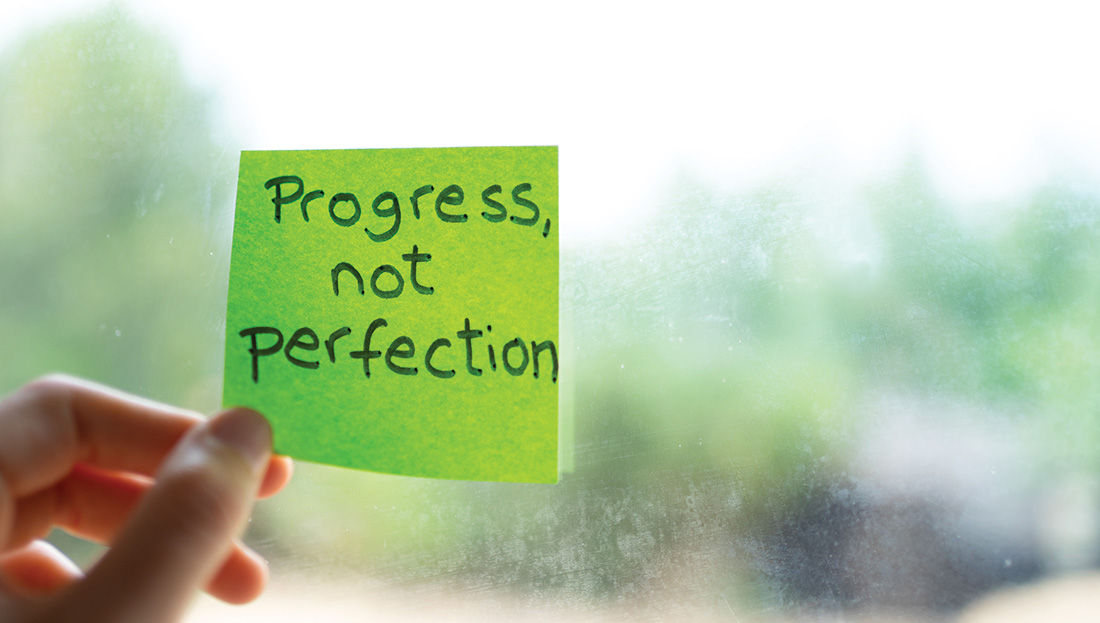
One of my personal mantras is “Progress, not perfection.” After years of putting off certain business goals, for fear of failure and not doing it perfectly, I’m finally checking them off my list. As one of my mentors reminds me, “Imperfect, massive action is better than no action at all.”
Coaching People Who Struggle With Perfectionism in a Digital World
Today’s clients often come to sessions armed with numbers: steps, heart rate, calories burned, sleep scores and more. For a client with perfectionistic tendencies, these tools can be helpful—but they can also become another way to chase flawless performance. A “bad” sleep score or a missed step target can derail their mood for the entire day or cause them to abandon a program altogether.
As a health and exercise professional, you can normalize variability and coach clients to see data as information, not judgment. Instead of asking, “Did you hit your targets?” you might ask, “What does your data suggest about how your body is responding?” and “How do you feel?” This shifts the focus from chasing perfect numbers to using feedback to make caring, flexible decisions.
You can also invite clients to take planned breaks from tracking if it seems to be increasing shame or anxiety. Framing this as an experiment—“Let’s see how your body and mood respond when we focus on how you feel during and after exercise, instead of the numbers”—helps clients experience that healthful movement is valuable even when it isn’t measured.
| One final note for ACE Certified Professionals: As a health and exercise professional, you can facilitate “guided discovery” by walking clients through a six-step process worksheet we created just for you. You and your clients can use it to dissect a perfectionistic thought cycle and then develop an action plan for countering all-or-none thinking and other cognitive distortions that may block their path to a healthier way of living. You can access this exclusive bonus tool by clicking on the bar at the top of this page. |
Here are a few resources you can use to help coach your clients to imperfect action.
Never Enough: When Achievement Culture Becomes Toxic—and What We Can Do About It by Jennifer Breheny Wallace – Investigates how high-pressure, achievement-focused environments impact young people’s mental health and offers practical strategies for creating a healthier definition of success
The Perfection Trap: The Power of Good Enough in a World That Always Wants More by Thomas Curran – Explores how modern culture fuels socially prescribed perfectionism and shows readers how embracing “good enough” can reduce anxiety, burnout and self-criticism
The Anxious Generation: How the Great Rewiring of Childhood Is Causing an Epidemic of Mental Illness by Jonathan Haidt – Examines how smartphones, social media and changes in childhood have contributed to rising anxiety and mood problems, and offers guidelines for supporting healthier development in the digital age
The Perfection Detox: Tame Your Inner Critic, Live Bravely, and Unleash Your Joy by Petra Kolber – A practical, story-driven guide to loosening the grip of perfectionism in everyday life
The Perfectionism Workbook: Proven Strategies to End Procrastination, Accept Yourself, and Achieve Your Goals by Taylor Newendorp, MA, LCPC – A structured workbook with exercises you can adapt for coaching conversations
The CBT Workbook for Perfectionism: Evidence-Based Skills to Help You Let Go of Self-Criticism, Build Self-Esteem & Find Balance by Sharon Martin, MSW, LCSW – CBT-based tools for clients who like worksheets and step-by-step strategies








 by
by