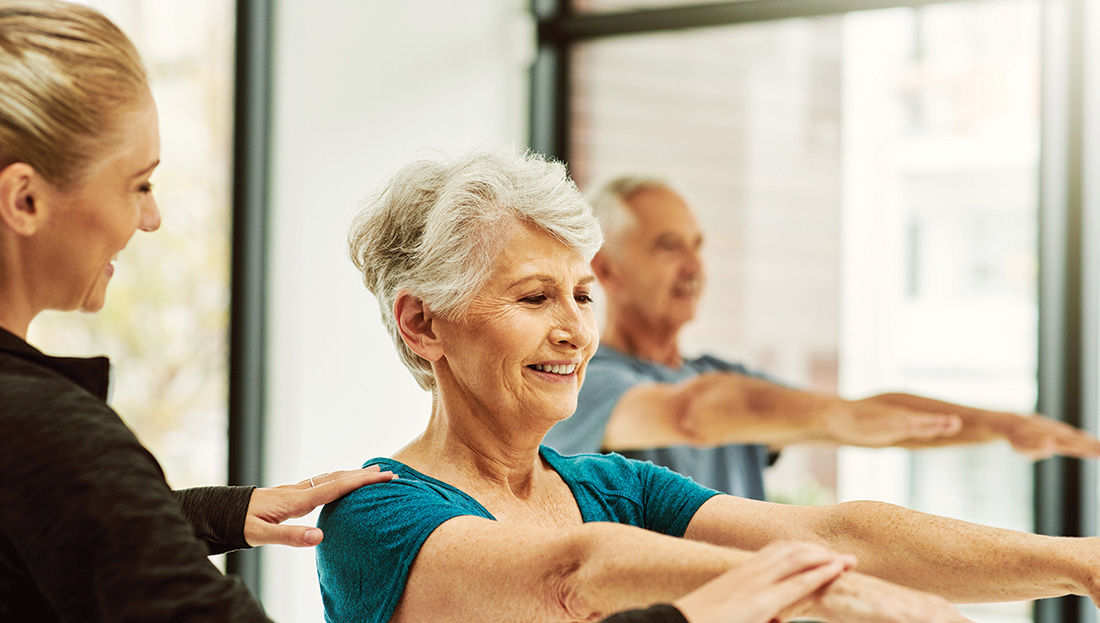
Falls are a serious—and common—health concern for older adults, and balance is at the center of the conversation. When balance declines, fall risk rises, and everyday tasks (plus the activities clients enjoy most) can start to feel less accessible. The good news: balance is trainable, and health and exercise professionals are in a prime position to make it a consistent, intentional part of older-adult programming. In this article, you’ll find practical strategies for building better balance, along with sample exercises and simple-to-advanced progressions you can put to work with your clients right away.
The Role of Balance in the ACE Integrated Fitness Training® Model for Muscular Training
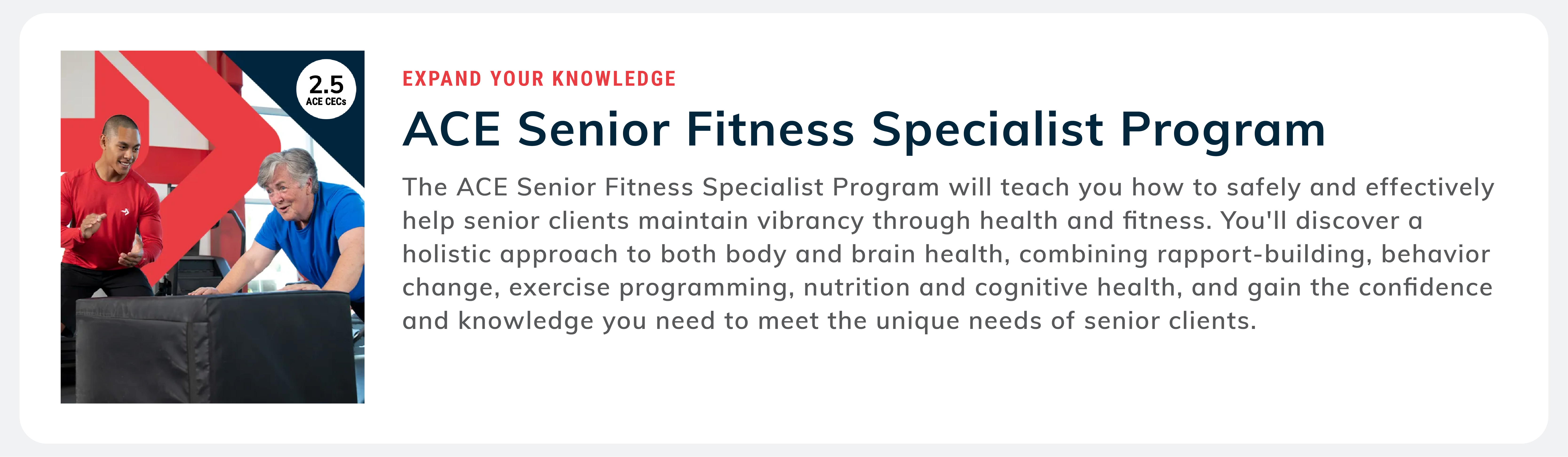
The Muscular Training component of the ACE IFT® Model provides a systematic approach to training that starts with helping clients to improve poor postural stability and kinetic chain mobility, and then incorporates programming and progressions to help people train for general fitness, strength, and athletic performance. The ACE IFT Model Muscular Training component is divided into three phases, including Functional Training, Movement Training and Load-Speed Training (see Figure 1). Exercises that promote static and dynamic balance (e.g., neuromotor exercise) may be included in the Functional Training phase, as these aspects of fitness rely heavily on proper stability and mobility in the joints and kinetic chain.
Figure 1. ACE IFT Model – Muscular Training Phases
To design effective balance exercise programs for your clients, you must understand the factors that contribute to impairments in balance. Balance challenges are rarely caused by just one thing; rather, they’re often a mix of factors, including cognitive changes, reduced strength, vision issues and slower reaction time. Because the “why” is complex, the solution needs to be, too—one that addresses the whole person, not just a single system. Next, we’ll zero in on three key considerations that form the foundation of a well-rounded approach to balance training.
1. Multi-component training is superior to single-component balance training.
The two explanations generally given for a lack of favorable adaptation from balance exercises are a lack of specificity in training and the use of single-component rather than multi-component training. Research suggests that programs made up of only single-task activities fail to place the client in environmental conditions similar to those experienced prior to and during a fall. Importantly, while balance training that is focused on improving functional tasks (e.g., heel-toe walking or standing on one leg) can successfully enhance performance of that specific activity, it does not adequately replicate activities of daily living that require maintaining balance while completing several activities simultaneously or while distracted.
As a health and exercise professional, it is important to design programs that involve the concurrent performance of balance exercises and additional tasks. For example, in addition to heel-toe walking, the client may simultaneously be asked to complete a cognitive task, such as counting backward from 100 by increments of three. Another form of dual-component training involves combining a balance exercise with a physical activity. For instance, balancing on one leg could be performed while playing catch with a light medicine ball. In summary, multi-task balance training more closely replicates the activities of daily living that your client requires for proper function, and during which their balance is most likely to be challenged by a disturbance.
2. Simulate loss of balance during training.
Balance exercise training programs should also include a focus on balance-recovery reactions. Ultimately, it is the capability—or lack thereof—to recover from a loss of balance (also referred to as a balance perturbation) that determines whether a client falls. Balance disturbances can arise from collisions, slips and trips. Additionally, loss of balance can occur during voluntary movements, including bending, reaching and turning.
The body has a natural line of defense against balance disturbances that consists of rapid limb movements. For example, reaching out to grab a supporting object or quickly stepping forward with a lower limb are compensatory mechanisms aimed at preventing a fall. Accordingly, as a health and exercise professional, it makes sense to address your clients’ balance-recovery skill levels; the most effective training programs will replicate sudden and unpredictable balance disturbances. Importantly, to elicit the most favorable adaptations in a client’s balance-recovery reaction capacity, design exercises and activities that do not allow the client to anticipate a balance perturbation.
3. Change the availability of sensory cues.
Many falls occur under conditions to which a client isn’t accustomed to. Poor lighting or uneven surfaces can impair the sensory cues typically available to an individual, temporarily compromising balance performance. You can introduce these challenges into the training program as a way to better prepare your clients for situations in which sensory cues are reduced or unavailable.
For instance, heel-toe walking may be performed while wearing sunglasses (indoors), with eyes closed or while slowly turning the head from side-to-side. Additionally, standing balance exercises can be completed on a foam pad or balance disk to disrupt the surface conditions to which a client is habituated. For a well-rounded approach, altering the sensory cues available to a client is an important consideration when developing an overall balance training program.

The FITT Recommendations for Balance Exercise Training
The frequency, intensity, time and type (FITT) approach to exercise programming used for cardiorespiratory fitness program design can also generally be applied to balance exercise programming. Although research has yet to identify the optimal frequency, intensity, duration and type of balance exercises, evidence-based guidelines suggest that balance training be performed three days per week for 10 to 15 minutes per session. Balance training should be integrated into the overall physical-activity program, and the intensity of the exercises should be safe, but challenging.
How to Safely Progress Balance-Training Exercises
A training program designed to optimize balance training and fall prevention should incorporate each of the key points discussed earlier in the article. Clients with no previous balance training experience should initially perform basic sitting and standing exercises to improve balance performance. (Note: If you're an ACE Certified Professional, be sure to check out the bonus tool at the top of this page. There you'll find a protocol for assessing your client's static balance, which can help inform your program design and the types of balance exercises that are safe for your client.) As these initial exercises become easier, you can increase the difficulty using several different strategies:
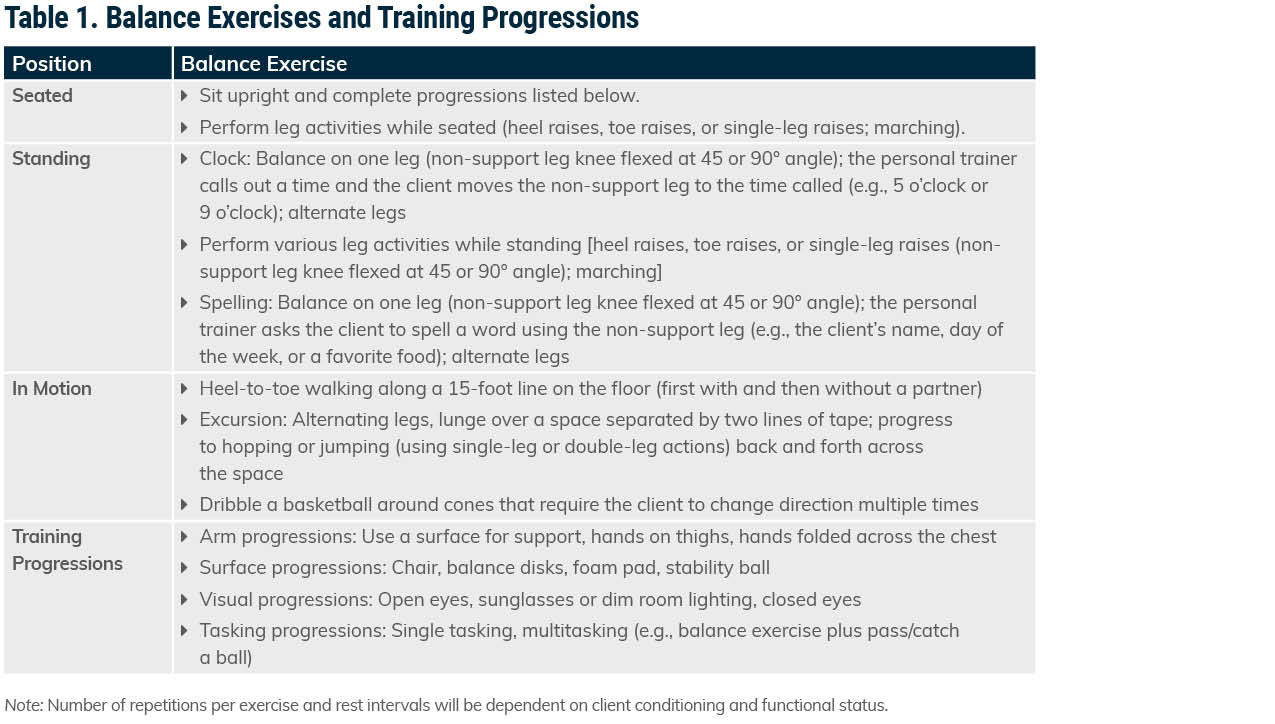
Arm Progressions: The use and position of the arms can be varied in numerous ways to make a given balance exercise more difficult. Hands may at first need to be grasping or touching another object, such as a wall or back of chair, to facilitate balance. Progressively, exercises can be performed with arms spread out and raised to shoulder height to assist with stability. Ultimately, clients can progress to moving their arms in from their sides to a folded position across the chest.
Surface Progressions: The surface or apparatus on which clients perform balance exercises can also be altered to progressively increase the difficulty of a given exercise. For instance, foam pads, balance disks and BOSU balance trainers can be substituted for a hard, flat surface when performing multiple standing balance exercises. Similarly, stability balls can be used in place of chairs when performing sitting exercises.
Visual Progressions: The visual sensory cues provided to the client during nearly all balance exercises can be altered to increase the challenge. For example, ambient lighting can be gradually dimmed, sunglasses may be worn indoors or the eyes may be shut completely.
Tasking Progressions: It is important to require that clients first master each balance exercise performed as a singular task. When this level of achievement is attained, cognitive or physical tasks should be added to the routine.
In addition to progressing the difficulty of a balance exercise, it is also paramount to continuously seek novel and fun balance exercises for clients. While it is sometimes part of human nature to seek greater challenges, clients should be cautioned about proceeding in difficulty without first demonstrating competency at the current level of balance exercise. Progressing too rapidly can actually contribute to a fall. Sample balance exercises and training progression (from simple to complex) are presented in Table 1.
Designing a Program for Your Client: A Case Study
The previous section equipped you with the most important balance-training guidelines. Now you’re ready to put those principles into practice by designing a comprehensive balance exercise program that integrates each of these key considerations. Below is a sample weekly program for an older-adult client.
Jackson, 78, attends a community fitness program offered through a local university three mornings per week. After several near falls in his home, Jackson realized he needed to start working on improving his balance. He has been participating in the current program for three months and has progressed in difficulty on several exercises. A sample of the five exercises he completes each morning, along with a photograph, is presented below. Each exercise takes approximately three minutes to complete, with the total program lasting 15 minutes in duration.
|
Single-Leg Raises
|
Catch
|
Spelling
|
Heel-Toe Walking
|
Stand
|
|
10 reps on each leg
Alternate 2 sets with 1-minute of rest
Arms crossed while balancing on a stability ball
|
Use a 4-lb medicine ball
Complete 2 sets (15 tosses per set) with 30 seconds of rest in between
Rotate the spot from which the ball is thrown and balance on a stability ball
|
2 words per leg Alternate 2 sets with 30 seconds of rest
Arms extended while standing on a hard, flat surface
|
50 yards
Complete 2 sets with 30 seconds of rest in between
Walk with a partner
Arms crossed, eyes closed
|
With arms crossed and eyes closed, the client balances on a BOSU balance trainer and is nudged 10 times
Complete 2 sets with 30 seconds of rest
|
|
* Note that the program integrates each of the key considerations discussed in the article.
|
|

|

|

|

|

|
Take-Home Message
A comprehensive balance training program requires careful planning to ensure your clients experience improved balance performance and reduced likelihood of falls. Use the sample program as a guide, then adjust the exercises, complexity and conditions to match each client’s needs and environment, so balance gains carry over to where they matter most: everyday life.







 by
by