In an effort to help you more efficiently earn continuing education credits while you explore
CERTIFIED™, you can now take the quiz as you read. Get the latest, science-based information
while you earn 0.2 CECs.
I just need motivation, then I can change my habits.
A person must make large efforts to positively impact health.
Changing a behavior is a straightforward process.
I’m too old to make a change in my life.
As a health and exercise professional, it’s likely you’ve heard these types of (or similar) statements before. Prior to starting your professional journey, you may have even held some of these beliefs yourself. Before I became a health and exercise professional, I was completely unaware of how behavior change worked and felt that “if a person just wants to change, they can do it.” How misguided I was.
Today, 23 years into my career, with a continuous commitment to learn and grow, my goal is to help others avoid the same mistakes I once made. With this article, which highlights common mindset traps clients and professionals experience regularly, I hope you’ll feel reassured that you aren’t alone in experiencing these mindset traps—we’ve all been there—but together we can rise above and elevate not only our own individual practices, but the industry as well.
Today’s clients are also navigating a very different world than they were a few years ago—one filled with quick-fix messaging, viral “health hacks,” wearable data, and wellness influencers who may or may not be qualified to give advice. That constant stream of information can make clients feel like they should be able to flip a switch and change overnight. Your role is to help them replace that pressure with a practical, confidence-building approach: small steps, honest expectations and skills they can use in real life.
The Client Lens
It’s not surprising that health-coaching clients experience misperceptions about behavior change, particularly because clients often perceive themselves to be “broken” and needing to be “fixed.” As a result, they initially believe that working with a health and exercise professional will be the “fix” they need. However, the work of a health coach and a client (as well as the process of behavior change) isn’t nearly that black and white.
Common client misperceptions about behavior change typically fall into one of the following five themes:
Change must be big. Lee Jordan, ACE Health Coach, professor and national presenter, often hears that it takes extraordinary actions to accomplish extraordinary outcomes. However, Jordan shares, “this rarely works, as people become paralyzed (analysis paralysis) trying to determine what and/or how to execute an extraordinary action. The truth is that extraordinary outcomes (especially sustainable ones) are achieved through ordinary actions done daily.”
Chris Gagliardi, ACE Scientific Education Content Manager, agrees. “Lasting behavior change doesn’t require drastic overnight overhauls or an ‘all-at-once’ effort.” Rather, says Gagliardi, “meaningful change is often built from intentional and consistent steps taken over time.”
Coach Scripts: What to Say in the Moment
Even experienced professionals can feel pressure to say the “perfect” thing. The good news: you don’t need perfect—you need language that keeps the client in the driver’s seat and moving forward. When a client is overwhelmed, a simple reframe can unlock action: “What’s the smallest step you could do on your busiest day and still feel proud you followed through?” If a client has a lapse and immediately calls it failure, interrupt the spiral with a reset message: “This isn’t a verdict—it’s feedback. What got in the way, and what would make that situation easier next time?” When you feel yourself slipping into the fix-it role, return ownership to the client by offering choices: “I have a couple options—would you like to hear them, or would you rather talk through what feels doable first?” And when a client is waiting for motivation to show up, normalize the reality that motivation is inconsistent: “Let’s build a version of the plan that works even when you don’t feel like it.”
The lesson: Small changes add up to big results. Clients get caught in the trap of needing or wanting to address multiple changes all at once. As coaches, we can help our clients focus on what is most important to them by aligning their goals with their values. (Note: If you are an ACE Certified Professional, be sure to check out the bonus tool linked at the top of this page. It features behavior scientist BJ Fogg's method for creating healthy habits, one tiny step at a time.)
One practical way to bring this to life is to help clients choose a “starting step” that feels almost too easy—something they can do even on a busy, stressful day. That might mean a 10-minute walk after lunch, adding a glass of water with their first meal, or prepping one high-protein snack for the workday. When clients experience quick wins, they build momentum and self-trust, which is often the missing ingredient behind the “I just need to try harder” mindset.
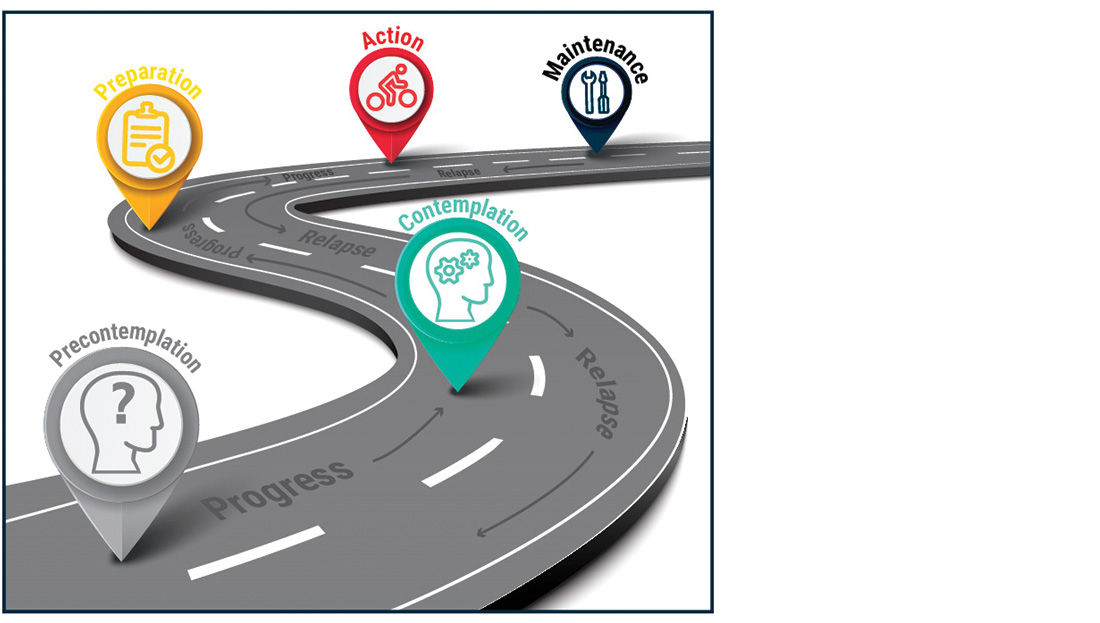
Change is easy. In reality, change is a nonlinear, back-and-forth process. This is one reason the transtheoretical model of behavior change (Figure 1) is often displayed as a winding road or a funnel image, as it accurately represents the fluidity of movement through the stages, lapses and all. Humans travel back and forth and up and down along their journeys. That’s expected. It’s normal. It’s part of the process.
Figure 1
“Change is not easy,” says Gagliardi, “When engaging in behavior-change conversations it is important to acknowledge that the process of change is a journey filled with opportunities for growth, reflection and inevitable stumbles, not just goal attainment. Understanding and respecting the fluidity of the stages of change is helpful when normalizing that bumps in the road along the way are not only normal but build resilience beyond mere willpower. Change is not about hitting the bullseye on your first try. It is about progressively moving closer to the center of the target by making manageable adjustments.
A simple coaching approach here is to plan for “real life” before it happens. You might say: “Most people hit speed bumps—travel, late meetings, family stuff, inadequate sleep. If that happens this week, what’s a smaller version of your plan that keeps you moving forward?” This gives clients permission to adapt without quitting, and it reinforces that consistency is built through flexibility—not perfection.
Change is directed by the professional. It’s a common thought that the professional is the “fix” or the individual who will solve a client’s problem or concern by directing them toward specific actions and prescriptive steps. Behavior change isn’t something that is done to someone; rather, behavior change happens as a collaborative and guided process. “It is important to remember that you can’t want the change more than your client does.This way of thinking is backwards. If you are arguing for change and your client is arguing against change it is time to take a step back and consider what stage of change the client is in and what are the most appropriate steps you can take and skills you can use to shift the desire for change from the pro to the client. The behavior-change conversation has to be done at a time when the client is ready to change,” urges Gagliardi. “We do not make our clients change, argue for change or fight for change. We simply create the space for the client to explore where we are going (the change journey), why they want to go there (meaning and values), and how they want to get there (action steps).”
As a health and exercise professional, you may be the content expert, but the client is the expert on themselves. For change to occur, you must recognize and respect the difference.
To keep this collaborative (and avoid the “fix me” trap), try pairing your expertise with choice. Offer two or three realistic options and ask the client what feels doable right now. For example: “We could start with steps, strength training twice a week, or a simple nutrition routine—what feels like the best starting point for you?” When clients choose the plan, they’re more likely to own the process and follow through between sessions.
A lapse equals failure. We’ve all felt the twinge of guilt or sadness when we veer off course while working toward a goal. Clients feel this during their journey when confronted with a bump in the road. This misperception relates to “change is easy” myth discussed earlier. Lapses and setbacks are bound to occur during the process of change, and they are not synonymous with “failure.” You have an opportunity to reframe this message by helping your clients plan for high-risk situations that may threaten their forward progress.
You can also help clients “debrief” a lapse without shame. Instead of asking, “Why did you mess up?” try: “What got in the way, and what would make that situation easier next time?” This turns a setback into useful information. Over time, clients learn to troubleshoot patterns—like inadequate sleep, skipped meals or overly strict rules—that tend to trigger off-track choices.
One change is the cure-all. “Clients don’t always perceive the unique differences between isolated acts and lifestyle change,” says Gagliardi. “A single change is not curative.” Lifestyle change requires continuous effort and investment over the long term. You can share this message with your clients by assisting them in establishing short- and long-term process goals.
This is also a great place to reset expectations around “one perfect habit.” Many clients want one magic lever (a supplement, a cleanse, a single workout plan). Your coaching superpower is helping them build a manageable system instead—one that includes realistic routines, supportive environments, and progress checks they can maintain. When clients think in systems, they stop looking for a cure and start building a lifestyle.
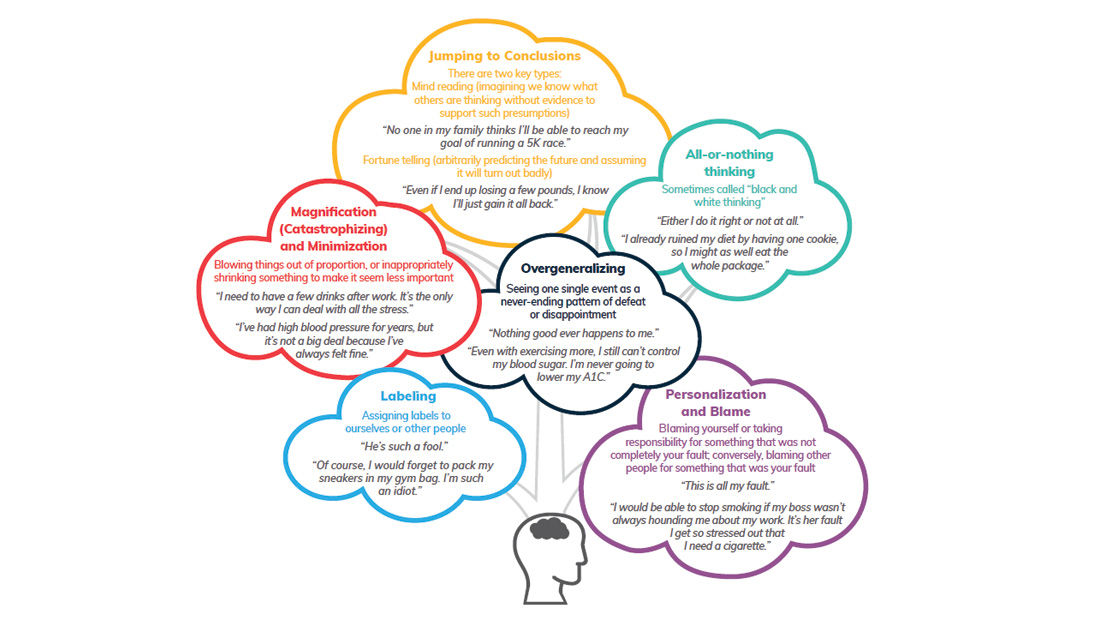
Cognitive Distortions
This graphic presents some additional cognitive distortions that may reinforce your clients’ negative thoughts and feelings and lead to chronically negative and unproductive views of themselves and life.
In plain terms, cognitive distortions are “thought habits” that can make change feel harder than it needs to be—like all-or-nothing thinking (“If I can’t do it perfectly, I won’t do it at all”) or mind reading (“Everyone at the gym is judging me”). When you can spot these patterns, you can help clients separate facts from assumptions and choose a more productive next step.
A quick way to coach this is to ask clients to put their thought into words and then test it: “What’s the evidence for that?” or “If your best friend said that about themselves, what would you say back?” This keeps the conversation supportive and practical—without drifting outside your scope. If a client’s thoughts feel overwhelming, persistent or tied to mental-health concerns, it may also be a good moment to discuss referrals and additional support.
The Health and Exercise Professional Lens
Misperceptions and misunderstandings aren’t limited to clients and consumers, as health and exercise professionals can also fall into mindset traps that don’t serve them or their clients. Here are six beliefs about behavior change that health and exercise professionals may mistakenly hold:
Knowledge equals behavior change. “It’s not about the knowledge,” insists Gagliardi. “It’s about the application of knowledge and the development of skills that lead to lasting change.” Think about the apple-a-day cliché. It’s far more common for someone to hear “an apple a day keeps the doctor away” than it is for that same person to intentionally consume an apple a day. Therefore, it’s critical that you work with clients on focused skill development and habit formation. Clients require tools, skills and self-monitoring to continue making progress.
I must know it all to be effective. Our practice is ever-changing and our skills, much like our clients’ skills, are always being sharpened and refined. We will never know it all, which is a good thing because it means our field is continuing its evolution and making discoveries as it shifts and grows. The biggest and most important ingredients are passion and commitment to traveling along this journey of change with your clients. “Being comfortable with not having all the answers can sometimes feel like one of the hardest parts of coaching,” says Gagliardi, “along with understanding that the person you are speaking to is the foremost expert on themselves.” This can be a big shift for many coaches. The client is genuinely viewed as the expert on what is possible and this keeps every interaction client centered.
More is better. How many of us have thought this during a session with a client? We sometimes neglect to appreciate the silence and hold still in that space. “Sometimes more is just more, not better,” explains Gagliardi. “It’s easy to fall into the fixing reflex or give advice. What we need to do is sit quietly, stay present and allow time for the client to reflect. Embrace the pregnant pause, as it is a revealing moment.”
One way to make the “pregnant pause” feel more natural is to pair it with a follow-up that keeps the client in the driver’s seat, such as: “What stands out to you from what you just said?” or “What feels like the next step?” When you slow down and let clients talk, you often hear the real barrier (time, confidence, fear of judgment, all-or-nothing thinking) instead of just the surface-level goal.
The coach is responsible for program success. Gagliardi used to feel like he had failed his client if they didn’t meet their objectives. “If my client wasn’t successful, I made the inward judgment that I didn’t do something right, that I failed,” he admits. There are, however, many reasons why a program may not be effective. Maybe a client’s goals aren’t aligned with their values, or perhaps the timeline is too rigid and doesn’t leave room for flexibility or change. Furthermore, key elements of social supports may not be identified or utilized. Sometimes a program isn’t successful because of adherence, compliance or because the chemistry between the client and the coach is just “off.”The success of any program (or any change) does not rest entirely on a coach’s shoulders. Change is a collaborative experience.
It can help to redefine what “success” means in the early sessions. Instead of measuring only outcomes (like pounds lost or perfect attendance), build in process markers you can celebrate, like showing up twice this week, getting one extra hour of sleep, cooking at home once or doing a 10-minute strength circuit when motivation was low. When success includes skill-building and follow-through, clients feel progress even before big results show up—and you take pressure off yourself to “perform miracles.”
Coaching skills are generalizable to family and friends. According to Gagliardi, a coach can mistakenly believe that they can use their behavior-change skills to influence or make friends and family members change. He offers this word of caution: “Behavior-change conversations can only effectively and respectfully occur when the client/friend/family member has given you permission to coach. Behavior-change skills are not intended to be used for manipulating someone to change, nor are they designed to be used unsolicited.” For change to happen, the desire, reasons, ability and needs must come from the individual wanting to change, not from the professional telling the individual to make a change.
This same permission-based mindset can protect you from burnout. Even when you care deeply, you can’t want change more than the other person does. A helpful boundary statement is: “I’m here if you want support—just tell me what kind of support would be helpful.” That keeps your relationships intact and keeps coaching from turning into pressure.
Red Flags: When a Client Needs More Support
You can make a powerful difference by coaching habits and skills, but you’re not meant to be the only layer of support. Sometimes the most professional move is to pause, zoom out and help a client connect with additional resources. Consider discussing referral options if a client’s negative self-talk is constant and intense, if they describe persistent low mood or anxiety that’s interfering with daily life, or if their relationship with food or exercise feels punishing, rigid, or driven by fear. Another red flag is when a client repeatedly “starts over” after small slips and can’t recover without harsh self-judgment. In these moments, you can stay within scope while still being supportive by saying something like: “I’m here to help with your health routines, and I also want you to have the right support for what you’re dealing with. Would you be open to talking with a qualified mental health professional?” The goal isn’t to diagnose—it’s to make sure the client is supported by the right team.
Motivation is the pinnacle. A coach may mistakenly feel as if the key to changing a behavior is all about motivation, observes Jordan, and that a person simply needs to focus on that aspect. In reality, “motivation is complex, and it changes for people over time. Keeping ‘enough’ motivation is very challenging and a bit like a game of ‘whack a mole.’ A better approach is to address the habit being built by simply reducing its difficulty to meet a person’s shifting motivation level.” By doing this, explains Jordan, the client can lean into frequency, which is key to habit design, “leading to mastery and behavior change.”
You can strengthen this approach by looking beyond motivation and into “design.” What makes the habit easy to start, and what creates friction? For example, a client might be more consistent if workouts are shorter, scheduled earlier, paired with a friend or tied to an existing routine (like training right after dropping kids at school). When you design for real life, motivation becomes a bonus instead of a requirement.
Conclusion
There are misconceptions associated with every topic we work within: nutrition, exercise, fitness, weight loss, chronic disease management, etc. The source of the misconception may include unqualified influencers on a social media channel, poorly communicated science concepts or our clients’ (or our own) lack of understanding or experience. As health and exercise professionals, we grow in our understanding over time as we gain more experience, make (and embrace) mistakes (some more significant than others), and recover from those errors. And we can do the same for our clients. We can help them grow in their understanding and acceptance that behavior change is a process that requires patience, self-grace and continual commitment.
If you want one takeaway to bring into your next session, it’s this: Listen for the misperception behind the goal. When you can name the “mindset trap” (big changes, lapses are seen as failures, the coach as the fix, motivation as the key), you can coach the skill that actually moves the client forward.
Sign up to receive CERTIFIED™
CERTIFIED™ is a free online monthly publication from ACE designed to equip certified fitness professionals and health professionals alike with the knowledge they need to continue growing.
Author
Dr. Erin Nitschke
Contributor
Dr. Erin Nitschke, NFPT-CPT, NSCA-CPT, ACE Health Coach, Fitness Nutrition Specialist, Therapeutic Exercise Specialist, and Pn1 is a health and human performance college professor, fitness blogger, mother, and passionate fitness professional. She has been in the health and exercise industry since 2003. Erin believes in the power of a holistic approach to healthy living. She loves encouraging her clients and students to develop body harmony by teaching focused skill development and lifestyle balance. Erin is also the Director of Educational Partnerships & Programs for the NFPT. Erin is also an editorial author for IDEA and NFPT where she writes on topics related to personal training, health coaching, behavior change, and career success. Email her at erinmd03@gmail.com.
In an effort to help you more efficiently earn continuing education credits while you explore
CERTIFIED™, you can now take the quiz as you read. Get the latest, science-based information
while you earn 0.2 CECs.
Sign up to receive CERTIFIED™
CERTIFIED™ is a free online monthly publication from ACE designed to equip certified fitness professionals and health professionals alike with the knowledge they need to continue growing.








 by
by