Mary, my 85-year-old client, recently tripped over her dog’s leash and fell onto her concrete garage floor. Despite her having osteoporosis, she didn’t break a bone, partly because she was able to catch herself and soften her landing. She was also able to easily get herself back up to standing. She credits her quick reaction time and ability to get up without assistance to the strength training, flexibility and balance work we do together.
Falls in people over 65 are common, with one in four experiencing a fall every year. And while Mary’s fall resulted in just a scrape on her knee, many others are not so fortunate. In fact, in 2020, non-fatal falls racked up a whopping $80 billion in U.S. healthcare costs. And since falls are the number one cause of fatal and non-fatal injuries in people aged 65 and older, preventing them must be a priority.

While it’s never too late to start working on fall prevention, the ideal time is before reaching older age. “With the knowledge that falls are the leading cause of injury and the leading cause of injury-related deaths for older adults, it is important that people start working on ways to prevent falls before they are 65 years old,” says Candace Brown, PhD, FGSA, associate professor of gerontology at the University of North Carolina. “When we are in our midlife—40 to 64 years old—and likely more physically and neurologically healthy, we should create habits that focus on improving our bodily systems and acquire skills that will be embedded in our lifestyles.”
Keep reading to learn what skills and systems are involved with fall prevention, exercises to hone those skills and practical ways to help your clients prevent themselves from falling.
What Body Systems Are Involved in Fall Prevention?
While it may be obvious that muscle strength and balance are vital for fall prevention, it goes well beyond just that. “When the musculoskeletal system works in tandem with the sensory system and the central nervous system, a person can move most effectively,” says Brown. “When a part of one of the systems is compromised, this can potentially cause issues with movement and increase the chances for falls.”
“Fall prevention includes multiple bodily systems that all must work together to keep us upright and safe,” agrees Rick Douglass, DPT, chief clinical officer for FYZICAL Therapy and Balance Centers. “The vestibular system of the inner ear works in concert with both the cerebellum of the brain and our visual system to ensure that our eyes and ears are sending and receiving the correct signals about where our head is positioned in space.”
This “principle of verticality,” explains Douglass, “helps us to maintain a stable foundation against gravity and includes the proprioceptive system, which sends and receives signals through receptors in our muscles, tendons and joints to alert the central nervous system about the position of our limbs in space. All of this lends itself to the small reactionary movements that we unconsciously do throughout the day to stay upright and avoid falls.”
Conrad Wang, MS, a licensed physiotherapist and managing director of EnableU in Australia, adds that cognition also plays a large role in preventing falls. “Cognitive abilities, including attention, speed of processing and judgment, all factor into our ability to anticipate and respond to fall hazards in our environment,” says Wang.
“Executive function, attention and judgment influence how and when a person moves, especially in unfamiliar or distracting environments,” agrees Leah Verebes, PT, DPT, GCS, assistant professor at the Touro School of Health Sciences Doctor of Physical Therapy program. “Just as importantly, skills like balance, gait control, reaction time and even situational awareness must be trained and maintained, especially in older adults.”
As we age, many of these systems are affected, notes Jen Brandon, PT, MPT, GCS, a physical therapist specializing in geriatrics at Hoag Orthopedic Institute. Eyesight and hearing changes, and touch sensation may be reduced, especially in the case of peripheral neuropathy in the feet, which is common in people with diabetes. Statistics estimate that 20% of 60- to 74-year-olds have peripheral neuropathy, with the majority of those cases attributed to diabetes.
Our brains also change as we age. And while we all experience some memory or thinking issues, mild cognitive impairment (MCI) is a condition that can sometimes represent an early stage of Alzheimer’s disease and is also associated with an increased risk of falling. “Cognitive problems, including problems with memory, such as in dementia, or with judgment, such as in Parkinson’s disease, may also increase the potential for falling,” says Wang.
In addition to cognition, thoughts and beliefs come into play, including fear, anxiety and a lack of confidence. “Following an injury or some near-fall experience, many older adults usually start withdrawing from their daily activities,” says Nick Bach, PsyD, a licensed clinical psychologist in Louisville, Ky. “This, in turn, accelerates weakness and isolation and makes them prone to falling again. So, in fall prevention, building confidence back into their system is essential.”
Exercising to Prevent Falls
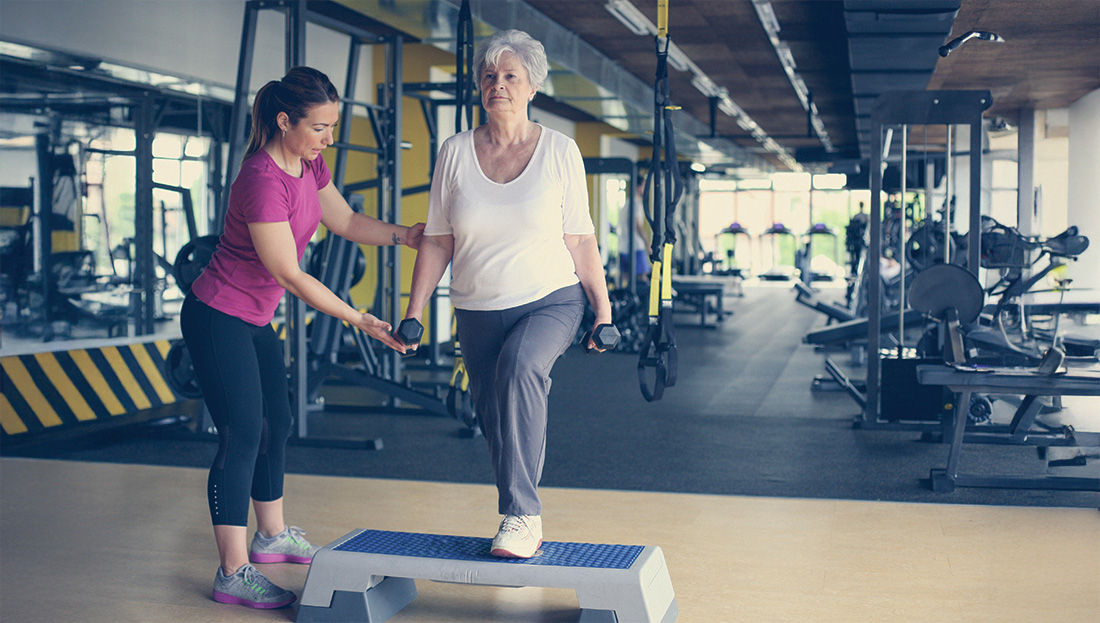
Douglass states that the best exercises for fall prevention are those that use and challenge all the involved systems. “Exercises with both multiple and repetitive head position changes, conducted with eyes open or closed, challenge the vestibular and visual systems. Bringing these in with exercises that challenge the proprioceptive system—like standing on one leg or on an unstable surface—further challenges the systems to ensure that they are all coordinated and working together.”
“We start with strength and balance,” says Winston Loza, DPT, Director of Rehabilitation at United Hebrew. “Flexibility matters, too. Tight hamstrings, especially after knee or hip replacements, make people more prone to buckling, so a few minutes of stretching helps.”
To build strength and balance, Loza suggests starting with a single-leg stance, “initially with support from a sturdy surface, like a handrail, so a person can catch themselves. We’ll also do tandem walking—one foot in front of the other in a straight line—and true heel-to-toe stepping.”
Building in exercises that mimic activities of daily living is important, too. “Reaching forward to dust, loading the dishwasher, turning and placing items—those small tasks quietly challenge balance,” says Loza. “For walkers, add dual-tasking—hold a conversation or sing along to music while walking so that the brain is doing more than just moving the feet. And if someone’s more advanced, dancing is great.”
Verebes adds that dynamic balance can be trained by having clients practice stepping over objects, and that strength training needs to move beyond exercises that are just single-muscle movements. “Target the glutes, quadriceps, hamstrings and calves with functional movement drills,” says Verebes. “Practice getting in and out of chairs, cars and bed, stepping onto [and off of] curbs and navigating tight spaces—the very movements where falls often occur. And encourage clients to move deliberately and avoid rushing.”
Along the lines of mimicking real life, it’s also imperative that you have your clients practice getting up from the floor in the case of a fall. Of course, this is assuming no injury, like broken bones, occurs with the fall.
The core muscles are also involved in balance, so find exercises that are accessible for your clients based on their abilities and health conditions. If they have limited mobility, stability and range of motion, activities like chair yoga or seated Pilates might be more appropriate for them.
Home Safe Home
Your clients spend just a fraction of their time with you, so it’s important to also address their home environment. Remember that we’re trying to avoid falls, which also includes removing obstacles throughout the home. All our experts recommended the following:
- Install motion-sensor lights and nightlights to illuminate pathways and the bathroom in the dark.
- Install grab bars at the toilet and in the shower.
- Add nonskid mats or remove mats and area rugs, which could pose a tripping hazard.
- Remove other trip and slip hazards, like clutter and puppy and child gates.
- Ensure that electrical cords are tidy and not strewn across a walking path.
- Encourage proper shoe wear; slide-on shoes and slippers and flip-flops are a trip hazard.
Preventing falls really is a whole health-team effort. Know your scope of practice as a health and exercise professional and seek counsel from, or refer clients to, physical therapists who are knowledgeable in gait training and the use of assistive devices and can recommend specific exercises for you to use with your client. Research the medications your client is taking and reach out to their healthcare provider, with your client’s permission, if you feel a medication they’re taking may be causing issues that challenge balance, such as lightheadedness or muscle weakness. Refer clients to a registered dietitian nutritionist to discuss their nutrition and hydration status, as low-calorie intake, an imbalance in macronutrients and electrolytes, and low hydration status can all affect balance. And clients with diabetes must check their blood sugar levels regularly.
Verebes concludes that while falls are complex, they are preventable and require collaboration with the whole team, including family and caregivers. “Invite the home into the clinic,” says Verebes. “Ask questions. Create mock environments. Teach both [clients] and families to identify risks—and empower them with the tools to reduce those risks.”
Other Factors to Consider
Medications: “If strength is improving but dizziness persists, medication may be contributing,” says Verebes. “Fall prevention requires both exercise and medical oversight.”
Proper use of adaptive devices: “Devices, [like walkers], only reduce fall risk when the patient is trained to use them correctly,” says Verebes, who notes that walking devices should also be properly fitted to the person.
Pets: “We love them, but they’re a common trip hazard, particularly dogs that rush your feet, and cats weaving around your ankles,” says Loza. “Consider gating them if you’re up at night for the bathroom or when navigating tight spaces.”
Eyeglasses and hearing aids: “[Make sure they’re keeping] eyeglass prescriptions current and getting hearing aids checked,” says Loza. “If you’re talking louder to be heard, they probably need adjustment. Hearing ties into balance more than people think.”
Nutrition and hydration: It’s common to reduce fluid intake as we age, but this doesn’t mean it’s healthy or less important. Diet is also a component in aging and fall prevention, as too few calories or a deficiency of certain nutrients will affect balance, as will unstable blood glucose levels. Refer your client to a registered dietitian nutritionist who can evaluate their food and fluid intake and prescribe an individualized plan for them based on their medical history and needs.






 by
by