







ACE-Supported Research: Turning Up the Heat on High-Intensity Functional Training
Certified™: December 2025

You know all about high-intensity interval training (HIIT) and have already read ACE-supported research about its cousins REHIT and HIRT here in CERTIFIED. It’s time to add HIFT, or high-intensity functional training, to the party.
Functional training uses exercises and movement patterns meant to replicate ways that people move throughout their day. It is truly personalized, as the movements a young athlete needs to optimize performance in their chosen sport will be vastly different from what an older adult may need to perform daily tasks and retain independence, and the exercise program you develop with each client should reflect that.
Typically, functional training workouts focus on enhancing mobility and stability and the ability to perform activities of daily living through movements that combine cardiorespiratory and muscle-strengthening exercise. So, how do we make those movements “high intensity”?
In this study, the researchers created a workout that had participants perform functional training exercises in an AMRAP format (meaning “as many rounds as possible”) to increase intensity. ACE wanted to know whether HIFT workouts were intense enough to drive meaningful changes in a client’s cardiorespiratory and muscular fitness levels.
We were also interested in the effect of heat on the outcomes of HIFT workouts. There is evidence that exercising in the heat may result in increased endurance, among other metabolic benefits, so we wanted to know whether heat could be used as an environmental stressor to increase the intensity of HIFT workouts without asking clients to do more work.
ACE turned to Lance Dalleck, PhD, and Kimberly Allan, MSc, of the High Altitude Exercise Physiology Program at Western Colorado University to help us answer two important questions about HIFT and exercising in the heat.
- What are the acute physiological and metabolic responses to a session of HIFT and how does performing HIFT in a hot setting change those responses?
- What level of muscle activation is achieved during a session of HIFT under normal temperature conditions?
The Study
The researchers recruited 22 participants to take part in this study, 19 of whom completed both exercise sessions (none of the three absences were related to the study itself). The participants were between 19 and 43 years old and were generally healthy. Their activity ranged from lightly active to extremely active and they had varying degrees of experience with HIFT.
Participants were excluded from the study if they had a diagnosis of, or took medications for, heart, liver, kidney or neurological disease, had any musculoskeletal or orthopedic conditions that limited exercise participation, had previous heat injury as self-reported, or were pregnant or planning to become pregnant.
Prior to the study, researchers collected anthropometric measures of each participant and had them perform a baseline maximal oxygen uptake (VO2max) test. Then, over the subsequent two weeks, the participants visited the lab to familiarize themselves with HIFT workouts and the environmental testing conditions. They also practiced the various exercises at the required effort level, which was 7 to 9 on the 1–10 ratings of perceived exertion scale (RPE).
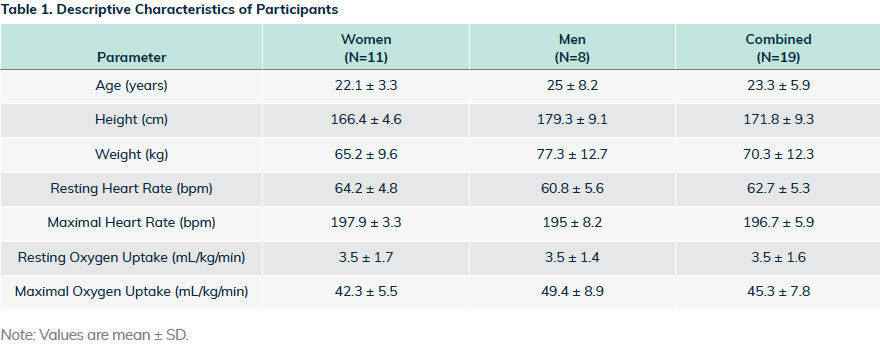
Participant characteristics are shown in Table 1.
The HIFT Workouts
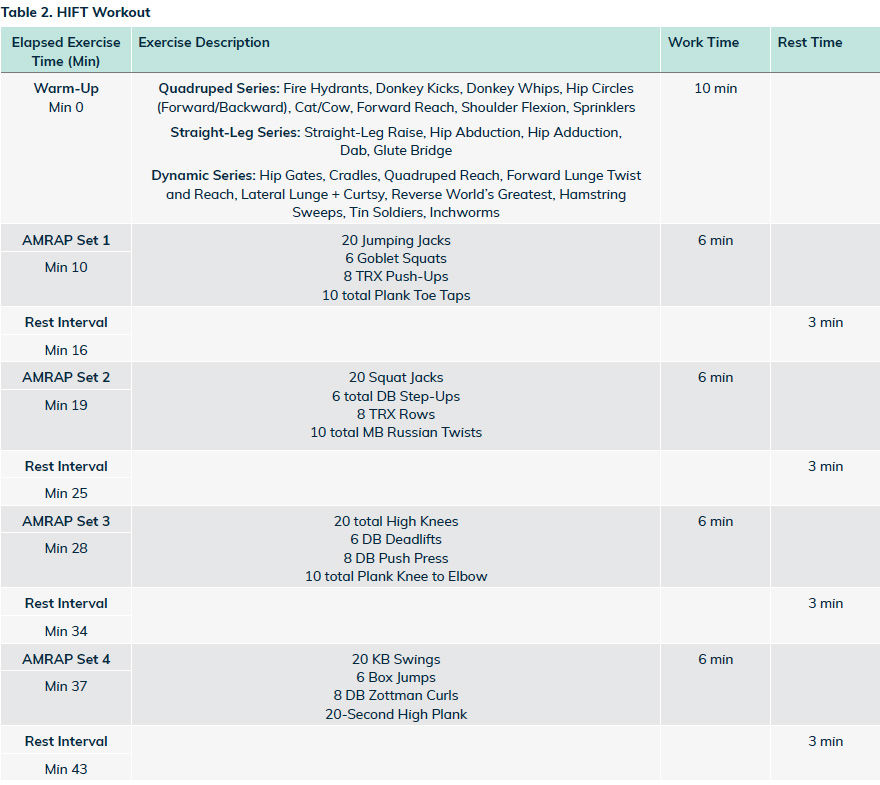
The HIFT workout that participants performed is presented in Table 2. In addition to a warm-up and cool-down, the workout consisted of four six-minute sets, with three minutes of rest in between. Each set included a round of an aerobic priming exercise, lower-body resistance exercise, upper-body resistance exercise and core strengthening exercise. Participants were asked to perform “as many rounds as possible” (AMRAP) of these four exercises within the six-minute set. All subjects performed the same number of repetitions of each exercise per round, but the amount of resistance was individualized to achieve a session RPE between 7 and 9 (on the 1–10 scale). Total work time was 24 minutes and total rest time was 12 minutes, equating to a work to rest ratio of 2:1.
At that point, the participants were ready to begin the study. During week 1, half of the participants completed the workout under NORM conditions, while the other half did so under HOT conditions.
- NORM = Approximately 65° F (18° C) with 7% humidity
- HOT = Approximately 111° F (44° C) with 15% humidity
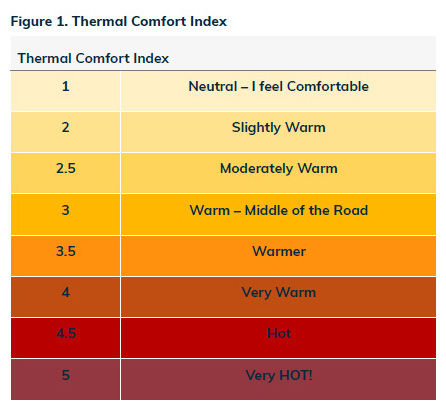
After a washout and recovery period (a three- to seven-day break between sessions to allow for recovery and avoid residual dehydration), they completed the workout under the other environmental condition. The washout/recovery period served two purposes: Given the high-intensity nature of HIFT, a minimum of 72 hours was needed for participants to provide a similar performance on the second HIFT bout. Additionally, when HIFT was performed in the HOT environment, there was a possibility of some residual dehydration if the second bout were to be performed too soon. Individual perception of heat exposure was measured at rest, after the warm-up, after each AMRAP and rest period, and at the end of the cool-down to determine how the participants felt during the HOT session (Figure 1).
Finally, all participants completed the workout again under NORM conditions so that researchers could obtain muscle activation measures via electromyography (EMG).
The Results
Acute Physiological and Metabolic Responses in NORM and HOT Conditions
The results of this study suggest that HIFT workouts, whether they are performed in NORM or HOT conditions, fall within the moderate-to-vigorous intensity range. As you can see in Table 3, the HOT conditions created a statistically significant increase in all the parameters measured.
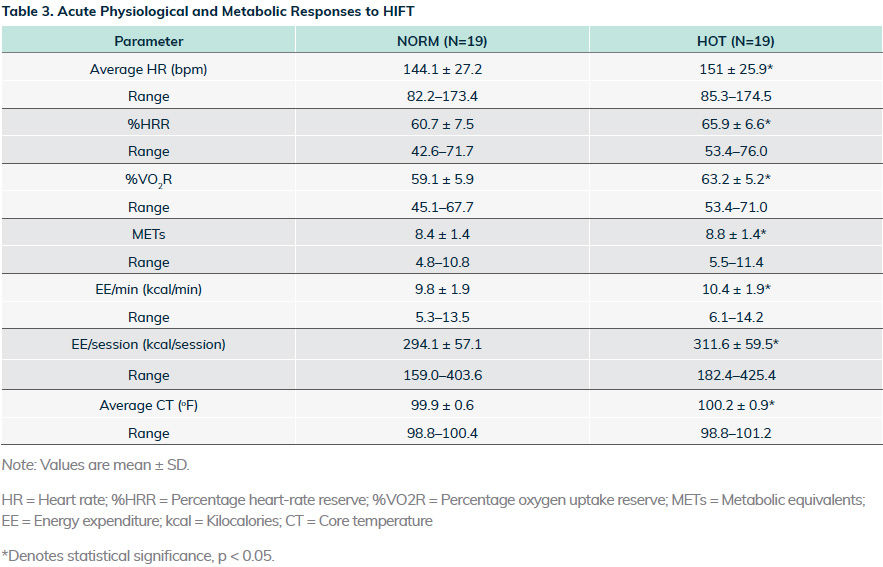
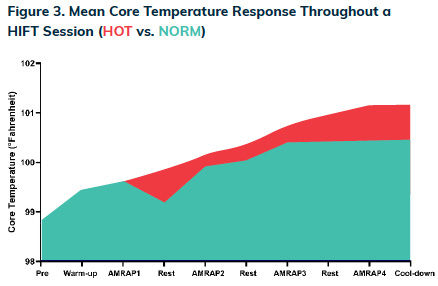
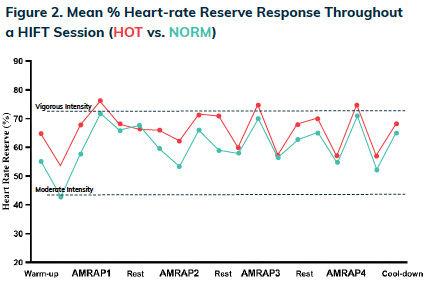
Figure 2 illustrates the mean heart-rate reserve, while Figure 3 shows core temperature response to HIFT under both NORM and HOT conditions. “The core temperature is what’s sort of driving everything,” explains Dr. Dalleck. “If you can increase the core temperature, your cardiovascular system is going to have to work a little harder to try to maintain homeostasis. You’re trying to get rid of some of that extra heat, but you’re also trying to do the same standardized exercise. So, to get any kind of benefit from heat, it’s critical to have a bit of an increase in core temperature.”
EMG Measurements
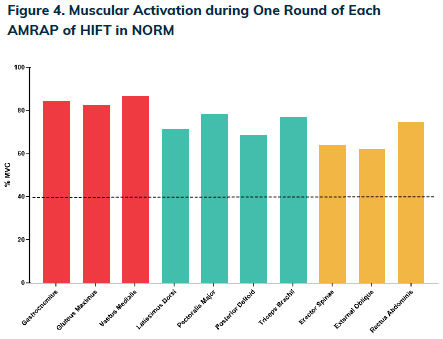
EMG was recorded for various muscle groups during each AMRAP to provide representative data on muscular activation during HIFT under NORM temperature conditions. All muscles showed a maximum voluntary contraction (MVC) above 40% (Figure 4), which is the generally accepted threshold for improving muscular strength and represented by the dotted line in Figure 4. As you can see, most were considerably above that threshold.
Perception Ratings and Rounds Completed of HIFT
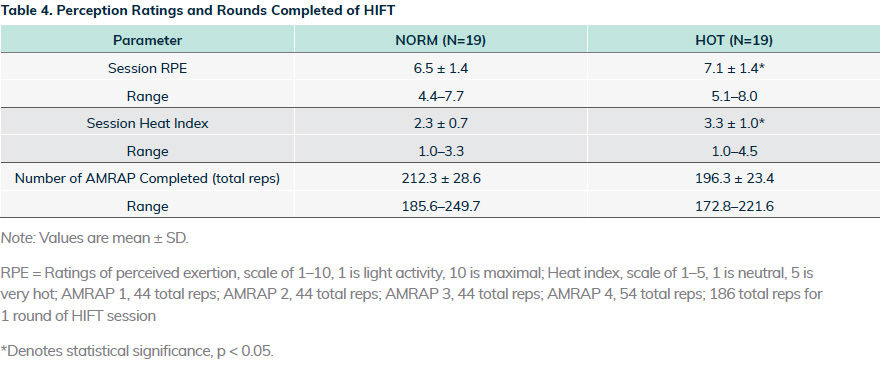
Perception ratings and rounds completed (mean ± SD) during HIFT are presented in Table 4. Participants reported higher RPE and thermal comfort rating scores in HOT vs. NORM conditions. No statistical significance was found in the number of rounds of HIFT completed in HOT vs. NORM. That said, an average of 16 fewer repetitions were performed during the HOT session, which coincides with the perception ratings of HIFT in HOT conditions being higher. In other words, the participants felt like they were doing more in HOT conditions, even though they were doing less work.
The Bottom Line
The results of this study show that HIFT sessions, when performed under normal temperature and humid conditions, constitute moderate-to-vigorous intensity exercise, and that is only enhanced by the introduction of hotter conditions. Importantly, participants in this study performed roughly 150 minutes of HIFT and had no adverse events related to either the workouts themselves or the HOT conditions.
With an average energy expenditure of 312 calories in HOT conditions and 294 calories in NORM conditions, in less than 1 hour of exercise, HIFT offers a safe and effective means of maintaining weight and improving health and fitness.
The muscle EMG findings further support this, as all muscles evaluated worked well above the 40% MVC threshold required to improve muscular strength.
Dr. Dalleck highlights the many public servants and other professionals who routinely work under high temperatures—firefighters, law enforcement and tactical personnel, for example—and says that the fitness industry should seek to understand if we can better emulate what they are doing in the field through training. This type of research may help us better serve those populations. It’s also vital that we evaluate how environmental stressors impact the wear and tear on the body when performing certain tasks.
What Do the Findings Mean to Health and Exercise Professionals?
The ultimate question with any piece of research centers on its practicality. How might the findings impact the work you do every day as a health and exercise professional? In this case, the lesson to be learned is twofold:
- HIFT is a safe and effective workout protocol under normal environmental conditions.
- Exercise intensity can be modified for clients without asking them to necessarily work out longer or more intensely. You can challenge the body by simply increasing the temperature of the workout space.
Safety should be the primary concern when moving a workout from normal to hot conditions, so use common sense when deciding whether to crank up the heat or move outdoors into the Arizona summer. You don’t want to overdo it or overstress your clients and transform a safe workout into a dangerous one. Dr. Dalleck points out the simplicity of the setup for their HOT conditions—adding a few space heaters to a small workout space was enough.
Dr. Dalleck estimates that the temperature change in this study increased the stress on the body by about 5% across the board, which he says is within a physiologically safe range. It may not seem like much at first glance, but increasing the intensity of every workout by 5% would drive meaningful changes over time without the client having to do 5% more exercise.
HIFT workouts can be safe and effective in variety of settings and within varied environmental conditions. If opting to turn up the heat, discuss this concept with your clients to see if they are open to the idea and plan accordingly. Many clients will like the idea of getting 5% more out of their workout and will feel like they are getting a greater return on their health investment.
This study was first published in the peer-reviewed International Journal of Research in Exercise Physiology.


More Articles
- Certified™: December 2025
The Maintenance Mindset: Helping Clients Sustain Results
Contributor
- Certified™: December 2025
Fall Prevention for Older Adult Clients: An Evidence-Based Guide
Contributor
- Certified™: December 2025
Exercise as Immune Therapy: New Research Shows Lasting Benefits
Contributor