






 by
by |
Key Takeaways HYROX is an indoor fitness race that blends endurance and strength through a standardized format designed to be both accessible and challenging. Try this HYROX-inspired workout, which combines functional training with cardio exercise, to get a taste for the event:
Check out the ACE Exercise Library. |
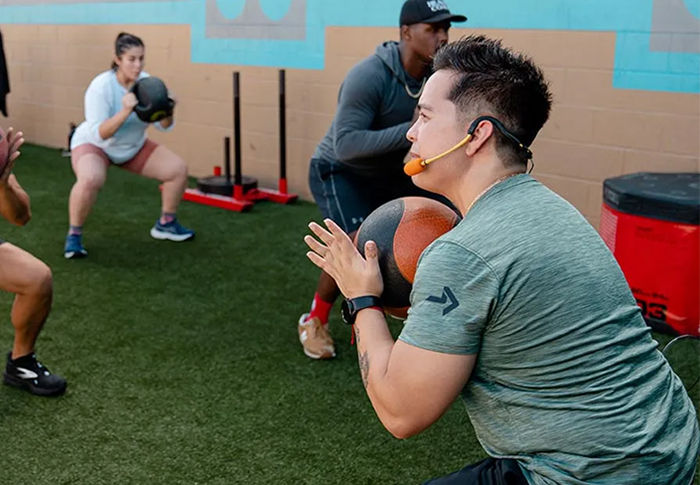
HYROX is an indoor fitness race that blends endurance and strength through a standardized format designed to be both accessible and challenging. Each race consists of eight 1-kilometer runs, each followed by a functional workout station. These stations typically include movements such as sled pushes and pulls, burpee broad jumps, rowing, farmer’s carries, sandbag lunges, and wall balls. The consistency of the format across all events allows participants to train with specificity and measure progress over time.
At its core, HYROX is not just a test of fitness capacity—it is a demonstration of foundational movement patterns performed under fatigue. When viewed through a functional training lens, the race format becomes a practical application of the primary movement patterns: push, pull, bend-and-lift, single-leg and rotate (with anti-rotation/stability components).
- Push movements are prominently featured in the sled push and wall balls. These exercises require coordinated force production through the lower and upper body, emphasizing triple extension, core stability and upper-body pressing strength.
- Pull patterns are challenged through the sled pull and rowing. These movements demand posterior chain engagement, grip strength and the ability to generate force while maintaining alignment and control.
- Bend-and-lift mechanics are essential for efficient rowing, deadlift-based movements and general force transfer. A strong hinge pattern supports power production and reduces injury risk, particularly under fatigue.
- Single-leg patterns are directly tested through sandbag lunges and indirectly through running mechanics. These unilateral movements require balance, coordination and the ability to produce and absorb force through one leg at a time.
- Rotation and anti-rotation are less obvious but equally critical. While HYROX movements are largely linear, the ability to resist unwanted rotation—particularly during carries, sled work and running—relies heavily on core stability and neuromuscular control.
By understanding HYROX through these movement patterns, exercise professionals can design training programs that are not only race-specific but also aligned with principles of functional movement and long-term athletic development. This approach reinforces movement quality, enhances performance and supports injury prevention. =
While the workout below is a good starting point for clients who are interested in learning more about HYROX or are inspired to change up their workouts, check out the HYROX website for training strategies for preparing to compete.
Sample Functional Training Circuit
To complete this workout, perform two or three rounds, moving through the exercises in order. Perform each exercise for 40 seconds, then rest for 20 seconds. Rest for 1 to 2 minutes between rounds.
- Squat to Overhead Press (Push)
- Emphasizes total-body pushing mechanics similar to wall balls
- Focus: Coordinated lower- and upper-body force production
- Bent-Over Dumbbell Row (Pull)
- Reinforces pulling strength and posture important in rowing and sled pulls
- Focus: Scapular retraction and posterior chain engagement
- Hip Hinge/Romanian Deadlift (Bend-and-Lift)
- Develops posterior chain strength for all stations
- Focus: Glute and hamstring activation with neutral spine
- Reverse Lunge (Single-Leg)
- Builds unilateral strength and balance important in walking lunges
- Focus: Control, alignment and force production through each leg
- Farmer’s Carry (Stability)
- Mimics HYROX carry demands
- Focus: Grip strength, core stability and posture under load
- High Plank with T-Spine Rotation (Anti-Rotation)
- Enhances core stability and control needed for all stations
- Focus: Resisting rotation while maintaining alignment
- Step-Up (Lunge/Locomotion)
- Supports running mechanics and lower-body endurance
- Focus: Single-leg strength and control
- Cardio Interval (Run, Row, or Bike
- 250–500 meters of moderate-intensity effort
- Reinforces aerobic capacity and transition readiness
 |
Whether you're a beginning exerciser who needs help getting started or someone who wants to add some variety to your fitness routine, our ACE Exercise Library offers countless movements to choose from. Exercises are organized by body part, equipment and experience level, and each comes with a detailed description and photos to help ensure proper form. |











 by
by