





 by
Last updated on October 22, 2026 (originally published on May 9, 2017)
The aging process can be challenging, particularly for those dealing with health and medical issues such as loss of (or deteriorating) hearing and vision, osteoporosis, lack of mobility and heart disease. These issues can negatively affect the quality of one’s daily life and result in pain, falls, depression and more.
While basic exercise programs can help (and even alleviate) some of the health issues faced by older adults, many people are simply unable to perform traditional workouts. However, chair workouts can be a highly effective alternative, allowing individuals to train for strength, flexibility and balance. Here are a few sample chair exercises for older adults featuring each of these components of fitness.
Strength
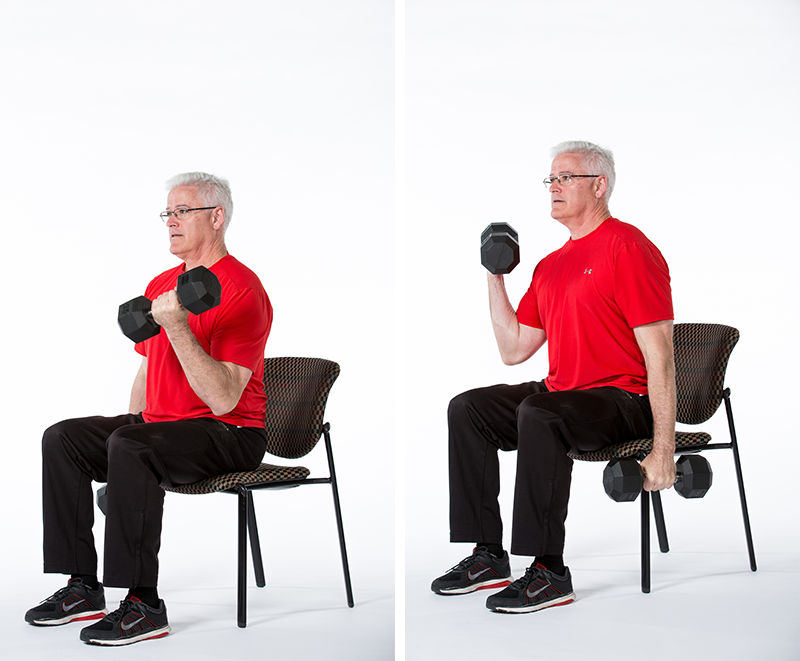
Seated Biceps Curls
- Sit with back straight, feet on the floor and knees bent at 90 degrees.
- Hold a dumbbell in each hand and allow the arms to hang at your sides.
- Bend the arms at the elbow and raise the weight toward the shoulder.
- Slowly lower and repeat with the other arm.

Hip Abduction
- Sit with back straight, feet on the floor and knees bent at 90 degrees.
- Wrap an exercise band around legs, just above the knees.
- Slowly move the knees away from each other.
- Slowly bring the knees back to the starting position and repeat.
Dumbbell curls, lateral shoulder raises and triceps pushbacks are additional examples of exercises that can be performed from a seated position.
Extra Tips: Avoid overhead presses, static isometric exercises and challenging or confusing moves. Using a light resistance is acceptable.
Flexibility
Most older adults tend to have overly tight muscles, which can lead to poor mobility and, in some cases, pain. Increased flexibility can help improve range of motion and possibly help individuals avoid injuries and experience less pain.

Seated Hamstrings Stretch
- Sit with legs extended and heels touching the floor.
- Slowly lean forward and slide the hands down the legs.
- Stop when tension is felt in the lower back or the back of the legs.
- Hold for five to 10 seconds.
- Slowly return to the starting position and repeat.
Extra Tips: Many older adults can easily become lightedheaded, so it may be necessary to have them keep their heads above their hearts as they stretch. Avoid prolonged stretches unless individuals have prior experience with flexibility training.
Balance
Poor balance can lead to falls and, potentially, broken bones. Some simple balance training using a chair as a stabilizer can help improve balance.

Standing Leg Raise
- Stand beside a chair and hold or touch the back of the chair as needed.
- Slowly lift one leg off the floor by fleing the hip and bending the knee.
- Hold for 5 seconds.
- Slowly return to the starting position and repeat on the opposite leg.

Standing Hip Circles
- Stand beside a chair and hold or touch the back of the chair as needed.
- Slowly lift one leg off the floor and rotate the hip counterclockwise and then clockwise.
- Slowly return to the starting position and repeat on the opposite leg.
Extra Tips: Be sure to use a stable chair and always look straight ahead when performing balance exercises.
Modifying exercises, when needed for older adults can be challenging, but is well worth the extra effort to create a more inclusive environment. Not all older adults have the same level of fitness and training experience, so don't assume that program modifications are or are not needed based on a person's age alone. As with all clients, be sure to conduct a preparticipation health screening to determine if medical clearance or a referral to other health professionals is necessary before beginning an exercise program. Get a physician’s clearance and thoroughly review the health history of older adult clients before they begin an exercise program.
 |
Empower a growing population of older adults to gain strength, reduce muscle deterioration and lower the risk of inactivity-related diseases and cognitive decline by becoming an ACE Senior Fitness Specialist (worth 2.5 ACE CECs). |






 by