







 by
by |
Key Takeaways Active listening, sometimes called reflective listening, is a key element of motivational interviewing and a core skill for health coaches and exercise professionals. Communication often breaks down between what a speaker intends and what a listener interprets, so it’s important to learn how to use reflections to enhance your overall communication skills. Consider this six-step process to forming reflections:
To learn more, check out this course: Behavior Coaching Skills That Turn Knowledge into Action. |
Active listening, sometimes called reflective listening, is one of the four core elements of motivational interviewing and an essential skill for health and exercise professionals to practice and master. Active listening is much more than remaining quiet while another person is speaking. It involves listening with empathy in order to understand another person’s unique perspective and world.
Reflections are part of active (that is, reflective) listening and are used to demonstrate that you heard what a client has shared and are trying to perceive and understand the meaning that the words convey. Done well, reflections can pull out the client’s most salient points, highlight value and summarize possibilities.
If you need a refresher on the basics of active listening, be sure to read When in Doubt, Listen: Active Listening for Health and Exercise Professionals. This blog picks up where that one leaves off by exploring various types of reflections and providing strategies to help you practice this important skill.
How Does Reflecting Help?
Have you ever heard the saying “lost in translation?” This phrase can be used to indicate a breakdown in communication between people due to different perspectives or language barriers. Reflective listening can be used during the process of communication to minimize the risk of feelings, meaning, values and perceptions being lost in translation.
Each arrow in Figure 1 represents a point at which miscommunication may occur between a speaker and listener. Let's take this step by step, starting on the bottom left. In Step 1, the speaker is thinking and feeling something before trying to convey it to the listener, while in Step 2, the speaker is conveying meaning with verbal and nonverbal communication. Between those two steps, meaning can sometimes be lost if the speaker does not accurately or clearly express what they intend the listener to understand. Step 3 involves what is heard by the listener. Again, another opportunity for miscommunication exists between Steps 2 and 3 if the listener is distracted or simply misunderstands what’s being said. Part 4 requires the listener to take what is heard and to run it through their personal decoding system to interpret what they think the speaker means, which is yet another place where misunderstanding can take place. By this point, the interpreted meaning in Step 4 can be very different from what the speaker was thinking and feeling back in Step 1.
Figure 1
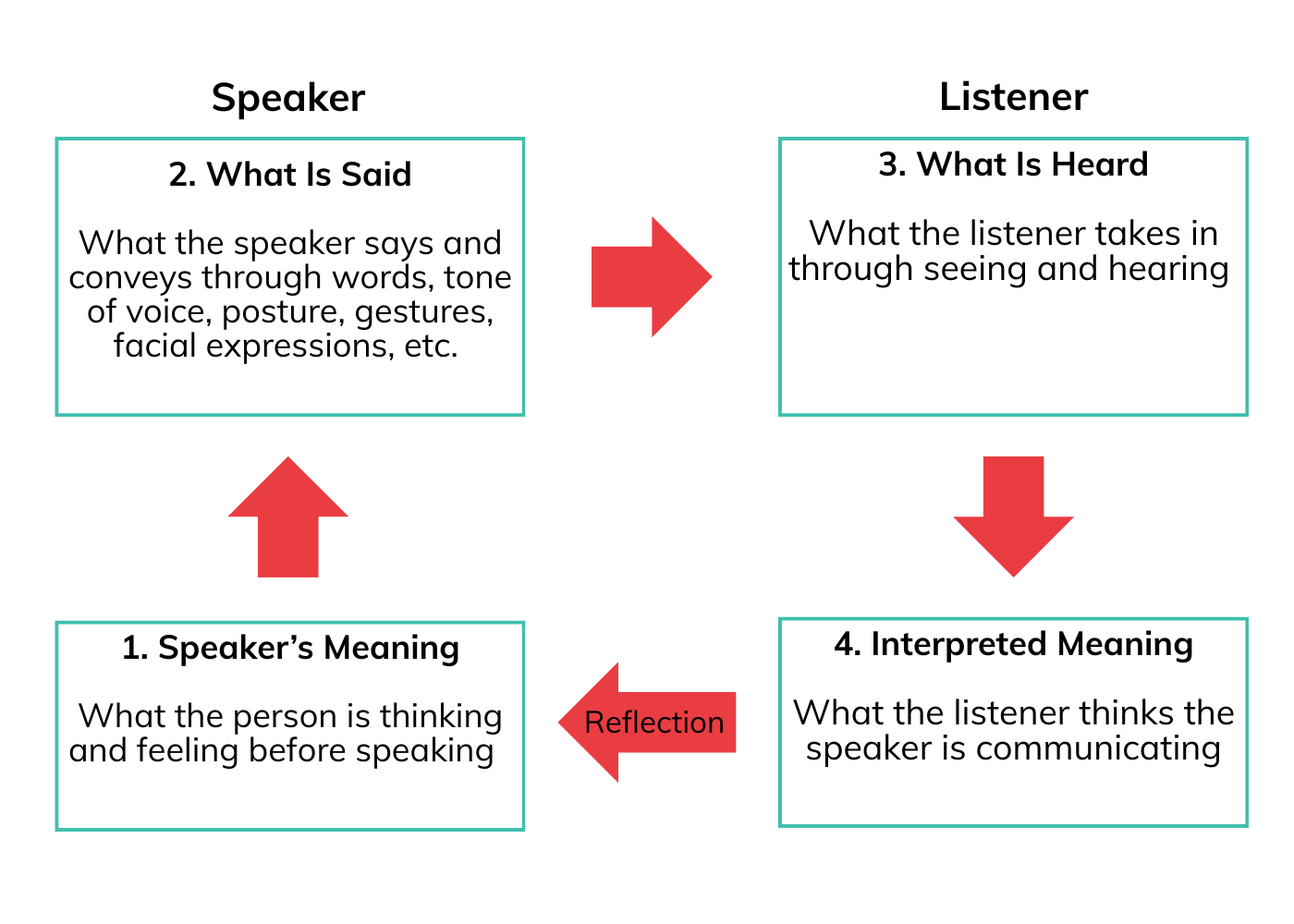
Source: Miller, W.R. & Rollnick, S. (2023). Motivational Interviewing: Helping People Change and Grow (4th ed.). New York: Guilford Press.
Reflection skills are used after Step 4 to better align the listener’s interpreted meaning with the speaker’s intended meaning. Instead of internally imagining what the person means and holding that in, you can find out if your best guess is accurate and give the speaker a chance to confirm, correct and elaborate.
Types of Reflections
There are several types of reflections you can use. Consider the following examples, all of which follow a client stating, “I was supposed to go hiking with my brother this weekend, but he never showed up.”
- Simple reflections are restatements that are fairly close to what the client said. For example, “I heard you say that you are angry at your brother for failing to show up for the hike.”
- Complex reflections involve guessing at the underlying meaning of what the client has said. For example, “You feel frustrated because you were counting on your brother’s help to get a good workout.” This is usually not a big jump from what the person has said but a possible extension.
- Continuing the paragraph involves a reflective statement where you take a guess at what you think might be the client’s next sentence and involves hearing both what has been said and what has not yet been said (i.e., reading between the lines). For example, after your client says something like, “It really bothers me when my brother plans to exercise with me and then does not show up. It is so much easier to exercise with him.” Continuing the paragraph might sound something like this: “Working out with a partner makes it easier to stay committed.”
- Overstated and understated reflections give the client an opportunity to clarify a statement. The level of intensity used in a reflection matters, so strategically using words that amplify or reduce intensity can move a conversation forward. Understating might look something like this: “You are a little annoyed that your brother did not show up.” This gives the client permission to say more and to clarify just how upset they might be. The client might raise the intensity and tell you they are way more than a little upset. Overstating might look something like this: “You are furious that your brother did not show up.” This type of reflection allows the client to take a step back and perhaps reduce the intensity of the language used.
- Double-sided reflections integrate both sides of a dilemma or combine a client’s sustain talk with the client’s previously stated change talk. The client’s statements are joined by “and,” with the sustain talk stated first, followed by the change talk. For example, “You don’t have time to exercise and when you exercise you are more productive at work.” The use of the word “and” respects both sides of the dilemma, though words like “but” and “however” can also be used. An important characteristic of effective double-sided reflections is that the word “but” acts like an eraser and places less emphasis on what was said before the “but” and more emphasis on what is said after. Restating the pro second is more likely to amplify that side of ambivalence and advance change talk.
Forming Reflections
Here are some steps recommended by Miller and Rollnick in their book Motivational Interviewing: Helping People Change and Grow that you can take when forming a complex reflection:
- Consider the context of the larger conversation.
- Take a best guess about the meaning of a client’s statement.
- Offer a reflection. Rather than making assumptions about the underlying meaning of what was said, use reflective statements to check your hypothesis.
- Allow the client time to respond. Listen carefully. You will know you are on the right track if the client expands on what they were saying and continues to talk. You are checking for alignment and moving the conversation forward.
- Be open to being wrong. If you are wrong, your client will let you know.
- Follow open questions with at least one reflective response or, better yet, use multiple reflective statements between open questions. A greater ratio of reflections to questions may have a positive impact on client outcomes.
Final Thoughts
Reflective listening is the art of hearing and is more than just a communication technique. It is a powerful tool for building relationships and trust. Demonstrating a genuine interest in viewing the world from another person’s point of view creates a safe space for open dialogue. Remember, this skill takes time to develop, so be patient with yourself and start small. Practice reflecting during the next conversation you have and witness the positive impact on your professional relationships.
 |
If you’re interested in learning more about how to use reflections and other behavior-change skills, check out Behavior Coaching Skills That Turn Knowledge into Action (worth 0.1 ACE CECs).This course explores evidence-based skills that help clients turn intentions into habits, build self-efficacy and create sustainable lifestyle changes. |






 by
by