







 by
by |
Key Takeaways Many clients wonder how to meditate and are looking for strategies to help them get started. In this blog, you’ll learn why meditation and mindfulness are vital to success for both you and your clients, and how to incorporate meditation into a busy lifestyle. Here are some key takeaways from this conversation with Lauren Aguon, LMSW, YACEP, E-RYT500, of My Vinyasa Practice:
Check out the course: Foundations of Meditation |
Meditation is a mindfulness practice that helps individuals focus attention and cultivate awareness. Research continues to show that a consistent meditation practice can support mental clarity, emotional steadiness, self-awareness and overall well-being. For health and exercise professionals, incorporating meditation into personal routines or clients’ programs can enhance mind-body awareness, support adherence and help quiet unhelpful thought patterns. Despite its growing popularity, meditation is often misunderstood or oversimplified, leading to uncertainty about what it truly is and how it works.
To help clarify this practice and its modern relevance, ACE is proud to introduce Foundations of Meditation from My Vinyasa Practice. In this blog, Lauren Aguon, LMSW, YACEP, E-RYT500, explores the science behind meditation and offers practical application strategies you can use both for yourself and in your work with clients.
What inspired you to create Foundations of Meditation, and why do you believe meditation is especially relevant for today’s health and exercise professionals?
After more than 10 years of teaching yoga and running a wellness business, I saw a consistent gap: meditation was often treated as an “add-on” rather than a foundational skill. Many professionals wanted to teach or recommend meditation but didn’t feel confident in their own practice or in their language around it. Foundations of Meditation was created to demystify the practice and make it accessible, practical and teachable.
For today’s health and exercise professionals, many of whom are navigating burnout, nervous system overload and increasingly complex client needs, meditation isn’t optional. It’s a critical tool for self-regulation, presence and sustainable leadership. When professionals embody these skills, it naturally elevates the quality of service they provide.
Meditation is often misunderstood or simplified. What do you think people most commonly get wrong about meditation?
One of the biggest misconceptions is that meditation is about “clearing the mind” or achieving a constant state of calm. That idea sets people up to feel like they’re failing before they even begin. Meditation is really about building awareness of thoughts, sensations, habits and patterns, without immediately reacting to them.
Another misunderstanding is that meditation is passive. In reality, it’s an active, trainable skill that strengthens focus, emotional resilience and discernment over time. It’s not about escaping life; it’s about learning how to meet life more skillfully.
How do journaling and self-reflection enhance meditation practice, both personally and professionally?
Journaling creates a bridge between internal experience and conscious understanding. In my own practice, and with students, I’ve found that reflection helps clarify what meditation is actually revealing. It can provide internal information on patterns of reactivity, moments of insight or shifts in perspective that might otherwise go unnoticed.
Professionally, journaling supports integration. It helps practitioners articulate their experience, refine their teaching language and develop greater empathy for clients. Reflection turns meditation from something you do into something you actively learn from.
What skills or insights do professionals tend to gain that surprise them most as they move through the course?
Many professionals are surprised by how much their listening skills improve, both internally and with clients. They often report greater patience, clearer boundaries and an increased ability to stay present without needing to fix or perform.
Another common insight is realizing that meditation doesn’t require perfection or rigidity. Professionals gain confidence in adapting practices to real people, real bodies and real lives, without losing the integrity of the tradition.
Can you offer strategies for sustainable, real-world integration of meditation into daily life and work, especially for professionals or clients who feel “too busy” to meditate?
Sustainability starts with letting go of the idea that meditation has to be long or formal. Consistency matters far more than duration. Even one to five minutes of intentional practice before sessions, between clients or at the end of the workday can be transformative.
I also encourage professionals to integrate mindfulness into what they’re already doing: conscious breathing while cueing movement, brief pauses for sensation awareness or reflective check-ins at the end of the day. Meditation becomes sustainable when it supports life, rather than competing with it.
How can professionals talk to clients who may be reluctant to try meditation, while both honoring traditional practice and offering an evidence-based explanation?
Start by meeting clients where they are. Not everyone resonates with spiritual or traditional language, and that’s okay. Meditation can be framed as attention training, nervous system regulation or stress resilience, without diminishing its depth.
At the same time, it’s important to honor the practice's roots by teaching with respect, clarity and humility. You don’t need to overpromise outcomes. Offering simple, evidence-informed explanations, while also inviting curiosity rather than compliance, builds trust and openness over time.
Final Thoughts
Meditation is a skill that develops over time, supporting presence, clarity and nervous system regulation in both personal and professional settings. For health and exercise professionals, these qualities can enhance self-awareness, communication, and the ability to create supportive environments for clients. Furthermore, it supports ACE’s holistic approach when working with clients by addressing not only physical performance, but also the mental and emotional factors that influence behavior, resilience and overall well-being.
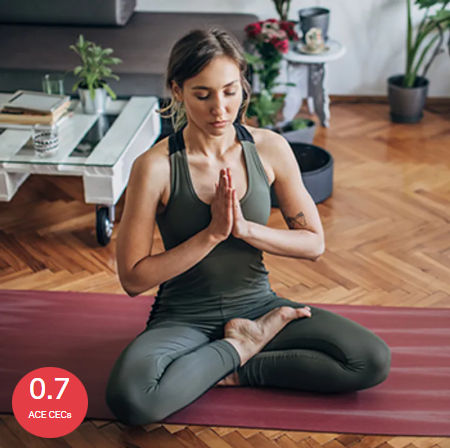 |
For those interested in exploring these concepts more deeply, Foundations of Meditation (worth 0.7 ACE CECs) offers a flexible, self-paced learning experience approved for Yoga Alliance credits. Designed for exercise professionals, yoga instructors and health coaches, the course provides practical tools for integrating meditation into everyday life and professional practice, without adding more to an already full schedule. |











 by
by