





Q. I'm trying to help my friend stick to her resolution to exercise regularly. Can you pass along some tips that will help her stick to it?
A: According to many experts, four of the
most critical factors regarding exercise adherence
are:
1. injuries
2. time
3. boredom
4. results
Not surprisingly, individuals won't stick
with exercise programs in which they get
hurt. The old adage, "no pain, no gain,"
makes no sense to most people. Individuals
prefer to engage in exercise regimens that are
time-efficient, which will allow them to continue
to enjoy valued hobbies and other interests.
Fortunately, individuals can experience
the innumerable benefits of exercise without
enduring marathon workouts.
Common sense dictates that people prefer
to participate in exercise programs that
are enjoyable. Boredom can have a devastating
impact on an exercise commitment.
At the very least, the activity should allow
an exerciser to disassociate from the negative
aspects of the exercise experience
(fatigue, muscle soreness) and to refocus on
more positive factors. For example, the
high-tech features on many contemporary
exercise machines are designed not only to
provide physiological and performance
feedback, but also to engage the exerciser
in a diversion from the physical effort
required for the exercise.
Achieving meaningful results can be among
the most important adherence factors for
many individuals. People typically participate
in exercise programs to achieve specific goals
(e.g., weight loss, stress reduction, improved
strength, etc.). Obviously, they're more likely
to continue expending the time and energy
involved if their efforts produce desired and
meaningful results.
There are a number of steps your friend
can take to increase her interest, enthusiasm
and, ultimately, long-term adherence,
including:
Establish the intrinsic motive to
exercise. Help your friend determine
exactly what she wants to gain from an
exercise program.
Emphasize short-term goals. Goal setting
should be viewed much like climbing a
ladder, with an emphasis placed on reasonable
distances between rungs.
Minimize injury/complications by not doing
too much, too soon. Oftentimes, novice exercisers
who increase their activity dosage too
abruptly become discouraged, especially if
they feel too sore or become injured.
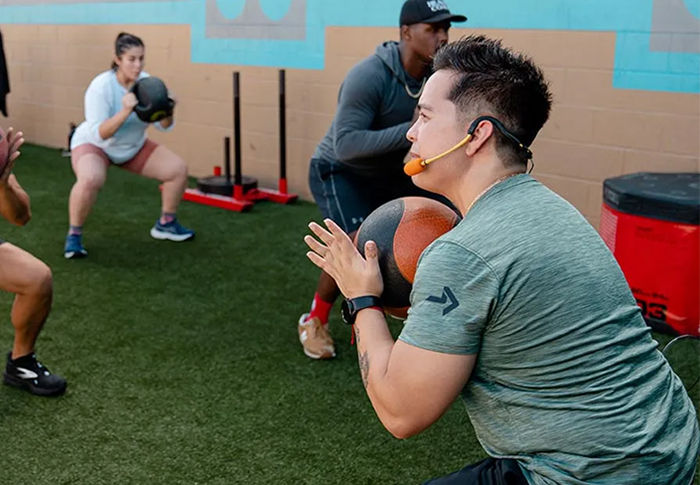
Encourage group participation. Group
commitments tend to be stronger than those
made individually. Often, the encouragement
of a group can provide an individual with the
incentive to continue exercising during periods
of decreasing interest.
Emphasize fun and variety in the exercise
program. The type of exercise program
also has been shown to influence long-term
exercise adherence. Unchanging and regimented
exercise programs often become
monotonous and boring, leading to poor exercise
adherence.
Include significant others, family members
and/or friends in periodic functions.
The attitude and support of those with whom
an individual interacts most frequently helps
determine whether that person will adhere to
an exercise program. A participant's significant
other, as well as family and friends, can
play an important role in this regard.
Keep an exercise log. The importance
of immediate, positive feedback to reinforce
desirable health-related behaviors is
well-documented. A progress chart that
allows your friend to record daily and
cumulative exercise achievements (e.g.,
total exercise time, mileage,) can help her
see the progress she has made.
Establish regularity of workouts.
People who start their workouts at the
same time each day are more likely to
make exercise a habit.
Source: Dr. Cedric X. Bryant, ACE's Chief Science Officer; ACE FitnessMatters, Mar/Apr 2007.
Sign up for ACE's FREE e-newsletter for fitness enthusiasts.