By Caitlin McCarthy, M.S., John P. Porcari, Ph.D., Tom Kernozek, Ph.D., John Willson, Ph.D., and Carl Foster, Ph.D., with Mark Anders
Barefoot-style and minimalist shoes are one of the hottest trends to sweep the footwear category since Nike Waffle Trainer running shoes and Crocs. In fact, according to OIA Vantage Point and Leisure Trends, these types of shoes have continued to enjoy double-digit sales growth since the start of 2010 and have outsold nearly every other type of shoe during that time.
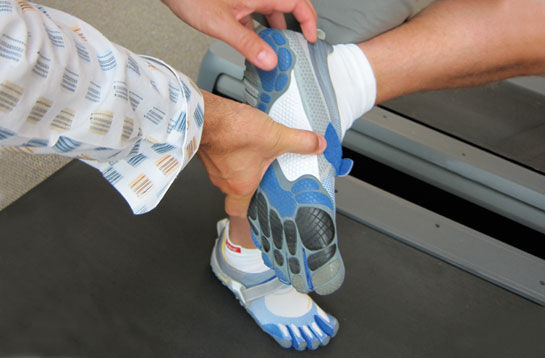
One of the shoes that has led the surge in popularity is the Vibram FiveFingers, a quirky-looking sock-style shoe with separate compartments for each toe. These shoes are designed to combine the feel of being barefoot with the abrasion protection of wearing a shoe. Many adherents also believe these shoes improve proprioception, balance and foot strength. You’ve no doubt seen people wearing these types of shoes to work out in the gym, for fitness walking, yoga, water sports and, one of the most controversial uses, running.
Don’t Want to Run?
Try Lifting…
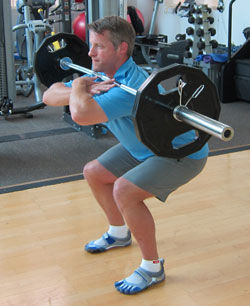
ACE Exercise Physiologist Pete McCall recommends trying Vibrams or similar style footwear while strength training. “They allow the foot to have better contact with the ground,” he says. “Having your heel elevated, like in a running shoe or other kind of training shoe, can actually throw off your balance.” Besides better balance, McCall says he’s experienced improved foot dexterity after a few years of strength training while wearing Vibrams.
But why would someone want to run without running shoes? Lower-extremity injuries can be found in 20 percent to nearly 80 percent of all those who run, with some experts pointing to the high-impact forces of heels hitting the pavement and the use of over-cushioned, overly supportive running shoes as potential culprits. To that end, a small niche of runners have shunned shoes altogether as a way to escape chronic pain and injuries.
Here’s their logic: Barefoot runners tend to run more lightly, landing near the balls of their feet while generating less pounding than regular heel strike-style runners. Less pounding should then equal fewer injuries. And that notion seems to be catching on even more quickly with the advent of barefoot-style shoes, which make running “barefoot” more comfortable and more appealing to some runners.
Here’s the potential concern, though—most runners have spent a lifetime wearing shoes and have thus been ‘programmed’ to run in the conventional heel-strike manner. So what happens when they switch to running in barefoot shoes? It’s an intriguing question, and one that the experts at the American Council on Exercise (ACE) sought to answer.
For more helpful tips on how to safely and effectively wear barefoot-style shoes, check out this video from ACE Exercise Physiologist Pete McCall.
The Study
To analyze how similar running in Vibram FiveFingers is to running barefoot, as well as determine how it varies from running in regular running shoes in terms of ground-reaction forces and the motion of the lower extremities, ACE enlisted a research team from the University of Wisconsin, La Crosse. Led by John Porcari, Ph.D., and Caitlin McCarthy, M.S., the researchers from the Exercise and Health Program recruited 16 healthy, injury-free female subjects, ages 19 to 25, all of whom were considered recreational joggers.
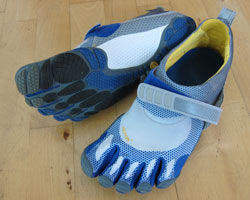
Two weeks prior to testing, each of the subjects was fitted with a pair of Vibram FiveFingers Bikila ($90). These 4.8-ounce barefoot-style shoes are specifically designed for running, with slightly more padding in the heel, a higher heel lip and a snugger fit. To get accustomed to running in the Bikilas, the subjects were then asked to wear the shoes while running for up to 20 minutes per day (or until discomfort), three times a week for two weeks.
Once acclimated to running in the Vibrams, subjects returned to the lab for 3-D motion analysis and measurement of ground-reaction forces as they ran under three separate conditions: (1) while wearing the Vibrams; (2) while wearing a pair of neutral running shoes (New Balance 625); and (3) while barefoot. The order was randomized between Vibrams and the running shoes, but the barefoot condition was always measured last.
To conduct 3-D motion analysis, subjects were outfitted with reflective tracking markers affixed to specific points across the body. These coordinates were used to track the motion of the pelvis, femur, shank and foot, as well as lower-extremity joint angles (hip and knee flexion-extension, abduction-adduction, and internal-external rotation) as each subject ran along a 20-meter runway.
Flush mounted on the runway was a force platform designed to measure ground-reaction forces (the pounding of feet) as subjects crossed the runway. Data was collected for each subject in seven trials per condition (i.e., Vibrams, neutral shoe and barefoot) for a total of 21 trials per subject.
The Results
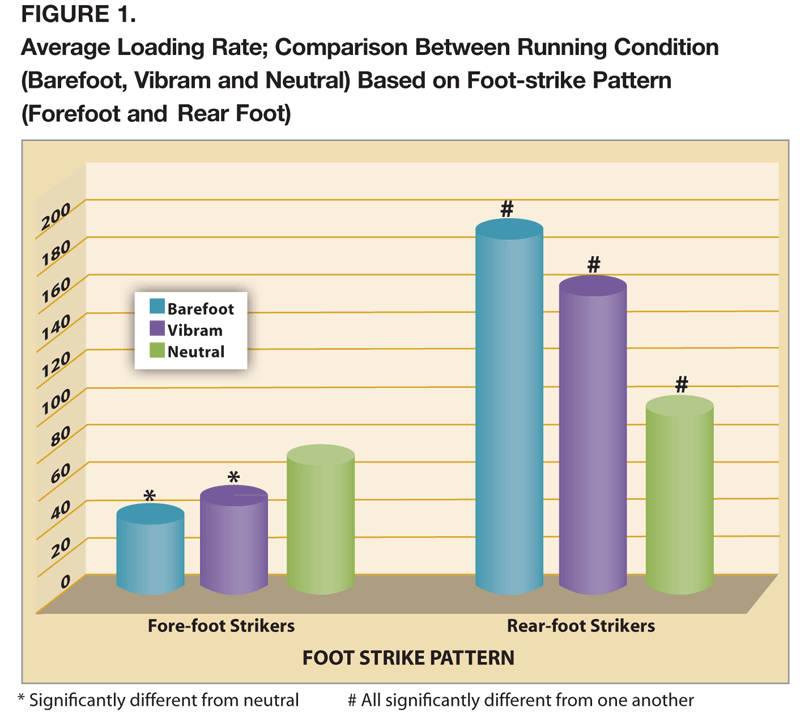
Upon completion of testing, the data was crunched and processed. Porcari and his team reported that all of the subjects were rear-foot strikers while wearing typical running shoes, landing predominantly on the heel. However, while running barefoot and in Vibrams, approximately one-half of the subjects switched to a forefoot strike pattern while the other half continued to impact the ground with their heels (Figure 1).
“It’s tough to re-learn to run,” says Dr. John Porcari. “When you look at the data even though we encouraged them to run with a more forefoot strike while wearing the Vibrams, half of the subjects still continued to land on their heels. Even with two weeks to practice and instruction in how to use the barefoot shoes, [the subjects’] bodies still tended to run the way they’ve always run.”
Those subjects who switched to a forefoot strike showed a much more plantarflexed ankle at ground contact while wearing the Vibrams and while barefoot running. This greater flexion appears to allow better absorption of the impact forces of running. However, those subjects who continued to utilize a rear-foot strike pattern experienced a higher rate of loading while wearing the Vibrams and running barefoot. In fact, load rates surpassed those of running with the typical running shoes, perhaps due to the lack of heel cushioning of the Vibrams or while running barefoot.
Researchers also noted that, for all subjects, there was less knee flexion while running barefoot and with the Vibrams, a condition associated with lower injury rates. While running barefoot, subjects showed less pronation. However, while running in Vibrams, all subjects showed greater pronation, similar to the pronation exhibited while running in the regular running shoes. (Note: Excessive pronation can be the reason for some overuse injuries.)
The Bottom Line
While synthesizing these results can be a bit complex, the bottom line is clear. “Just because you put the Vibrams on your feet doesn’t mean you’ll automatically adopt the correct running stride,” says Porcari.
Runners who fail to change over to a more forefoot stride while wearing Vibrams may open themselves up to discomfort and possible injury. “Buying these Vibrams and continuing to land on your heels is probably worse than wearing regular running shoes because the Vibrams don’t have any cushioning,” he says.
As evidence, Porcari points to an anecdotal rash of foot and shin injuries from some runners who’ve started running in barefoot-style shoes. Minus the support and extra padding of conventional running shoes, barefoot-style shoes place unique and new stresses on the muscles of your lower extremities.
“If you want to run in the Vibrams, you should be prepared to change your gait pattern,” says Pete McCall, an ACE exercise physiologist, who has been exercising (but not running) in Vibrams since mid-2009. “If you run in them, give yourself time to acclimate to them and adapt.”
Take it Easy!
Whether you’re planning to run barefoot or while donning Vibrams, follow these tips from ACE’s Pete McCall:
Walk first. Give your body time to acclimate and adapt,” he says. “Start walking in them first and let your body get used to it.”
Ease on in. “If you’re currently doing 30 miles a week, try a quarter of that wearing the Vibrams or barefoot, and do the rest in your regular shoes.”
Change it up. McCall says it’s key to change your running style to fit barefoot running. In particular, focus on running with short strides while landing lightly on your forefoot.
Porcari echoes that sentiment. “Running in Vibrams could be good for some if they adopt the appropriate running style.” But detailed instruction on how to run with a more forefoot gait is key. “People may need very explicit instruction and time spent practicing how to land on the ball of the foot. Otherwise, they may be doing themselves more harm. Simply switching to Vibrams doesn’t guarantee that a person is not going to experience more injuries.”
So should you or your clients ditch the running shoes and start running barefoot or in Vibrams? If you aren’t experiencing chronic injuries while running, don’t quit with your shoes just yet. Going barefoot or wearing Vibrams will affect which muscles are used and how you use them, all the way up the kinetic chain, says Porcari. And the results of those changes are uncertain. “I think it’s one of those things—If it ain’t broke, don’t fix it,” says McCall.
That said, for those people who suffer chronic running injuries and still want to continue running, they may want to give the shoes a try.
This study was funded solely by the American Council on Exercise (ACE).
___________________________________________________________________

MARK ANDERS is an award-winning journalist who has covered a wide range of topics from rock star profiles to surfing river waves in Africa. His work has been published in more than 20 different magazines and books.